
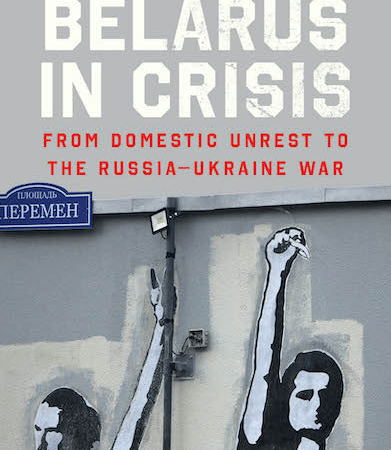
Mike Phipps reviews Belarus in Crisis: From Domestic Unrest to the Russia–Ukraine War, by Paul Hansbury, published by Hurst
Little-known Belarus shot to international notoriety following a disputed presidential election in August 2020, when the incumbent Alyaksandr Lukashenka was re-elected with an improbable 80% of the vote. This prompted hundreds of thousands of Belarusians to take to the streets in protest. The authorities detained tens of thousands in the brutal crackdown that followed and thousands of Belarusians went into exile. Yet the protests persisted into 2021. Belarus drew further international outrage when it acted as a staging area for Russia’s invasion of Ukraine, allowing missiles to be fired from its territory into Ukraine.
For those looking more closely, the dictatorial tendencies of Lukashenka, first elected in 1994, were visible much earlier. In 1995, on his orders, two pilots taking part in an international hot air balloon race were shot down in flames to their death after straying off their approved route in Belarusian air space. There was an echo of this behaviour in May 2021 when a Ryanair commercial flight flying over Belarus from Athens to Warsaw was forced to land in Minsk so that Raman Pratasevich, a young journalist living in exile, and his Russian girlfriend, could be forcibly removed by Belarusian state security goons. He was later sentenced to eight years in prison.
There are those on the left internationally who like to present the recent courageous anti-government protests in Belarus as entirely directed by agents of Western imperialism, keen to open up the country to the penetration of its capital. But, as with Ukraine’s Maidan Revolution and elsewhere, the upsurge against Belarus’s corrupt regime is genuine and driven by domestic factors, as Paul Hansbury’s book makes clear.
From the start of his rise to power in the 1990s, Lukashenka resolved to bypass the country’s elected legislature. In 1993 he called for a boycott of parliamentary elections with the result that turnout in more than half of the electoral districts did not reach the 50 per cent threshold required to elect a representative. Consequently, the parliament did not have a quorum, enabling Lukashenka to rule by decree.
In a subsequent referendum, Lukashenka won the right to dissolve parliament. When opposition MPs accused him of a blatant power-grab and staged a sit-in of the parliamentary chamber, Lukashenka turned to the security services. A bomb threat was fabricated to clear the chamber, with police arresting deputies who refused to leave. Further referendums centralised power into Lukashenka’s hands, with his early popularity reinforced by his avoidance of painful economic reforms and his preference for a stagnant command economy, propped up by loans from Moscow.
More shocking was the sequence of disappearances and unexplained deaths of leading oppositionists which began in 1999. State officials were clearly implicated and Lukashenka was forced to replace the head of state security. The disappearances also prompted the first European Union sanctions against Belarus, introduced in 2004.
By the 21st century, the parliament had been replaced by a puppet assembly which most opposition parties boycotted. By 2006, Lukashenka’s presidential election victory margins were being blatantly falsified and protests against them ruthlessly suppressed. In 2010, all but two of the of the candidates who stood against Lukashenka found themselves in prison shortly after the vote.
In 2017, there were significant protests against government plans to introduce a tax on the unemployed, a ‘social parasites’ tax’. The Covid pandemic also widened the gulf between the regime and the public. Lukashenka made international news headlines with his recommendation that people should drink vodka and visit the sauna to avoid the virus.
Schools were kept open and no centralised measures on mask-wearing or social distancing were introduced. As officials openly manipulated the mortality data, Telegram channels took off as a means of communication among younger people in their search for information about the pandemic. They would go on to become a central channel for the protest movement.
Support was clearly ebbing away from Lukashenka as 2020’s presidential election approached. Key opposition candidates were barred from running on trumped up grounds and protests were violently dispersed. But such was the shift in mood that on polling night some electoral districts announced victory for Sviatlana Tsikhanouskaya, the main opposition candidate, who entered the race after her husband was arrested.
“When the results were officially announced they were blatantly falsified,” notes Hansbury. “In district after district Tsikhanouskaya received precisely 14.7% of the votes and Lukashenka a devilish 66.6%.”
The final farcical result gave Lukashenka over 80% of the vote, as usual. Tsikhanouskaya was summoned by the puppet Central Election Commission which released a footage of her conceding defeat – which has been likened to a hostage video – before fleeing the country the same evening. People streamed onto the streets in protest. Some 3,000 citizens were arrested on election night and the following day, on 10th August, the first death occurred among protesters. Thousands more were arrested but the protests grew. 300,000 marched on 16th August and there were further ‘freedom marches’.
The protests went on for months. Workers went on strike. When Lukashenka visited the Minsk Tractor Works, the audience chanted “Resign! Resign!” at the embarrassed dictator. Police officers increasingly wore masks to conceal their identities as they cracked down on protesters. Protesters started yanking the masks from police officers’ faces and posting photographs online, encouraging their neighbours to identify the culprits. Many cops, disgusted at the violence being meted out to protesters, did resign – but not at the top.
The upsurge was all the more significant given the fraught conditions in which civil society organisations are forced to operate. Like parties, Belarusian NGOs are periodically deregistered – and working for an unregistered NGO is a criminal offence punishable by up to two years in prison. There was a major crackdown on such groups after 2020’s stolen election.
State repression intensified, aided by a new blackout on the protests inside the country. One high-profile case was opposition activist Mariya Kalesnikava who in September 2020 was driven by state security to the Ukrainian border and told to leave. In defiance, she tore up her passport and refused: she was detained for a full year before being sentenced to eleven years in a penal colony.
Strike leaders were fired, independent media outlets suppressed and union and human rights groups raided. By the end of 2020, 27,000 citizens had been detained, harsher sentences introduced and the border closed. Lukashenka used his extensive network of patronage to secure his acceptance by the political elite and relied on Russian media, financial and security resources to bolster his failing regime.
Hansbury discusses Western sanctions as a response to these events, but is dubious about their efficacy, suggesting that some hit Belarus’ citizens more than the regime and others are ineffective. It would be useful to hear what the country’s opposition forces want and expect from the West.
In response, Belarus not only opened its border to westbound migrants from the Middle East: it facilitated their transit through the country – some argue through organised trafficking operations – bussed them to the border and beat them if they tried to return. One migrant who begged to be allowed to return to Minsk, said guards threatened to cut his fingers off with the bolt cutters they use to cut the barbed wire, through which they push the migrants into Poland.
Unsurprisingly, the EU’s harsh and restrictive policy towards inward migration allowed Belarus to pose as humanitarian in its exploitation of the issue. In reality, the Lukashenka regime’s policy was: take money from migrants to bring them to the EU border, then take money from the EU to take them back to where they came from.
When Russia invaded Ukraine last year in an act of illegal, unprovoked aggression, the West labelled Belarus as a co-aggressor for allowing its territory to be a staging post for Putin’s forces. Was this an indication that Belarus had effectively lost its sovereignty and could eventually be annexed by Russia at some later stage? It might also reflect a desire by the isolated Lukashenka regime to win favours from Putin by making itself indispensable to his war effort and even behaving as a kind of outlier for Russian policy – hence Lukashenka’s recent threat to deploy nuclear weapons. Yet, the regime’s refusal to deploy Belarusian forces also reflects public hostility to the war within the country itself.
Sympathy for Ukraine within Belarus has led to some heroic sabotage activity such as the ‘rail partisans’, a guerrilla movement that sought to disrupt the movement of Russian troops and materiel by rail to the Ukrainian border, which the regime swiftly attempted to suppress. This repression has widened to anyone showing support for Ukraine in its war effort.
The death penalty has now been extended to cover ‘attempted’ acts of ‘terrorism’ – a law aimed at the continuing opposition to the regime. Additionally, those who fled the country – perhaps as many as 300,000 – now risk losing their citizenship.
Meanwhile, price inflation is soaring and real wages are declining. If public protest is at a low ebb, it reflects both the impact of state repression and a recognition by opponents of the regime that international attention has shifted away from Belarus to Ukraine over the last year.

Mike Phipps’ book Don’t Stop Thinking About Tomorrow: The Labour Party after Jeremy Corbyn (OR Books, 2022) can be ordered here.
 Labour Hub