
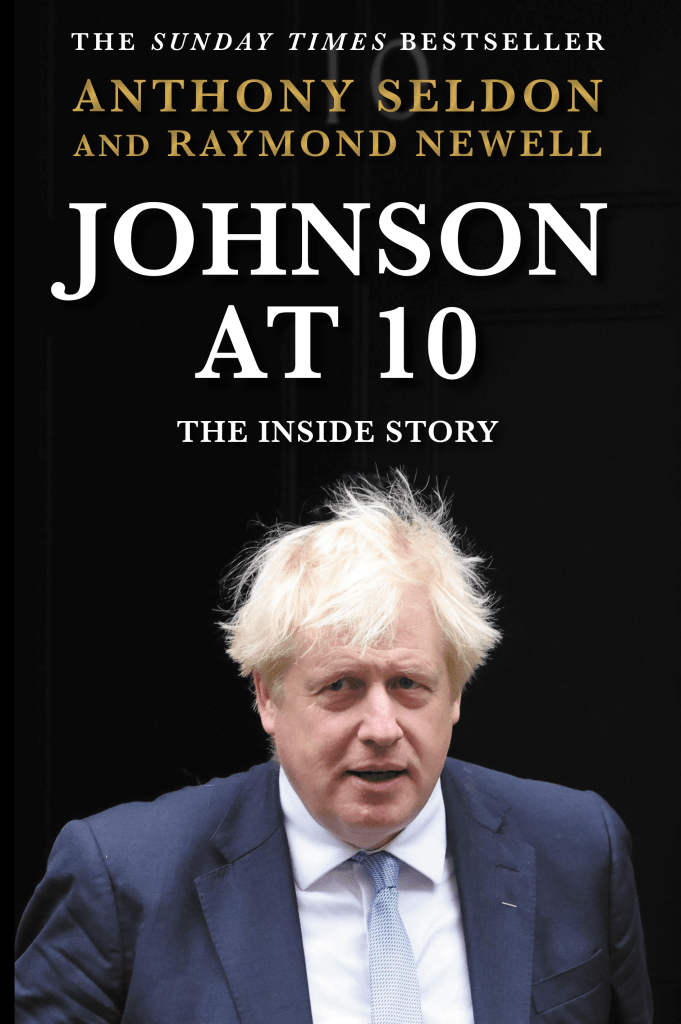
Mike Phipps reviews Johnson at 10: The Inside Story, by Anthony Seldon and Raymond Newell, published by Atlantic
Introduction
Another slice of instant history from Anthony Seldon and collaborators. Seldon has been doing this for a while, having written, or co-written Blair (2004),Blair Unbound (2007),Brown at 10 (2010), Cameron at 10 (2015) and May at 10 (2020), reviewed on Labour Hub here.
Over 200 witnesses contributed to this latest analysis and it doesn’t disappoint. Seldon and Newell see parallels between Boris Johnson and Lloyd George over a century ago. Both had similar magnetic characters, won landslides after leading unstable parliamentary majorities and focused on resetting Britain’s relationship with Europe, while attempting to ’level up’ at home. Both nearly died from a contemporary pandemic – at the same age – and “both fell because they lost trust and credibility with the public, amid accusations that they had tarnished the office and public life.”
But unlike Lloyd George, Johnson cut an isolated figure, frequently bypassing Cabinet and officials, the ultimate insider trying to cast himself as an outsider. His main traits reveal a charismatic communicator, but self-absorbed and lacking moral seriousness, say the authors. His defining attribute was spotted long ago by his housemaster at Eton. “He honestly believes, he wrote, “that it is churlish of us not to regard him as an exception, one who should be free of the network of obligation that binds everyone else.”
Defined by Brexit
Unlike standard biographies, this book doesn’t linger on Johnson’s formative years but cuts straight to the action. It’s clear that he backed Vote Leave entirely for reasons of personal gain. His response to the 2016 referendum result was: “Holy s**t, f**k, what have we done?”
Intimates said they had never seen him more frightened and dismayed. He recovered quickly enough to prepare to run for prime minister after David Cameron resigned, only to be publicly shafted by his former ally, now rival, Michael Gove.
Instead he became Theresa May’s Foreign Secretary, although the creation of a new Department for Exiting the EU took from him the single most important part of the brief. His relationship with May became bumpier the more the job bored him.
He quit after having second thoughts about the EU deal that May’s Cabinet had thrashed out at Chequers in July 2018, but not before his cavalier attitude and tendency to mis-speak had worsened the plight of British Iranian Nazanin Zaghari-Ratcliffe, then languishing in an Iranian jail.
Johnson’s campaign to be leader in 2019 was a lot more disciplined than anything he did before or after. “He was given strict instructions on which MPs to see, had a timekeeper to hold him to twenty-minute slots and was told to read just half a page of information on each MP to pretend he knew something about them.” Wild offers of promotion and peerages were made during this charm offensive.
His leadership victory owed more to the belief that he could get Brexit done and beat Jeremy Corbyn in a general election than any great faith in the idea that he had the skills to be good prime minster. But having committed himself, for career reasons, to the nationalist right wing of the Conservative Party, he was now their prisoner, forced to ‘get Brexit done’, deal or no deal. Central to this approach was the ruthless Dominic Cummings, described by one aide as a “political terrorist”.
Opposition within the Tory Party and beyond to a no-deal Brexit and to the lack of debate in Parliament was significant. Johnson sought to puncture it by removing the whip from 24 rebel MPs, his only reservation being that it might make him unpopular, which he disliked intensely.
Cummings’ response to the parliamentary rebellion which aimed to take control of the Brexit process was to advise the Prime Minister to break the law if necessary, browbeating officials who stood in his way. When the Supreme Court ruled that the government’s proroguing of Parliament was unlawful, Johnson reacted with fury, cursing Court President Lady Hale and blaming aides for failing to warn him of the risks: “What the f**k am I reading? You all told me this would be fine.”
Against Cummings’ advice, negotiations with the EU resumed. Despite earlier pledges to the contrary, Johnson agreed to an Irish Sea border, in typical fashion accepting something he hoped to repudiate later. When, a year on, he said there would be such a trade border “over my dead body”, it was not out of ignorance of the deal he had signed up for, but rather, suggest the authors, “of a brazen disregard for honesty.”
The implication is clear. The entire platform on which the Conservatives fought the 2019 general election – the ‘oven-ready Brexit’ – was a lie.
Yet there was no doubt that Labour made mistakes in the 2019 campaign, regarding Johnson as a buffoon rather than a serious threat, often popular on the stump. One Tory strategist said Labour saw 2019 as a rerun of the 2017 election: “One more swing of the axe, and the deal will be done.” There is some truth to this and this misjudgement helps explain Labour’s catastrophic defeat.
Priorities derailed
Re-elected, Johnson’s priorities were entirely focused on bolstering his own standing. He disliked Cabinet and reshuffles in particular because he did not want younger challengers to emerge to threaten his position. For someone just elected, he was utterly insecure, obsessed with defining his legacy, based on major infrastructural projects, although this had not worked as London Mayor – Boris Island? His ideas at No 10 were even more hare-brained, such as the ludicrous Scotland-Northern Ireland rail link.
The commitment to ‘levelling up’ was at least aimed at cementing the ‘red wall’ to the Conservative Party for the foreseeable future. The problem was Johnson’s lack of focus on detail. His shallow grasp of virtually every departmental brief meant that there was little delivery on any of the government’s supposed priorities.
Then Covid struck. Johnson, argue the authors, “proved to be completely unsuited to the challenge,” showing “desperation to please all the wrong people.” He failed to attend several crucial early meetings and demonstrated a complete lack of grasp, leading to vital weeks of preparation being lost and the first lockdown being delayed. Even once the full scale of the danger became apparent, ministers, aware there would be a subsequent enquiry into the pandemic, prioritised appearing to look competent over delivering results.
At this time, Johnson’s closest advisor, Dominic Cummings, became “unhinged”, according to one colleague, “shouting and swearing at his computer.” After Johnson contracted Covid, his attempts to work in isolation were farcical, as he struggled to master basic computer tasks. When Cummings himself breached lockdown rules, through his notorious trip from London to Durham, officials refused even to discuss it, so fearful were they of Cummings’ ability to end their careers.
Such chaos resulted in multiple lethal failings, on PPE, testing, ‘Eat out to help out’ and much else. Health Secretary Matt Hancock was a particularly weak link: “totally f**king hopeless”, in Johnson’s eyes – but allowed to keep his job so he could be made a scapegoat later.
Johnson’s response to Covid’s second wave was even less evidence-based and more influenced by anti-lockdown MPs and right wing newspapers. The decision to opt for local lockdowns on October 12th 2020 was “the worst of all worlds.” “It was completely indefensible,” said one No 10 Covid official. “We had all the information to make the right choice.”
Three weeks later, the government U-turned and brought in a second national lockdown. Johnson was still in denial, saying to Cummings, “ No more f**king lockdowns. Let the bodies pile high.” To prevent Johnson backtracking on the decision, the new lockdown was leaked to the media as soon as it was decided. It’s worth emphasising that the majority of Covid deaths occurred in this second wave, when Johnson deliberately disregarded the scientific advice.
General dysfunction
Cummings’ own importance in No 10 is also explored here. “Not since Thomas Cromwell under Henry VIII,” suggest the authors, “had the country witnessed an advisor to a principal with so much political power.”
The reason for this was simple: the hole at the centre of Johnson’s government. So exposed did Johnson feel, so desperate was he get Cummings beside him that the latter dictated his terms, demanding unprecedented powers. But tensions began soon after the Tories’ 2019 election victory: Cummings bridled at the lassitude and torpor around Johnson and he went to war against those who stood in the way of his own radicalism. He succeeded in removing both the Chancellor of the Exchequer and the Cabinet Secretary and increasingly took decisions without consulting the Prime Minister, whom he now regarded as “ an idiot”.
Johnson’s decision to stand by Cummings after he broke lockdown rules so flagrantly “was a dress rehearsal for later scandals,” argue Seldon and Newell. “Lacking moral compass, his judgements were made on faux loyalty and political expediency.”
Perhaps it was Cummings’ denigration of Johnson’s spouse as “Princess Nut Nut” that finally prodded Johnson to ditch his special advisor. Although there was no great improvement in governance, with Cummings gone, the disastrous libertarian influence on Covid policy did at least subside a bit.
That did not stop the outbreak of other periodic crises, however. When the fiasco over A level algorithm-determined results landed, the instinct of ministers and advisors was to run away from the problem, rather than sort it out and risk being scapegoated. Meanwhile, the new Treasury boss Rishi Sunak, aware that Johnson could not afford to lose two chancellors so quickly, began to push a tough financially restrictive line against No 10’s spending agenda.
In international affairs, as elsewhere, Johnson was at sea. “Put down in 3,000 words what you think my foreign policy should be,” he told dismayed officials.
Brexit inevitably dominated the agenda. Johnson was apparently advised by both Michael Gove and Brexit negotiator Lord Frost that he could sign the Northern Ireland Protocol with EU leaders and change it later. Those words from his old schoolmaster about Johnson not feeling bound by normal obligations took on new meaning, when he introduced a bill into Parliament which his own minister admitted broke international law.
After weeks of manoeuvring, the government negotiated a face-saving, but ultimately damaging EU-UK Trade and Cooperation Agreement. Against this background, Russia’s invasion of Ukraine “landed on Johnson like manna from heaven” and he exploited the conflict in a forlorn attempt to salvage his own leadership.
Johnson failed to learn from the poor quality of his early appointments. He repeatedly made the mistake of hiring unsuitable cronies and then failing to back them in their work, allowing them to be briefed against by hostile factions, one of which was led by his wife. He undermined the civil service by dismissing, against the evidence, allegations of ministerial bullying. He downgraded any vestige of Cabinet government, which he regarded as both a waste of time and, insecure as he was, a challenge to his shrinking authority. When the end came, the conclusion that he had brought it all upon himself was inescapable.
Downfall
“I will spend every waking hour of my life working to bring him down,” said Dominic Cummings soon after leaving No 10. Rishi Sunak, reportedly a key source of Partygate leaks, was another who contributed to Johnson’s demise. But ultimately Johnson himself was the author of his own downfall.
Politically, his vision was incoherent and his manifesto undeliverable. Personally he was morally deficient, lying “morning, noon and night”, in the words of one of his own aides.
Many Tory MPs distrusted his economics and personality but supported him only as long as he was a winner, seeing off Labour in 2019 and delivering Brexit. Johnson should have seen the storm clouds gathering, but his own sense of entitlement blinded him to them.
The final turning points, he and his aides were convinced, were merely “Westminster bubble stuff”, presumably because they thought that rules and integrity did not matter. But even Tory MPs and ministers were tired of too often being required to defend the indefensible: the change to the rules on the disciplinary system for MPs in order to save the skin of Owen Paterson, only for No 10 to U-turn on the proposal 24 hours later; or the blatant lies told over whether Johnson knew about Chris Pincher’s record of sexual harassment before appointing him Deputy Chief Whip. It was entirely fitting that this sordid scandal was the final nail in Johnson’s coffin.
Johnson’s incomprehension at his ejection from office is at one with his ‘who cares?’ attitude to truth and responsibility. As the final ministerial resignations turned into a flood, he still sat plotting with his aides about who could be bought off with job offers and other patronage.
Beyond the remit of this book, what lessons are there here for the left? Many critics of Johnson realised early on that he was an unprincipled scoundrel, to put it mildly. Labour could undoubtedly have made more of his clear unfitness for office during the 2019 election campaign, although it was not in the nature of Jeremy Corbyn individually to make personal attacks on opponents.
But many on the left also politically underestimated Johnson. He was more Reagan than Trump, projecting a manipulative optimism which had a magnetic effect on some. He was a formidable campaigner and personally popular in the most unlikely areas, including the ‘red wall’. Few understood this, nor did they see that the usual anti-Tory arguments against austerity would not necessarily cut through against such an operator.
There are lessons in this book for Labour, about how future Boris Johnsons and other maverick Tories should be tackled. Had Johnson not had such deep-rooted failings, he might have been around for a very long time, with Labour’s attacks on him having little impact. As it was, he destroyed his own career. The fact that the Opposition had so little to do with his downfall should remind us that the poll lead that Labour has subsequently enjoyed may not last very long.
Mike Phipps’ book Don’t Stop Thinking About Tomorrow: The Labour Party after Jeremy Corbyn (OR Books, 2022) can be ordered here.
 Labour Hub