
Just over a year ago, El Salvador imposed a ‘state of exception’, removing basic constitutional rights from its citizens, the prelude to the arrest of thousands of alleged gang members in the country. At the same time, the penalties for gang membership were drastically increased. In the year since, which has seen over 60,000 arrests, human rights organisations report multiple violations of rights, arbitrary detentions, abuses by security forces and forced disappearances. Just this week, the human rights organisation Cristosal reported widespread torture and death in state custody. This update on the situation is edited from the blogs of Tim Muth, who lives in the country.
A post-gang El Salvador?
El Salvador appears to be moving to a new phase, a phase where Mara Salvatrucha and the two factions of Barrio 18 no longer control large zones where millions of Salvadorans live, and where the State of Exception appears to be the new normal. What are the benefits being realized, the costs being suffered, and what questions are yet to be answered?
In 2016, the New York Times and El Faro estimated MS-13’s annual direct revenue in El Salvador at $31 million, primarily from extortion. Private bus companies by themselves estimated they were paying $26 million that year in extortion to the country’s main gangs.
Those tangible benefits from the breakup of gangs during the State of Exception must be evaluated in the context of its costs in the form of ongoing violations of human rights norms, the destruction of democratic institutions and judicial control, and the cost of running a country as a prison state.
On the night of January 31, El Salvador’s President Nayib Bukele broadcast nationally his tour of the country’s new mega-prison, designed to hold 40,000 prisoners, the government says. The new prison was needed to hold a portion of the more than 63,000 persons arrested in the country since March 2022 under the State of Exception, accused of being gang members or collaborators.
Almost all of the 63,000 persons imprisoned during the State of Exception have not been convicted of a crime and are not yet serving court imposed sentences. Under El Salvador’s Constitution, they are supposed to be presumed innocent. They have almost all been charged with being gang members or collaborators, but have only had minimal hearings where judges have declared they can be held in prison for six months or more while police investigate before their cases move to a trial phase.
The Church speaks out
On March 24th, Cardinal Gregorio Rosa Chavez, the first cardinal of the church from El Salvador., preached on the abuses of the State of Exception. Recently, Rosa Chavez gave an interview to a Catholic Spanish weekly based in Madrid:
“Bukele has returned to a strong-arm policy against gangs. This has never worked. How do you see it?
“It is the most painful human drama. No person who believes in human dignity can agree to this policy. There is no rehabilitation component in the Government’s proposal. The gang member has been demonized in such a way that he is destined to die in jail. The population has suffered so much from the scourge of the gangs that, gripped by fear, they think that if a gang member is released, they will go back to their old ways. Therefore, the choice is to lock him up for life…
“What do you think when you see detained men crowded together like animals?
“The memory of the concentration camps of the Nazis comes spontaneously to me. The Government itself, with its propaganda, has gloated over these scenes and has shown in great detail what awaits whoever falls into the hands of the Police or soldiers. The presumption of innocence does not seem to enter into the formula of those who deal with the security of the Salvadoran people.”
Impact on religious freedom
In May, The US State Department issued its 2022 country report on International Religious Freedom for El Salvador. The State Department report mentions some positive impacts. In the second half of 2022, persons in formerly gang controlled communities felt freer to travel to religious services and activities.
However, the report also notes that the Salvadoran government has been hostile towards, including arresting and detaining, evangelical Christian pastors who laboured to address gang issues. In the Salvadoran press there have been several other reports of the arbitrary detentions of evangelical pastors during the State of Exception. A 32-year old pastor from San Miguel died two months after being detained under the current security regime. Mario Davis Arias Rivera, 44, a pastor and school director, was arbitrarily detained on May 10th, 2022, according to family and church members, during a dinner celebrating Mother’s Day as part of a church meeting. He died a month later in prison, which family members attribute to beatings and failure to provide his medication for diabetes.
The current approach of the Bukele government to describe evangelical pastors as gang members, to lock up tens of thousands without allowing access by evangelical or other religious figures to the prisons, and to reject rehabilitation as a goal of incarceration, destroys one of the few processes seen as successful in recent years to rescue individuals from the gangs. Added to this, there are numerous reports of persons who had left the gangs after in-prison conversions, being re-arrested under the State of Exception on the outside, solely based on their former membership with no indication they had returned to life in the gang.
Global report card
In recent months, several annual surveys of the strength of democratic institutions around the world have been published. El Salvador is shown to be losing ground as a democracy in all of these studies, as the researchers find a trend toward authoritarianism under Nayib Bukele.
Transparency International gave El Salvador a score of 33 out of 100, below the world average of 43, and ranking El Salvador 116th out of 180 countries. V-Dem’s Democracy Report 2023 characterizes El Salvador as an “electoral autocracy.” In the 2022 Press Freedom Index, El Salvador has fallen from 66th in the world to 112th in only 5 years.
Independent human rights experts assembled by the United Nations released a lengthy public statement including: “UN experts today expressed dismay at the renewal of El Salvador’s state of emergency, which has now been in place for more than a year. They called for the state of emergency to be lifted immediately.”
President Nayib Bukele has become the Latin American leader most lauded by the far right in the United States. The millennial president, who once labelled Donald Trump “nice and cool” is now being held up by the far right as a model for what a strong national leader should be.
At the end of May, El Salvador’s leading human rights organization released a damning report documenting the widespread abuse, torture and deaths of pre-trial detainees under the Bukele regime.
Next year’s election
On February 4th, 2024 the country will elect its president and all the deputies in the Legislative Assembly. Opinion polling shows very strong support for the re-election of Nayib Bukele as president, despite the fact that legal experts state that re-election of the president is expressly prohibited by the Constitution.
However, the magistrates of the Constitutional Chamber of El Salvador’s supreme court, put into office when Bukele’s Nuevas Ideas party summarily deposed the sitting magistrates in 2021, ruled that the president may be re-elected. Then on September 15th, 2022, Bukele announced to no one’s surprise that he would ask the Salvadoran public to re-elect him in 2024.
In what looks like a threat to people who might think of trying to challenge Bukele’s legitimacy as a candidate, the Legislative Assembly also passed a law which imposes up to a 15 year prison term on anyone who attempts to block the candidacy of a person who is duly qualified to run for office. In other words, if you try to challenge Bukele in court, and the Bukele-controlled judicial system finds that Bukele is entitled to run for office, you could end up in prison.
The last president of El Salvador to be re-elected was a dictator, Maximiliano Hernández Martínez, overthrown 78 years ago.
Postscript
El Salvador’s government has locked up five community organizers and environmental activists from the rural community of Santa Marta, alleging their participation in a decades-old crime during El Salvador’s civil war. But the circumstances surrounding the case suggest to many that the real motivation for their detention is to weaken resistance to metallic mining in the country and make possible the lifting of a mining prohibition.
The actions of the country’s Attorney General, Rodolfo Delgado, illustrate how the State of Exception with its suspension of judicial guarantees of due process is being used, not just to fight gangs, but to intimidate human rights defenders, including environmental activists. His actions show that the hard-won victory to ban extractive metallic mining in the country may be under threat.
Tim Muth is a US-trained lawyer who works on matters involving civil liberties and human rights. He blogs at El Salvador Perspectives, and you can follow him on Twitter as @TimMuth.
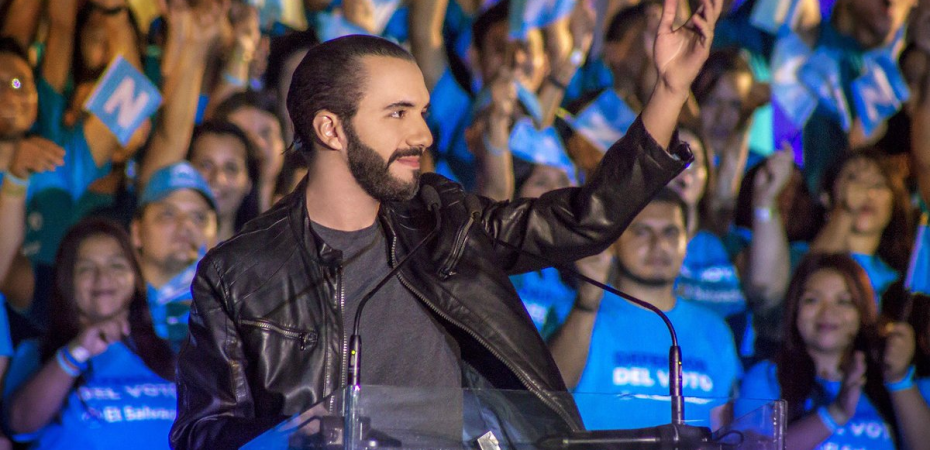
Image: Nayib Bukele. Source: https://www.facebook.com/watch/?v=1838215469678094. Author: Nayib Bukele, licensed under the Creative Commons Attribution-Share Alike 4.0 International license.
 Labour Hub