
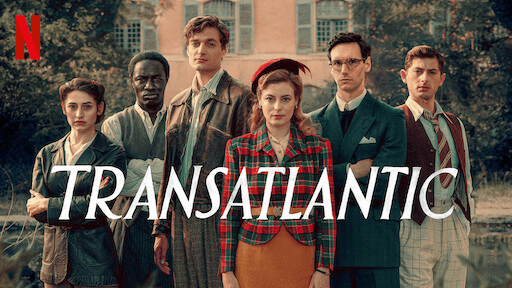
Richard Price reviews Transatlantic, Netflix’s new seven-episode historical fiction drama about the true story of Varian Fry and the Emergency Rescue Committee in Marseille in 1940.
The activities of Varian Fry and the Emergency Rescue Committee (ERC) in southern France between 1940 and 1941 form one of the most inspiring stories of the Second World War. Fry was an American journalist of liberal persuasions, who had witnessed Nazi brutality towards Jews in Berlin in 1935. He also had a close interest in modernist art. Fry formed the ERC with the support of Eleanor Roosevelt and 200 prominent intellectuals in New York in June 1940.
Between August 1940, when he arrived in Marseille, and September 1941, when he was forced to leave, Fry and his supporters saved well over 2,000 people from the Nazis. They included an impressive roster of artists and intellectuals, many of them Jewish, along with Jewish refugees. Their names read like a pantheon of mid-20th century culture – among them Hannah Arendt, André Breton, Marc Chagall, Marcel Duchamp, Max Ernst, Claude Lévi-Strauss, Jacques Lipchitz, Jean Malaquais, Heinrich Mann, Max Ophüls and Victor Serge. When so many notable artists arrived in New York, Fortune magazine described it as “the greatest migration of intellectuals since the Byzantine”.
Some 1,500 of those who escaped were conducted via a mountain route across the Pyrenees by Lisa Fittko aided by her husband Hans, who based themselves in Banyuls-sur-mer, near the Spanish border. Fittko – a 31-year old Hungarian Jewish socialist – was already a veteran of anti-Nazi resistance in several countries.
Fry’s main co-workers in Marseille were Miriam Davenport, a post-graduate art history student, Albert Hirschman, a young economist who had fought in Spain, and Mary Jayne Gold, a rich young heiress, who had stayed on after the French surrender, and who provided much of the finance for the rescue operation. Other funds were provided by Peggy Guggenheim.
The balance of the refugees needed ships to take them to any neutral country that would accept them. They also needed valid – or well-forged – exit visas, but ran up against the hostility of the American consul in Marseille, Hugh S. Fullerton, who ordered his staff not to help Jews or British POWs. Fortunately for all concerned, his deputy, the splendidly named Hiram Bingham IV, then in charge of the visa section, managed to spirit enough visas out of the consulate to enable hundreds to escape to Martinique, the United States and Mexico. Others were expertly forged by the Viennese cartoonist Bill Freier.
The ever-present threat of arrest by the Vichy authorities, and of being handed over to the Gestapo under the terms of the Armistice agreement; the danger of being turned back at the Spanish border; the extremely precarious status of foreign refugees, especially Jewish ones; the unique concentration of artistic and literary talent – all are ingredients that readily lend themselves to drama.
All of which brings us to Transatlantic – a seven-part Netflix series, created by Anna Winger and Daniel Hendler, and purporting to tell the story of the ERC. This, by the way, is not the first film depicting Varian Fry’s activities. Varian’s War, a 2001 cable movie starring William Hurt, was panned by the Varian Fry Institute and by members of Fry’s family. Instead of taking these criticisms on board, Winger announced that she was seeking to channel something of the style and comedy of Casablanca, presumably to avoid making the series too dour. But, whatever the charm of Bogie and Bergman, Casablanca is the mother of World War 2 anachronisms, due to its depiction of significant numbers of Germans in Vichy-controlled Morocco.
More worryingly, Transatlantic is ‘inspired by’ Julie Orringer’s highly speculative 2019 novel, The Flight Portfolio. “It’s a story that’s barely believable, but completely true,” gushed the Evening Standard, thereby demonstrating the dangers of commissioning reviewers who know little or nothing about their subject.
The suggestion in some reviews that Transatlantic has unearthed a hidden story is downright misleading. For a start, there are the memoirs of Varian Fry, Lisa Fittko, Victor Serge and Mary Jayne Gold, as well as Jean Malaquais’ novel World Without Visa. Rosemary Sullivan’s 2007 Villa Air-Bel is well-researched and reliable and there have been a further six books on Varian Fry in English in the last twenty-five years. Clearly, someone in pre-production decided that the well-attested and dramatic events of 1940-41 weren’t quite dramatic enough, and drew further inspiration from Color Me Badd’s I Wanna Sex You Up.
Episode 1, setting the scene for the ERC’s mission, doesn’t prepare you for the historical travesties to come. The luminous photography, filmed on location in Marseille last year, is brilliant throughout. In fact, it’s a little too luminous, with everything looking very spick and span. Marseille has undergone something of a renaissance in recent years, but in 1940 it was hardly a playground for the beautiful people. It was grubby and overcrowded, thronged with destitute refugees and a thriving criminal underworld. Nevertheless, Cory Michael Smith as Varian Fry and Gillian Jacobs as Mary Jayne Gold give it their best shot.
It’s in Episode 2 that the real problems begin. The Vichy police are tipped off that a number of the refugees are staying at the Hôtel Splendide. At the last minute, they are warned by Paul Kandjo (Ralph Amoussou), a black concierge at the hotel, and moved to the Villa Air-Bel outside of Marseille, which is occupied by Thomas Lovegrove, a kibbutz-raised Zionist, who happens to be working for British intelligence in the shape of the mysterious Margaux, and is a former gay lover of Fry.
Everything here is wrong. Kandjo, Lovegrove and Margaux are all fictitious characters. I find Kandjo – said to be from Benin and a former soldier – unconvincing, not least because by Episode 3 he and his brother launch a resistance cell committed to armed struggle well before anyone else in France. Lovegrove is introduced purely to give the whole story a gay sub-plot. According to his son, James, Fry, who was married twice and had three children, was indeed a “closeted homosexual”. The problem here is that he spends much of the series barely in the closet – indeed, most people in Marseille seem to know he is gay.
Margaux – who offers to fund the ERC if Mary Jane Gold agrees to work for British intelligence – is a black woman heading up the Special Operations Executive in Marseille. Again, highly implausible, and there is no evidence that Gold worked for the British. As for the Villa Air-Bel, the dilapidated château was rented from a French owner as the result of a trip to the eastern outskirts of Marseille made by Gold, Miriam Davenport, and Jean Gemähling.
From Episode 3 to Episode 5, Gold, under pressure from Margaux, plans and organises an armed prison break of British POWs. The truth is more prosaic. While Fry and friends did assist British prisoners, it was Fullerton who sent Hiram Bingham to an internment camp where British POWs were being held, with a brief to lobby against their release. But when Bingham arrived, the commandant assumed that he had come to ask for the British prisoners’ freedom, and before Bingham had said anything he offered to let them ‘escape’.
Back at the Consulate, plot devices are piling up. The real-life Fullerton is replaced by the fictional Graham Patterson, who, while convincingly right wing and anti-Jewish, is also something of a sexual predator. He’s considering taking a job with ACM – a thinly veiled IBM – which did provide the punched card technology used by the Nazis during the Holocaust. The Consulate secretary is (of course) working for German intelligence. Things are little better with the Chief of the Vichy police, Commissaire Frot, who, despite being more Inspector Clouseau than Inspector Maigret, seems to have an above-average knowledge of modern art.
Next, add a layer of bogus relationships. Mary Jane Gold is portrayed as having a relationship with Albert Hirschman, which, as far as anyone can tell, never happened. At the end of the series, when Gold has to return to America, Hirschman stays on to pursue the armed struggle. In reality, he left France in June 1941 after a raid on the villa, and had a successful academic career in the United States. Until April 1941, Gold was in a real relationship with Raymond Courant – a demobbed French soldier turned black marketeer-cum-gangster, who subsequently joined the SOE in London (under a British name!), took part in the St Nazaire raid and was later transferred to the SAS. Lisa Fittko meanwhile has a fictitious affair with Paul Kandjo, although she and her husband were reportedly a devoted couple.
Then season generously with armed struggle. At regular intervals throughout Transatlantic, many of the characters are just itching to get the guns out. In addition to Paul Kandjo forming a black-led resistance cell and Mary Jayne Gold and Lisa Fittko springing POWs from internment, Albert Hirschman can’t wait for it all to kick off. In Episode 3 we’re told that “British intelligence is forming resistance cells”, while in Episode 7 Mary Jayne announces that she knows where the British weapons are buried.
All of this is running well ahead of reality, and doesn’t fit with the timescale of August 1940 to September 1941. Prior to the invasion of the Soviet Union in June 1941, there was virtually no armed resistance in France. Colonel Fabien’s assassination of German naval officer Anton Moser in Paris on August 21st 1941 was the first time the resistance killed a German. Many of the early armed actions in 1942 weren’t carried out by French people but by the Francs-tireurs et partisans–main-d’œuvre immigrée (FTP-MOI) – an immigrant workers’ group affiliated to the Communist-led FTP, which included Jews and Poles and was led by an Armenian, Missak Manouchian. These took place mainly in the Paris region.
Maquis groups in the south only grew when the Service du travail obligatoire (STO) – obligatory labour service in Germany – came into force in February 1943. From then on, groups of mainly young people began to take to the hills to avoid forced labour. Many were very poorly armed and in no position to sustain guerrilla warfare. Until the Nazis occupied the southern zone in November 1942, there was little sense in provoking armed confrontations with the Vichy authorities, and resistance groups concentrated on propaganda and intelligence-gathering. In addition, it was much easier for the British to infiltrate agents in the north, mainly by Lysander aircraft. So the idea that the British had arms caches in and around Marseille in 1940-41 (you’re never sure what season you’re in because the sun always shines in Transatlantic) seems fanciful.
This isn’t just dramatic license: it’s historical falsification, and it doesn’t even work as drama. The artistic and literary characters are mere ciphers. They do what they do because the plot demands it, not because of any internal passion or doubt. They lack both conviction and authenticity. Walter Benjamin is tetchy and depressed. Marc Chagall is so doddery he can’t make up his mind whether to leave or not. (He lived for another 44 years.) Max Ernst is playfully surreal and nothing more. Victor Serge – one of the greatest witnesses to the first half of the twentieth century – and André Breton – one of the most influential surrealists – have barely a thought or an opinion between them.
All this glossy but shallow characterisation historicizes fiction and fictionalises history, and it’s become mainstream. You can see similar traits in the work of Stephen Poliakoff. Not that I think by any means that historical drama is doomed to fail. Hilary Mantel’s Cromwell trilogy, David Peace’s The Damned United and Tracy Chevalier’s The Girl With The Pearl Earring all work because at their centre is the inner life of individuals, real or fictional. They are not add-ons to a plot line, but people who take part in the evolution of the plot as participants.
There are dozens of French resistance films, and they vary vastly in quality. The French television mini-series Résistance, first broadcast in 2014, is superior in every department to Transatlantic. But the gold standard for conveying the grim harshness of France’s Dark Years remains Jean-Pierre Melville’s 1969 film, Army of Shadows. Transatlantic might as well have been titled Bright Young Things Go Wild In The Resistance.
Richard Price is Political Education Officer of Leyton and Wanstead CLP
Image: https://www.netflix.com/gb/title/81473474
 Labour Hub