

By Ralph Darlington
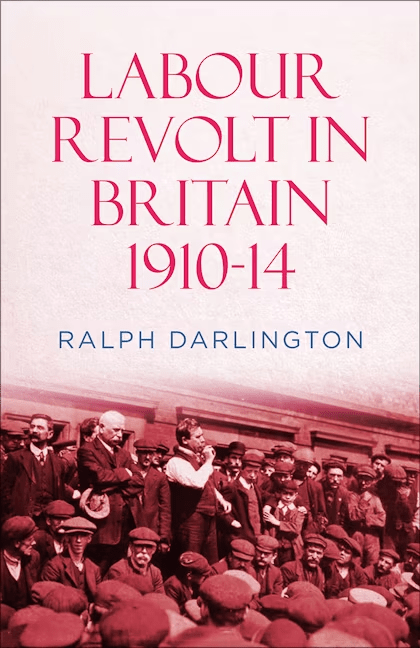
The so-called ‘labour unrest’ – or what more accurately should be termed ‘labour revolt’ [Darlington, R, Labour Revolt in Britain 1910-14 (2023), London: Pluto Press, p. 7.] – that swept Britain in the years leading up to the outbreak of the First World War between 1910 and 1914 was one of the most sustained, dramatic and violent explosions of industrial militancy and social conflict the country has ever experienced. Action largely took place unofficially and independently of national trade union leaderships, whose unresponsiveness to workers’ discontents, endeavours to channel grievances through established institutions of collective bargaining and conciliation machinery, and advocacy of compromise and moderation was often rejected by workers in favour of militant organisation and strike action from below.
But many workers on strike also became disaffected with parliamentary politics as a means of addressing and remedying their grievances or achieving political change more generally. This was caused in many respects by the functioning of the newly formed Labour Party in the House of Commons. Labour’s preoccupation with winning support from national trade union officials and growing its union affiliated membership and funding, as well its overriding concern with its electoral and parliamentary appeal, ensured that the pursuit of socialist objectives was firmly subordinated to the immediate and limited legislative needs of the unions’ politically moderate leaders. Even though there were many socialists in the Party’s ranks, notably from the affiliated Independent Labour Party (ILP), an overriding anxiety to hold in check adherents of any “new-fangled Socialist doctrine” meant the Labour Party “was predominately a Trade Union and not a Socialist, party” [Cole, G.D.H. (1946) British Working-Class Politics 1832–1914, London: Routledge, p. 226.], essentially the political expression of trade union officialdom.
At the same time, its focus on parliamentary effectiveness dictated an electoral accommodation with the Liberals. It meant Labour Party leaders in many respects acted as a mere adjunct of the post-1906 Liberal Party government, unwilling to press home their own distinctive policies, or vote against the Liberals for fear of endangering the position of the government and its programme of social reforms. As a result, the Labour Party “gave up its independence and consented to becoming a mere tail wagged by the Liberal dog.”[Ibid, p. 240.]
Such accommodation meant that not only did the Labour Party not become a vehicle or channel for the mass industrial discontent against the employers and government that swept Britain during the 1910-14, but its leaders often castigated militant strike action as a fruitless means for alleviating workers’ grievances and subversive of the Party’s parliamentary electoral objectives. Philip Snowden MP told the House of Commons the strikes had produced “an exceedingly trying time” for both the union leaderships and Labour Party, and that the way forward was through conciliation, not by means of “an … irresponsible movement”. [Cited in Askwith, Lord (1974 [1920]) Industrial Problems and Disputes, Brighton: Harvester Press, p. 145–6.]
Ramsay MacDonald, Chairman of the Parliamentary Labour Party from 1911–14, announced it supported “the general community” not the battles of capital and labour [Cited in Middlemas, K. (1979) Politics in Industrial Society: The Experience of the British System since 1911, London: André Deutsch, p. 55.], and argued “there is one kind of strike utterly valueless, and I would beg all my friends of the Trade Union movement not to place any reliance upon it, at all. I mean the sympathetic strike.”[MacDonald, J.R. (1912) Labour Party’s Policy, London: ILP, p. 12.] And a group of senior Labour Party MPs – including Arthur Henderson, the Party’s Secretary from 1911 – even proposed legislation to make strikes illegal unless a process of conciliation was first exhausted, with the imposition of a 30-day cooling off period of notice of strike action.
The crucial problem was that the Party’s strategy – based on the view that gradualist and reformist change was possible through electoral politics that built up Labour representation in Parliament and thus captured government office and control over the state – meant that winning elections (from a much broader constituency than trade unionists or even the working class) necessarily became the primary goal and main form of activity, rather than supporting ‘extra-parliamentary’ workers’ struggles. With its organisation built on an alliance with leaders of the unions, and a parliamentary strategy the success of which relied upon the co-operation of the Liberals, the Labour Party felt seriously challenged by widespread militancy in the industrial field. Thus, in the face of a strike wave which was perceived as being severely disruptive to the economy and often tended to develop into a battle against the state, repeatedly involving the intervention of the police and military to try to prevent or break strikes, the Labour Party leaders ended up taking the side of Parliament.
Yet ironically the party was often effectively ignored during the industrial revolt, much to the chagrin of Sidney Buxton, President of the Board of Trade, who reported to the Cabinet “the almost complete collapse of the Labour Party as an effective influence in this new development of labour disputes,” with “their elimination… a distinct loss to industrial peace.” [Buxton, Memorandum to Cabinet, ‘Industrial Unrest’, 13th April 1912, TNA/CAB 37/110/62; TNA/CAB 37/110/66.] One historian has claimed that whatever the causes of the “spirit of revolt” in the years between 1910-14, the Labour Party was not among them. [Callaghan, J. (2012) ‘The Edwardian Crisis: The Survival of Liberal England and the Rise of a Labour Identity’, Historical Studies in Industrial Relations, 33: 1–23, pp. 9–10).]
Yet we can only fully appreciate the causes, nature and dynamics of the strike wave and the growing influence of syndicalist ideas – with its doctrine of ‘direct action’, industrial unionism and class struggle in the industrial field instead of relying on political activity – in the wider context of the widespread perceived failure of the Labour Party and ineffectiveness of Parliament. The significance of the period lay precisely in the polarisation that developed between constitutional Labour politics of gradualist reform from above and the notion that the working class could achieve its goals through industrial militancy from below.
In other words, the prolonged outburst of industrial militancy was an expression of discontent with both existing strategies for advancing working class interests and aspirations, reflecting not only a growing awareness of the failures of official trade unionism and collective bargaining in the industrial sphere, but also of parliamentary support for moderate social reform in the political sphere. Neither of these two strategies had prevented the fall in real wages and the deterioration of working conditions, and hence the appeal for shifting the focus of action away from Westminster and the Labour Party, on the one hand, and conciliatory trade union bargaining, on the other, to the workplace and industrial militancy.
It is true that Keir Hardie stood on the side of workers’ struggles against employers and the state, and many socialist members of the ILP endorsed the criticisms made in Ben Tillett’s 1908 pamphlet, Is the Parliamentary Party a Failure?, which argued for greater emphasis on socialist ideas and more strenuous attempts to link the parliamentary Party with the working-class movement. Indeed, ILP members in some areas offered practical solidarity with those involved in disputes, and on occasion were in the forefront of strike organisation and action themselves.
But despite the ILP’s commitment to a ‘socialist commonwealth’ as an ultimate goal, Labour Party conferences consistently overwhelmingly rejected moves to write such a socialist goal into the Party’s constitution. Moreover, like the broader Labour Party, the ILP as an organisation, as well as the bulk of its members, refused to break with their scrupulous commitment to parliamentarism and the fundamental electoral logic that either publicly eschewed the class war or at the very least subordinated it to the political strategy of winning representation in local and national institutions.
In sum, the labour revolt was in part nurtured by the perceived ineffectiveness of progress via parliamentary channels, and as it developed the strike wave threw increasing doubt on Labour’s parliamentary political project, thereby reinforcing claims that the working class could achieve its goals through direct action in the industrial sphere alone.
Significantly, despite the completely different contextual circumstances and scale of the 1910-14 labour revolt compared with the strike wave that has taken place in Britain over the last year, there does appear to have been an important similar feature of contemporary relevance (amongst others). This is the way in which, despite the efforts of some local grassroots members, the Labour Party under Keir Starmer has at best been essentially irrelevant, and at worst openly antagonistic to strike action. As a result, workers and their trade unions have had to rely on their own organisation and activity, combined with solidarity initiatives from across the grassroots of the union movement, to defend workers’ pay and conditions rather than place any faith in official Labour Party backing.
Ralph Darlington is Emeritus Professor of Employment Relations at Salford University. He is author of a number of books including Glorious Summer: Class Struggle in Britain 1972 (2001) and Radical Unionism: The Rise and Fall of Revolutionary Syndicalism (2009). His new publication, Labour Revolt in Britain 1910-14 (2023), on which this contribution is based, can be obtained here. Ralph will be speaking about his new book at two forthcoming online events: firstly, a Socialist History Society meeting on Wednesday 21st June at 7.00pm, which is free to attend, but you will need to register in advance here; secondly, a Strike Map Book Club on Wednesday 28th June at 7pm, which is also free to attend via prior registration here.
 Labour Hub