
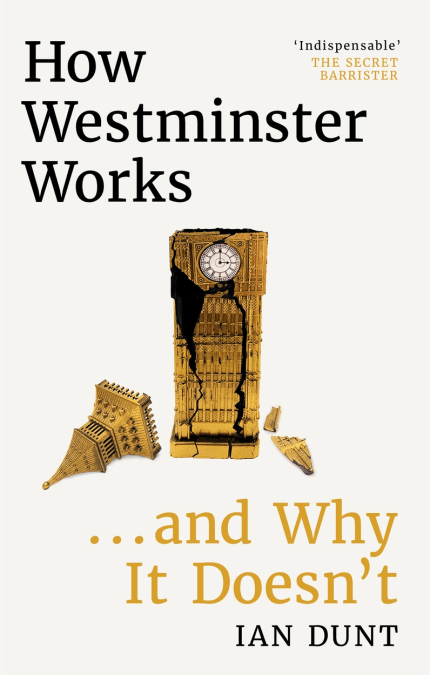
Mike Phipps reviews How Westminster Works …and Why It Doesn’t, by Ian Dunt, published by Wedenfeld & Nicolson
This is a vitally necessary but irritatingly flawed book. Necessary, because as journalist Ian Dunt explains at the outset, “The British political system rewards short-term tactics over long-term strategy, irrationality over reason, amateurishness over seriousness, generalism over specialism and gut instinct over evidence.” The result is increasingly bad governance.
There is undoubtedly some useful material here, including a strong critique of the first-past-the post voting system, which has many faults, but above all, it increases political tribalism and skews the allocation of government resources to winnable seats in a way that borders on corruption.
There are also quite a few things I didn’t know. One example is that Green MP Caroline Lucas tried in 2013 to introduce a proposal that every amendment to parliamentary legislation be accompanied by a 50-word explanation of what it was aiming to accomplish, which is standard practice in the European Parliament. It fell, basically because the party whips didn’t really want their MPs to know what they are voting on.
But some of the diagnosis is a bit lazy. There are some telling criticisms about the process for selecting parliamentary candidates; but bemoaning the factionalism that is rife in the Labour Party and then relying on the testimony of Neil Kinnock, one of the Party’s most factional leaders ever, is a bit much.
Likewise, Dunt savages the whipping system, citing how a Tory three-line whip protected Owen Paterson last year from a 30-day parliamentary suspension. But he doesn’t mention that, such was the outcry at this, the government was forced into a U-turn 24 hours later.
For someone who is trying to explain why Westminster is failing, he misses some obvious problems. For example, he praises parliamentary Select Committees as “exceptionally well staffed”. But, with the exception of the Public Accounts Committee, they really are not, especially when compared to their counterparts in the US Congress. Their reports are often ignored by government and press alike – as underlined by the recent comprehensive report by the Public Accounts Committee into the government’s multiple failings which was barely noticed by the mainstream media.
Here’s another rather lazy assertion: “[Ex-Labour MP Luciana] Berger was subject to a stream of anti-Semitic and misogynistic abuse from supporters of party leader Jeremy Corbyn and elements of the far right when she was a Labour MP” – an observation that neglects to note the contestable – even offensive – nature of juxtaposing Corbyn supporters and the far right. The paragraph goes on to bundle together a serious threat of extreme violence from an unnamed source against Berger with motions of no confidence in her submitted by her local party. These things, it should not need saying, are not the same.
A further failing is the author’s tendency to slide into cynicism. Chris Grayling decided to privatise the probation service, it is suggested, just to make a name for himself in a department he knew nothing about, before climbing further up the career ladder. It’s easy to write this, given the uselessness of most Tory ministers, but the bigger picture is the Tory ideology that promotes privatisation, irrespective of the disastrous, and in this case, fatal consequences. This ideology was the real reason that all professional advice was ignored and the Treasury approved the project, although the point about secondary legislation being used to bypass parliamentary scrutiny and votes on the policy is well made.
The core argument in Dunt’s book focuses on the dysfunctional nature of government, starting with the idea that the centre of the executive is based in a private house, with neither open-plan spaces nor enough meeting rooms, and where everyone craves proximity to the Prime Minister’s office to maximise their influence. “Your effectiveness basically depends on your ability to loiter,” says one former Downing Street official.
Cabinet is ever more irrelevant, as special advisors increasingly compensate for ministerial amateurism. “In the US,” notes one MP, “a defence secretary can be a four-star general and a vice chief of staff for the army. In the UK, we get Gavin Williamson.”
This under-performance is reinforced by over-frequent Cabinet reshuffles, a key cause of policy incoherence. Between September 2021 and September 2022 there were five Education Secretaries. This increases the tendency of civil servants to steer ministers – ‘boxing them in’, by offering them one sensible policy options against several mad ones. The problem occurs when a minister selects the mad option. “Liz Truss did it all the time,” the author is told.
Yet the same dysfunction is also replicated in the civil service itself. Its influence has been declining ever since Thatcher, in part because of overbearing, ideologically-driven ministers and their advisors. “I found [Dominic] Cummings terrifying as an experience,” one senior figure comments. “They were total animals. Saying it’s illegal was not an argument against doing something.”
Besides its generalism, elitism and increasing turnover – the average head of department lasts just two years and nine months in the job – a more recent reason for the comparatively poor quality of UK civil servants is that the most talented potential recruits are increasingly attracted into more lucrative careers, whose salaries have rapidly overtaken what the public sector can offer. As a result, the declining competence of civil servants is addressed by hiring ever more expensive private sector consultants.
One case study of how these failings played out is the belated evacuation from Afghanistan in the summer of 2021. Dominic Raab, Foreign Secretary with no foreign affairs knowledge or interest deliberately refused to take key decisions on evacuation cases when the crisis was at its height, which almost certainly resulted in preventable deaths. He headed a poorly managed department, where thousands of urgent emails from Afghanistan were not even opened. Evacuation cases were then prioritised on the basis of whether a constituency MP was applying pressure in a particular instance. Yet the dogs of an animal charity got priority over everything, allegedly after prime ministerial intervention, flown out of Afghanistan on a plane with 230 empty seats, while thousands of people waited at airports in vain.
Overall, between 75,000 and 150,000 people who had helped the British in Afghanistan and feared lethal retribution from the Taliban applied for evacuation. Fewer than 5% were helped. “The Foreign Office has not admitted any shortcomings.”
When it comes to fixing the problems identified here, Dunt’s remedies are a bit tame. The only major reform proposed is changing the electoral system, which would undeniably have a sweeping impact. Some ‘pure’ proportional systems, however, actually strengthen the power of party machines in the candidate selection process, so this idea needs more consideration than it gets here.
Other major reforms, such as greater devolution, an elected second chamber, the removal of the monarchy from political life, an entrenched Bill of Rights or citizens’ initiatives don’t get a look-in. Even with the smaller, incremental changes that Dunt favours, there are quite a few that he doesn’t consider. A more wide-ranging Freedom of Information Act; a Department for the Opposition; giving parliamentary Select Committees the power to subpoena witnesses and documents, as in the US; a curtailing of the Prime Minister’s patronage powers in the realm of public appointments and honours; and a codification of the powers of the Prime Minister, as envisaged in Tony Benn’s proposal for a “constitutional premiership” would all be high on my list.
But ultimately, if the problems are as big as the author claims – and they probably are – much more wide-ranging constitutional change will be needed to fix them. Whether any government will ever find the political will to do that is more doubtful.
Mike Phipps’ book Don’t Stop Thinking About Tomorrow: The Labour Party after Jeremy Corbyn (OR Books, 2022) can be ordered here.
 Labour Hub