
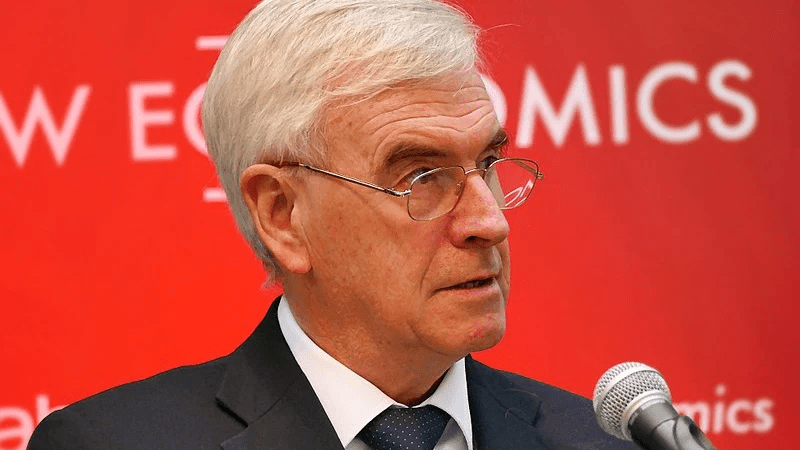
We reproduce the speech John McDonnell MP made to the annual conference of the Progressive Economy Forum on Saturday June 10th
The Progressive Economy Forum (PEF) has maintained a strong influential edge in progressive circles and amongst progressive policy makers.
Decisive period
It’s vital that the PEF continues to play this role in the next 18 months and beyond, as this will be a decisive period in establishing Labour’s Manifesto, its programme for government and then the development of that programme in office.
For we are facing three stages of policy making.
The first is Labour’s Manifesto construction which is starting in earnest in July with a special meeting of its National Policy Forum. The report from these deliberations will go to the Party’s annual conference in September and then there will eventually be the Clause V meeting of the National Executive Committee and Shadow Cabinet to agree the actual Manifesto draft.
Cast aside cynicism
We have to cast aside all cynicism that this is a performative process and the Manifesto will actually be drafted by Peter Mandelson and the hand-picked small team of acolytes he has appointed around Keir Starmer.
However, the pronouncements on the Green Prosperity Plan over the last few days have caused concerns. Witnessing the party’s spokespeople stumbling in the face of the first detailed questioning of a key policy is naturally worrying.
Entry into government phase
The second phase starts pre-election when the Opposition parties meet with civil servants to discuss the plans to implement their Manifestos if they win and in particular the first budget.
Implementation of these plans that make up the overall programme starts rapidly after the election.
Second year
There is another phase, not much talked about or planned for, but which is equally if not more important.
This is usually in the second year of a new government. It’s when the real world intrudes.
It’s when administrations have to face up to whether elements of their programme are working or are even implementable.
This is where real influence can be exerted. It’s when a party is in government and in need of ideas.
These are huge opportunities for the PEF to influence policy.
Power
I want to talk about a policy issue that is not raised much vocally. It’s about power – economic power.
1973 Programme
This month is the anniversary of Labour’s programme of 1973.
You may have seen some recent commemorative lectures and articles about this important document.
At the heart of the programme was the simple statement of aims, which was to secure “a fundamental and irreversible shift in the balance of wealth and power in favour of working people.”
In recent debates within the Labour Party and commentaries on Labour’s positioning, there has been quite a lot of discussion about the need for the redistribution of wealth, not just through redistributive taxation, but also through investment in public services, and increased wages and benefits.
But there has been little about the redistribution of economic power.
It might be the language: that to talk about power appears to be too aggressive, not business-friendly.
But if Labour is to make its mark on the lives and life chances of the people we seek to represent, we need to talk about a plan for redistributing economic power.
So let’s do that.
Six basic power-shifting policies
I want to convince Labour to adhere to six basic power-shifting policies.
First, the full implementation of the Institute of Employment Rights programme to restore employment rights and sectoral collective bargaining across the economy.
This simply seeks to rebalance the power in the workplace between capital and labour that has been deliberately swung by legislation over the last 40 years in favour of capital.
With some elementary reforms, trade unions would have their ability restored to negotiate better pay by securing a greater share of the wealth their members create.
This simple measure would be transformative.
Second, alongside the restoration of employment rights, it’s time to reopen the debate on industrial democracy that has been shelved for so long.
There are a multitude of proposals that could provide working people with greater control over their working environment and increase their employment security and prosperity at work.
They include workers on boards, supervisory committees involving workers and consumers, and, of course, collective share ownership.
Third, it’s a truism that ownership does confer power.
That’s why if we are to seek to harness more effectively key essential elements of our economy, especially to tackle climate change, we need to secure the power that comes with ownership.
There can be many alternative forms of ownership that transfer power, including modern day nationalisation and co-operative ownership, but they all need to have at their core the passing of control to the wealth producers and the service recipients – the true stakeholders.
Regulation as a technique has been shown to provide for the minimal transfer of power and by being so ineffective has been proven time and again to provide not even the power to prevent harm.
That’s why even in sectors such as auditing, there needs to be not only a root and branch reform of regulation but also the return of the public auditor.
Fourth, local and regional government have proved, in the most challenging political and financial climate, to be effective in extending the power of communities over their local economies by securing the devolution of many powers and responsibilities from Whitehall and by adopting community wealth building.
Alongside a regionalised national investment bank local councils and mayoralties with sufficient powers and resources can put an end to the UK being the most regionally unequal country in Europe.
Fifth, the overall management of national economic policy and economic decision-making has become increasingly detached from democratic control.
Corporate capture of not only our economic institutions but also government itself has undermined the ability of democratically elected government to manage the economy on behalf of its citizens rather than corporate interests.
The Treasury and individual government departments are permeated by corporate interests, influencing and often setting government policy.
The Bank of England remains independent but with a mandate that fails to address the interests of the people.
The financial services regulatory bodies are regularly criticised as being asleep at the wheel.
And decision-making is ill-coordinated and short-term.
We need a new structure for economic policy-making and implementation that is open, transparent and inclusive of the representatives of working people and the wider community.
I have long advanced the proposal for a new National Economic Policy Council, bringing together the Treasury and Bank of England along with representatives of the trade unions and employers and community to coordinate policy-making.
Although respecting the description of the Bank of England as independent, a new mandate determined by the National Council would set the Bank’s objectives better to reflect the need to tackle the economic and environmental challenges our people face.
Sixth and finally, reflecting on the work that both Ann Pettifor and Guy Standing have been doing, it’s starkly obvious that we must align ourselves internationally with those that are seeking to reform, deconstruct and reconstruct our global institutions that have caused such havoc in the Global South and pursued policies and programmes that have put our planet at risk through climate crisis.
A Labour government could play an important role in establishing alliances of progressive administrations to ensure that governments wanting to implement policy programmes that tackle inequality, address climate change effectively and manage their economies democratically are not swept off course by players in the global bond markets or by the looming crises in shadow banking.
It could link with the new alliances and support new initiatives that are emerging rapidly from the Global South that have the potential of rebalancing global power with the aim of empowering democratically elected governments to manage their economies in the interests of their people and not be dictated to by corporate interests.
Being part of these new movements and developing joint action can enable an incoming Labour government and all progressive governments to withstand the threats of the bond markets and overcome the risk of crises in shadow banking.
Conclusion
At the moment, it’s uncertain how much the current Labour front bench can be convinced to take up these elements of a power-shifting programme.
However, it’s all still to play for and that’s where PEF comes in, working with other progressives.
Especially, I believe the most significant opportunity will present itself when, with Labour in government, the real world intrudes, demanding more radical solutions needed to address the continuing economic and climate crises and to maintain the support of an electorate that has waited 13 years to remove the Tories and for a Labour government to give them hope.
John McDonnell MP was Labour’s Shadow Chancellor from 2015 to 2020.
Image: John McDonnell MP. Author: Sophie Brown, licensed under the Creative Commons Attribution-Share Alike 4.0 International license.
 Labour Hub