
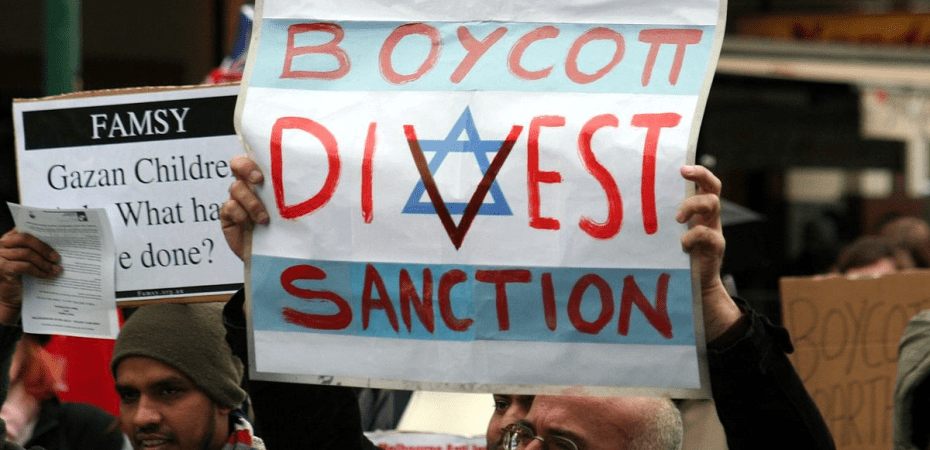
A Legal Opinion commissioned by Amnesty International thinks so. A special report.
The Government’s Economic Activity of Public Bodies (Overseas Matters) Bill, which reaches its second reading in the House of Commons tomorrow, aims to ban UK public bodies from imposing their own boycott or divestment campaigns against foreign countries and territories. Those who break the rules could face significant fines with Ministers among those able to conduct investigations into suspected breaches.
The Government argues that the Bill is necessary to stop public bodies pursuing their own foreign policy agendas. Yet far from doing so, local authorities and other public bodies may simply be concerned that international human rights law is being upheld in its dealing with overseas states, an issue the Government itself claims to be concerned about.
But a new Legal Opinion sought by human rights group Amnesty International and written by Stephen Cragg KC of Doughty Street Chambers suggests the Government’s proposed legislation may actually be in breach of the European Convention on Human Rights.
Firstly, the Bill appears to breach Article 10 of the European Convention, which states that “Everyone has the right to freedom of expression.” None of the conditions limiting the expression of this right – “national security, territorial integrity or public safety, for the prevention of disorder or crime, for the protection of health or morals, for the protection of the reputation or rights of others, for preventing the disclosure of information received in confidence, or for maintaining the authority and impartiality of the judiciary” – apply in the case of the Bill, according to the Legal Opinion.
Thus “there is a strong case to say that it is incompatible with the ECHR,” it says.
Secondly, the Opinion notes that the Bill gives the enforcement authority the power to issue a notice to a public authority requesting information – including personal information – that will enable them to assess whether the public authority has (or is likely to) contravene the legislation.
Such a measure could also fall foul of the European Convention on Human Rights. “This could pose severe intrusions on individuals’ right to respect for private life under Article 8 ECHR while also impacting even further on freedom of expression rights,” argues the Opinion.
The Bill is certainly against the spirit of freedom of speech. As the UN Special Rapporteur on freedom of expression said in relation to BDS restrictions in the USA in 2019: “[The legislation] appears clearly aimed at combatting political expression advocating boycott, divestment or sanctions against Israel. Boycott, however, has long been understood as a legitimate form of expression, protected under Article 19(2) of the ICCPR [the International Covenant on Civil and Political Rights].”
There are further concerns that the Government is reserving to itself the power to use secondary legislation to remove countries and territories from the ban as it sees fit. The Legal Opinion states that “there must be concerns about the power of the government to alter important and controversial legislation by way of secondary legislation without proper parliamentary scrutiny.”
Amnesty International argue that the Government’s Bill is “outrageous”. CEO of Amnesty UK Sacha Deshmukh said, ”People who care about issues such as climate justice or the arms trade will be dismayed by this legislation.”
In particular, the unique status given to Israel in the legislation shows it is driven partly by a desire to prevent opposition to human rights violations against Palestinians.
In a detailed briefing, Amnesty explain why the Bill undermines human rights:
“• It would make it almost impossible for public bodies to use their procurement and investment policies to incentivise ethical business conduct that is human rights compliant.
• Companies depending on public contracts will feel more confident that their global impacts on human rights and the environment will be irrelevant to their success in tendering processes.
• Businesses making an effort to adhere to global standards such as the UN Guiding Principles on Business and Human Rights may find themselves at a competitive disadvantage.
• It undermines the freedom of expression of public sector decision-makers who may find that statements of principle are illegal and punishable even if they are not reflected in their public body’s decisions.
• It uniquely privileges one State, Israel, at a time when Israeli authorities continue to flagrantly breach international law, including through imposing a system of apartheid on Palestinians.
• It conflicts with the UK’s long-standing policy to differentiate between Israel’s internationally recognised borders and the Occupied Palestinian Territories, which the UK doesn’t recognise as part of Israel.
• It runs contrary to the UK’s endorsement of UN Resolution 2334 that requires states to differentiate between their dealings with Israel in its recognised borders and the Occupied Palestinian Territories.
• It undermines the attempts of the UK’s devolved governments to integrate human rights into their procurement policies.”
The pressure group Liberty have also condemned the Bill on free speech grounds, saying that it is “the latest example of the shrinking space for freedom of expression in the UK, following the passage of the Police, Crime, Sentencing and Courts Act and the Public Order Act.”
Many Jewish groups have also expressed opposition. A motion passed unanimously at the recent Union of Jewish Students Conference stated: ”the UK government’s recently proposed BDS Sanctions Bill weakens the ability of British Jewish students to approach the conversation about Israel in a nuanced manner.”
The motion stated: ”UJS reaffirms its support for the democratic right to non-violently protest and opposes the government’s proposed Boycott Bill which is a curtailment of that right, as well as presenting a risk to British Jewish communities and a setback to Israeli-Palestinian peace.”
Additionally, a letter signed in the names of the Noam Masorti Youth, RSY-Netzer, LJZ-Netzer and Habonim Dror youth organisations, and sent to the Board of Deputies and Jewish Leadership Council, has also expressed “grave concerns” over the proposed BDS Bill.
Yachad, an important British Jewish organisation “whose primary mission is to empower British Jews to support a political resolution to the Israeli Palestinian conflict”, has also expressed opposition. In a recent briefing, it stated:
“Yachad does not support or promote the BDS Movement… However, we are unequivocal about the need to protect the right to express differences of opinions, even if they are opinions that we fiercely disagree with… non-violent tactics of boycotts and sanctions are legitimate acts and once legislation is passed in the UK that seeks to outlaw the use of these tactics in some spaces, it creates an atmosphere and environment in which the actions themselves are seen as inherently problematic.”
A group of British-based Jewish academics, with differing opinions on BDS, has also added its voice. They include Professor David Feldman, Professor Francesca Klug OBE, Dr Yair Wallach, Dr Clive Gabay, Professor Michael Berkowitz, Professor Adam Sutcliffe, Professor Nadia Valman, Dr Seth Anziska, Associate Professor Mohamed S. Farsi-Lindenbaum, Dr Brendan McGeever, Professor Hagar Kotef and Professor Neve Gordon.
MPs too have expressed concern that the Bill could undermine attempts to combat modern slavery and undercut support for the Uyghur minority in China. Labour’s Shadow Minister Lisa Nandy has herself voiced such concerns, which makes Labour’s decision to abstain on the Bill at its second reading all the more bizarre – or opportunist.
Amnesty International is calling on all MPs to speak and vote against the Bill in its entirety. John McDonnell MP has already indicated he will do so. Will other MPs take this principled stand?
Image: Israel – Boycott, divest, sanction. Source: originally posted to Flickr as Israel – Boycott, divest, sanction. Author: Takver, licensed under the Creative Commons Attribution-Share Alike 2.0 Generic license.

