
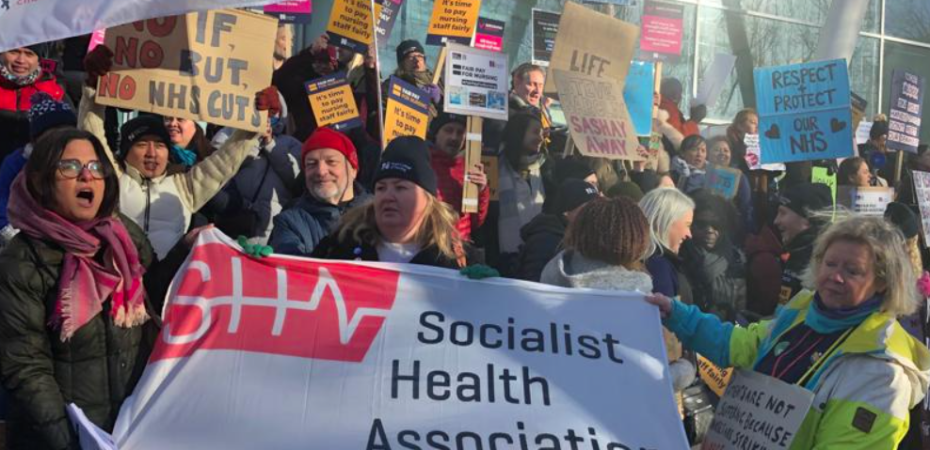
They are felt, rather than counted, argues Ben Goodair in his speech to Saturday’s Socialist Health Association Conference marking 75 years of the NHS.
Most of us in the UK oppose NHS privatisation. We do so because we think it is immoral to profit from healthcare, perhaps because of values of equity, and beliefs in socialised services – or because of experiences we’ve had as patients.
There is another string to our bow. The scientific evidence validates these beliefs, values and experiences. Evidence from the research community agrees. Privatisation comes at a cost.
In England we have experienced decades of increasing for-profit delivery of NHS treatments. Billions of pounds have been spent and millions of patients treated in the private sector.
This is all because of an ideological commitment to privatisation, sold as a silver bullet to solve any problem in the NHS, but more truthfully an exercise in smoke and mirrors.
This is happening both here and abroad where commercial interests and neoliberal ideologies too often underpin health systems.
So now it is time for the jury to come in. It’s time for the research community to detail, clearly and honestly how well this has performed. And the evidence is here.
Here’s what we know so far. The cost of privatisation is that on the health of patients and populations subjected to it.
Processes of privatisation in England and Italy have been found to correspond with more people dying of treatable causes.
Both these studies use similar methods, comparing areas with high levels of privatisation against areas with low levels. And the conclusion is stark. If you live in an area with high privatisation you are likely to suffer from worse quality care as a result.
Why? One answer is simple. Providers which are run for profit often deliver worse care than public providers.
We’ve seen this evidenced in ambulance services, children’s homes, adults nursing homes, prison health services, cleaning services, hospital management, hospital support staff and psychiatric care.
Evaluations of these kinds of specific services more often than not identify that public provision outperforms that in the private sector. Private companies cut corners, often taking the toll on staff, and ultimately on patients.
But another reason exists too. As we outsource services to the private sector, we subject the public sector to more strain.
Public hospitals are so efficient and, sadly, so cash-strapped that private providers often struggle to make money delivering the same services. And so, they pick and choose. They choose the regions, they choose the services, and they choose the patients that are most profitable to them.
This has been evidenced in so many situations over such a long period of time, but it is by design and integral to the model of outsourcing. The concerns are that public hospitals are not financially compensated for this and that the cooperative working environment gets damaged.
By chipping away at the public sector, it could be they that get fractured.
The evidence comes from around the Western world – Sweden, Ireland, Scotland, America, England, Denmark, Australia, Canada and Italy.
Hundreds of millions of patients are being subjected to worse quality care because of a policy direction taken up in so many countries.
It is easy to list the evidence and get lost in what is being measured by these studies.
The outcomes are life-changing, frequently life-ending, the people often disempowered and vulnerable. The costs of privatisation are not counted but felt.
In your efforts to improve the NHS, to prevent privatisation, in whatever way you do, know that as well as having the conviction of your values, the science backs you. The costs of privatisation are being measured and being written into the history books. Let’s hope that one day this is the only way they are experienced.
Ben Goodair is a Doctoral Researcher at the Department of Social Policy and Intervention at the University of Oxford.
Image: c/o SHA
 Labour Hub