
Our vision must include equality, says Lester Holloway, speaking at last Saturday’s Socialist Health Association Conference marking 75 years of the NHS
This Wednesday we celebrate the 75th anniversary of the NHS, and last week we marked the 75th anniversary of Windrush.
Of course, a significant part of the Windrush story was Caribbean nurses coming to the ‘Motherland’ to help build the NHS.
There’s a very comforting narrative around that: hardworking, dutiful (and to an extent patriotic) Caribbean nurses coming to England to help build the NHS which became a much-loved institution which many of us owe our lives to.
But that narrative, while comforting, doesn’t tell the whole story – both historic and contemporary.
On the historic: it doesn’t tell the nurses’ story – about difficulties within the public health service and from patients. The struggles and barriers they faced outside of work in wider society.
While Windrush and the NHS story is helpful in terms of strengthening bonds between the Black community and public services, it also excludes an important factor: and that is the Black patient experience.
We shouldn’t shy away from this. The historic and contemporary experience of many is feeling discriminated against within the NHS.
This is most starkly illustrated by the fact that Black women are four times more likely to die at or around childbirth.
And while more research is needed, all the indications point to racial attitudes around disregarding complaints of pain, of the view that Black women can endure more pain.
These are deep-seated attitudes that go back centuries, that have their origins in the medical racism of Victorian times.
The whole point about having a healthy perspective on faith is that you should be able to ask questions and challenge, while simultaneously holding firm to the ideal.
Sometimes our instinct – particularly at a time when the NHS is under attack – is to gloss over uncomfortable issues, for fear of distracting from the goal of defending the service from the Tories.
But if we want to not just save the NHS but restore it, then our vision must include equality: making it fit for purpose for everyone – and not just assuming that more funding alone will solve all of the problems.
We need cultural change too. And it is desperately needed. Because there were two key underlying reasons for the fact that Black people were three times more likely to die of Covid – four times in the case of African men.
One, was disproportionately working on the frontline. And we, on the left, definitely noted that.
But two, it was scepticism of medicine and the medical profession, brought on by historical and contemporary lived experience.
If we want to avoid that happening again in a future pandemic, we need to change not only the world of work, but also the Black patient experience.
It was absolutely shocking – but not surprising – that just this week the Health Secretary Steve Barclay, rejected a recommendation from the All-Party Women and Equalities Committee to set a target for the reduction in Black maternal deaths. There should have been more of an outcry about this.
While the government’s position on maternal deaths is horrifying, Labour’s attitude to the NHS is more than disappointing, with Shadow Health Secretary Wes Streeting consistently talking up the fact that he is not ruling out private sector involvement in the NHS.
Last week, Streeting said the left shouldn’t treat the NHS like a religion. The thing that Wes Streeting got wrong is that the NHS isn’t a religion; it is faith. And that’s something altogether different.
It’s faith in the ideals, not just of a public health service free to all, but the ideal that people shouldn’t suffer and die because they don’t have the money.
It’s the ideal that life is precious, and that people should live long and healthy lives regardless of their background and circumstances.
On average there’s an eight-year life expectancy gap between the most and least deprived, but that gap doubles when it comes to life lived “in good health.”
But our faith – and raw data – tell us that it’s even worse in the United States.
We know that while the NHS is struggling through chronic underfunding (especially health spending as a share of GDP), the answer is not selling it off.
We have faith in a service that lives up to the founding ideals, in a modern setting, which includes a National Care Service.
And when it comes to equality, we know that Black staff get a worse deal in the private sector. Race discrimination cases in Employment Tribunals are higher, trade union density is lower, and racial disparities in wages and grades even worse.
More private sector isn’t the answer for patients of all backgrounds, and that is also the case for race equality.
When I worked at CLASS, we produced a report and survey which showed that the working class experience of public services in general was quite poor. From the benefit office to the housing office, working class people were getting a bad deal.
And this wasn’t due to the hardworking public servants, but down to the structures and cultures set by management, and by government.
And we argued that one of the strongest cases for investment in public services was the ambition to make the experience of ordinary people better.
You’re less likely to be treated with dignity if the person who is treating you is themselves overworked and underpaid.
By the same token, achieving better equality and equity demands space to make that happen.
By that, I mean it’s not competing for time and attention with just getting the job done. You need time and space to think about how to make things better, to consult, and that takes investment too.
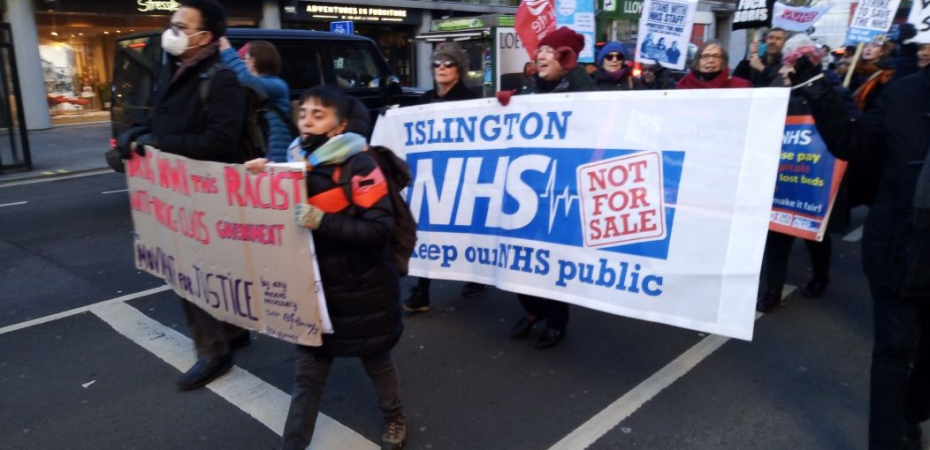
The 75th anniversary of the NHS is an opportunity not only to celebrate public healthcare and reaffirm our commitment to keep capitalist hands off the service, but a moment to reimagine an NHS that is not only well-resourced but hardwired to serve our multiethnic society.
Lester Holloway is the editor of The Voice newspaper.
Image; c/o Mike Phipps
 Labour Hub