
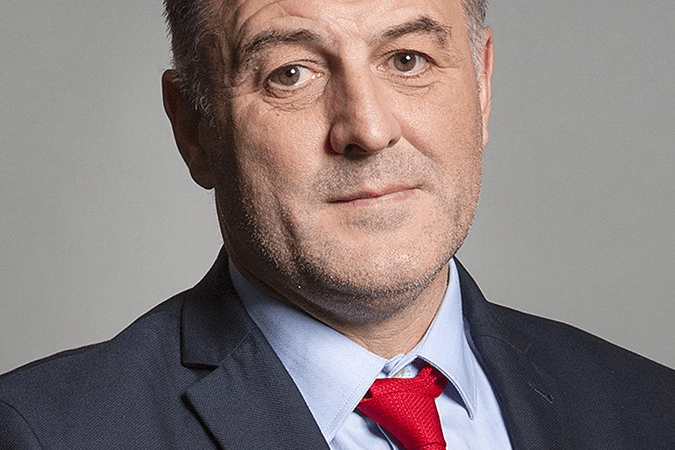
An edited version of Ian Byrne’s speech at last Saturday’s Socialist Health Association Conference marking 75 years of the NHS
Greetings of solidarity and thank you to the Socialist Health Association for inviting me to speak today. It is a real privilege to be able to speak and to follow such brilliant contributions.
For those of you who don’t know me, I am the Member of Parliament for Liverpool West Derby. I was elected in 2019 when I proudly stood on a transformative socialist manifesto which would have brought the NHS back into full public ownership and a right to food.
I, like millions of others, owe the NHS my life. I was born after 28 weeks and was on life support. It was the wonderful team at Oxford Street in Liverpool that kept me alive and here today. I can only imagine how that would work out for a working class baby in other countries not blessed with an NHS.
So we all are here to cherish this precious jewel which has done so much to combat the health inequalities we see around the globe.
But we are at a tipping point in this country and, I would argue, we cannot fight for just the NHS in isolation. We are fighting to defend the whole principle and ethos of the NHS; we are fighting to defend the socialism that underpins it, the principle of our fundamental right to healthcare being free for all at the point of use, and we are fighting against the drivers of poverty that have led to the vast health inequalities we are seeing today, which remind us of 1823 not 2023.
There is a life expectancy difference across Liverpool of 20 years – this horrific level of health inequality has been caused by social breakdown. One in three in my great city are in food poverty.
How did we get here? Political choices, comrades, political choices.
We’ve had 40 years of Thatcherism, privatisation and neo-liberalism – the political choice of austerity which has destroyed the social safety net and our vital council services, including social care, sports facilities and youth services.
The political choice to attack wages and workers’ rights and the end of a fair taxation system to ensure those with the broadest shoulders do the heavy lifting.
The political choice to underfund education and the destruction of free higher education: last week out of a group of 17 wonderfully talented young women from a school in my constituency, only three were considering university because of the cost and debt.
The political choice to destroy the council housing programme, which was transformational post ‘45, with Right to Buy and a shift to private landlords. My great friend Dr Ian Sinha from Alder Hey Children’s hospital in my constituency tells us of the impact poor housing has on the health of our nation, cutting life expectancy by decades. We saw starkly the consequences of poor housing in the heart rendering case of Awaab Ishak.
And finally, the political choice of privatisation of utilities and services, alongside the demonisation of public ownership; a complete failure to understand that public service for the public good will never prosper in the hands of the profiteers who are interested only in the maximisation of profit for shareholders. We are now reaping the consequences of this utterly failed ideology and will pay the price for generations to come.
Instability, insecurity, isolation and loneliness, powerlessness and inequality are the consequences of what Thatcher unleashed. The he images of this failed ideology are people queuing around the block for a food bank, many who work in the NHS, and baby formula milk – which was once provided as a public good – now 45% more expensive than two years ago and behind security locks on the highest supermarket shelf.
The NHS can never be allowed to be put in to private hands, driven by profit, but it’s now on the same life support system I was on in my early weeks of life and it’s vital signs are flickering.
We cannot allow it to become added to the list of public services destroyed by the privateers, but nor can we let it fail, under the pressure of the misery and inequalities caused by political choices.
So let’s touch on one element I feel could help to relieve the pressures: winning the Right to Food.
Food poverty leads to health and life expectancy inequality and malnutrition. Poverty destroys the life chances of future generations in our poorest communities. It affects children’s educational attainment and life chances. Less measurable, but no less important, is the effect on individual human dignity and social cohesion over time in our polarised nations of food banks next to investment banks.
How can we accept that we have more foodbanks than McDonald’s? When do we collectively accept that the system is broken and the Government is failing the people it is elected to serve?
Hunger is a political choice – -a choice made by those in power in Government.
Political choices are destroying our local and national economy by driving millions into abject poverty. Political choices are resulting in millions of our children starving.
The founder of the NHS, Nye Bevan, said, “Private charity can never be a substitute for organised justice.”
The time for sticking plasters – such as reliance on thousands of foodbank and pantry volunteers and donors – is over. We need systemic change so that all our people might live with the opportunity of health, happiness and dignity. Enough is enough.
This is why we started a campaign for the Right To Food – both as a grassroots national movement, and in Parliament – to make access to food a legal right for all, building on the work in the 2019 manifesto.
I have been working with an incredible range of local and national organisations, trade unions, community campaigners, medical practitioners and so many others – and wonderful politicians like Shami Chakrabarti and Beth Winter MP – and it’s been a huge privilege to work closely with Right to Food London with many in this room.
Our objective is to have the ‘Right to Food’ enshrined in law and to end the scandal of hunger and foodbanks once and for all.
We demand enforceable food rights to ensure the Government of the day is accountable for addressing the cost of food, making sure nobody goes hungry. And, crucially, so it is prevented from making decisions that lead to people being unable to afford to put a meal on the table.
I read about the formation of the Tredegar Workmen’s Medical Aid Society on which Bevan was famously said to have modelled the NHS. I’m proud that I see similarities with the Right To Food campaign and indeed our Fans Supporting Foodbanks food pantries in Liverpool which fed over a 100,000 people across the city in a dignified manner with choice solidarity, not charity. But this is still a sticking plaster that should not be needed in one of the world’s richest countries.
I’m proud this has been a grassroots organic campaign – providing people with materials and empowering them to run their own campaigns locally, not a top down campaign.
And it has been in collaboration with trade unions, football clubs, community groups, health workers and many more to build campaigns and build pressure through collective solidarity and the collective experience of food poverty.
Together the campaign has achieved:
– A motion passed unanimously at Labour Party Conference.
– A motion passed unanimously at the Trade Union Congress.
– Right to Food cities: Liverpool, Manchester, Greater Manchester Combined Authority, Liverpool Combined Authority, Rotherham, Brighton and Hove, Haringey, St Helens, Preston, Lancaster, Durham, Newcastle, Portsmouth, Totnes, Coventry, Sheffield, Birmingham, Portsmouth.
– Local and regional campaigns fighting for Right to Food to be realised in their areas, such as London Right to Food campaign.
– A right to Food Submission to National Food Strategy.
– BFAWU research and a UK wide research collective.
– A public petition and the handing in of a campaign letter to Downing Street.
We have five demands that are a starting point to realising our Right to Food in law. These are:
1. Universal free school meals.
2. For the Government to factor in the cost of food when setting minimum/living wages and benefits – because right now we know they are nowhere near enough.
3. Independent enforcement of legislation. Right To Food legislation must be accompanied by oversight and enforcement powers granted to a new independent regulatory body that will hold Government to account.
4. Community Kitchens. Government should fund dining clubs and ‘meals-on-wheels’ services for the elderly and vulnerable, school holiday meals for those most in need and cookery clubs for the wider community.
5. Ensured food security. Government must ensure food security and take this into account when setting competition, planning, transport, local government and all other policy. Price caps on essential items which I’ve asked for in recent weeks of both government and supermarket chiefs.
Comrades, this is achievable. I often hear that horrible phrase “hard choices in politics”. Well, for me, a hard choice is doing nothing when millions are suffering and you turn away in their hour of need -and with an NHS that’s suffering that needs rebuilding in the vision and ethos they had in ’45 – nothing more and nothing less.
It feels like the NHS is the last bastion of the socialism that we started in ‘45 that’s not been completely destroyed by the values of Thatcherism. We must defend it with every fibre of our beings because the very lives of the millions of working class people in this country depend on it and us..
I want to finish off with something Bevan said: “The NHS will last as long as there’s folk with faith left to fight for it.”
This is why we are all here today and why this event is so important.
Ian Byrne has been MP for Liverpool West Derby since 2019.
Image: Ian Byrne MP. Source: https://members-api.parliament.uk/api/Members/4831/Portrait?cropType=ThreeFour. Author: David Woolfall, licensed under the Creative Commons Attribution 3.0 Unported license.
 Labour Hub