
It’s not enough to ‘trust Ed’: now is the time to be loud, argues Bryn Griffiths
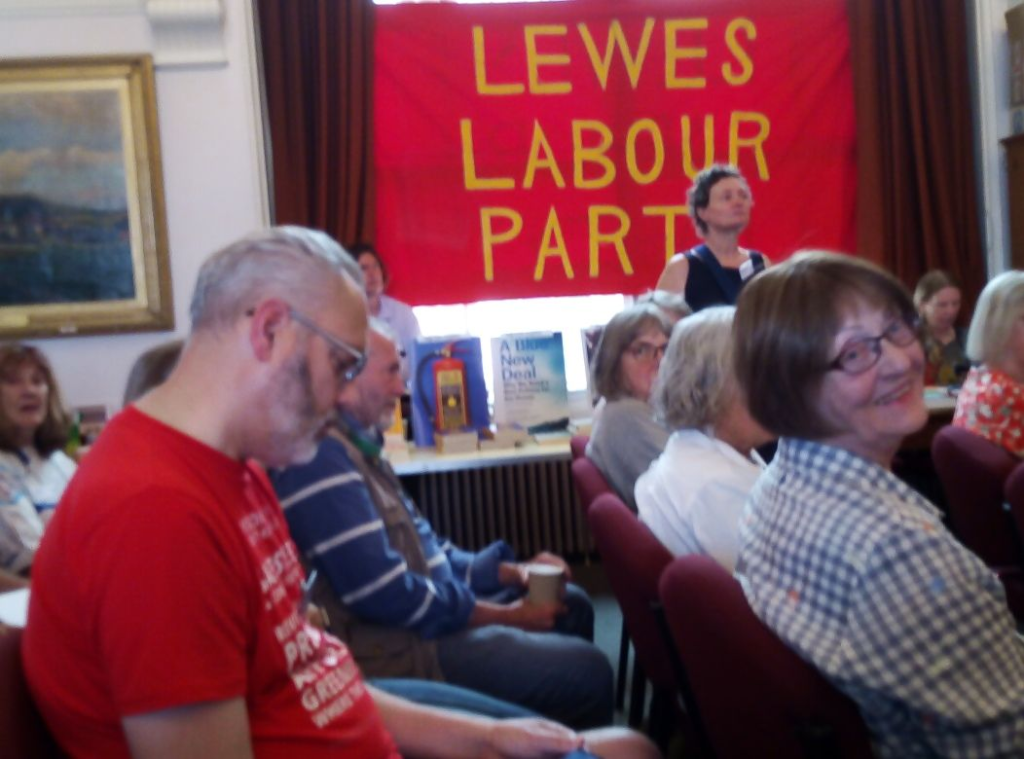
On Saturday 8th July I attended a day of participative discussion to plot the route from red to green, organised by Lewes Constituency Labour Party. The joy of Lewes political education events is that the local party still embraces the concept of a broad church and they celebrate participants holding a plurality of views. Discussion and constructive disagreement not only take place but it is positively encouraged. Even the unfairly maligned soft left Compass were present and I think it is fair to say they felt the friendly embrace of most Party members present.
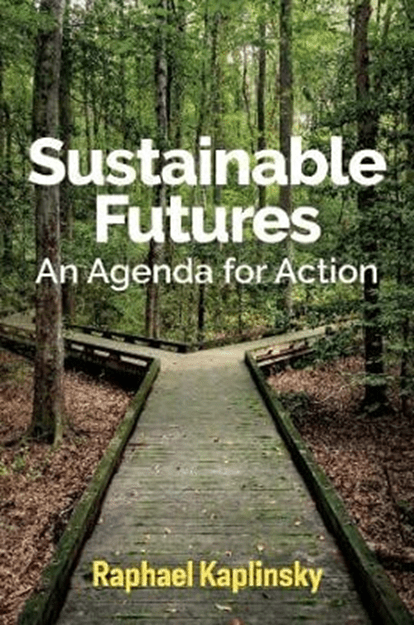
In the spirit of the event, I would like to address the thought-provoking contribution of the keynote speaker Raphael Kaplinsky. Raphael, an emeritus professor at Sussex University’s Institute of Development Studies is the author of Sustainable Futures An Agenda for Action so he was well placed to map a road from red to green.
Raphael began with a tour de force of the waves of creative destruction that have been at the root of economic creativity in the developed world. Grappling with the social, the political, the technological and the economic he led us through the Kondratiev long waves of development. He moved us from water power, to steam power, steel and heavy engineering to the mass production of Fordism. He grappled with the short-termism that today dogs our economy in a globalised world.
At the outset, he correctly stated that “research cannot be separated from action” so I was most excited when he moved on to what his book called An Agenda for Action. Having listened to his Agenda I left the day with a contradictory set of feelings. I embraced his Agenda with considerable enthusiasm but felt concerned that we did not have a movement to ensure its implementation. The presentation lacked praxis.
The world economy and indeed humankind is looking into the abyss of an existential crisis due to climate change. The UN Secretary General has said that “climate change is out of control.” The root of the problem, as Naomi Klein has cogently argued, is that the deregulated neo-liberal economic model is proving to be totally incapable of addressing a climate crisis which requires collective action and regulation. Gordon Brown, when Chancellor, commissioned the economist Nicholas Stern to explore the Economics of Climate Change and he identified that the problem is that it is “the greatest market failure the world has ever seen.”

With Klein and Stern’s words ringing in my ears, I listened to Raphael’s Agenda. My assessment was the agenda was very good but the movement to drive its implementation was absent.
In the table below I capture Raphael’s Agenda and then fill out a report card to show how Labour is shaping up.
| Kaplinsky Agenda | Labour Report Card |
| We should attack the current value system that defines taxation as bad. This will mean attacking the plutocracy and powerful. | Starmer and Reeves attended Davos to reassure the plutocracy they would be safe in Labour’s hands. |
| Rein in the financiers who are gambling on the short term. We must push money into greening society. | On the day of our discussion in Lewes Rachel Reeves, our Shadow Chancellor, tweeted “Labour will always respect the independence of economic institutions.” I fear this is not the market intervention and regulation envisaged by Klein, Stern or Kaplinsky. |
| Deliver a Green New Deal in the manner of Roosevelt’s New Deal. | Reeve’s abandonment of the £25 bn commitment is another bad sign. |
| Devolve power to lower regions. | Labour’s treatment of Jamie Driscoll does not signal a devolutionary extinct and the cool relationship with Mark Drakeford does not bode well. |
| Intervention in global development and address the problem of migration. | Labour is trying to neutralise the migration issue by fighting on the effectiveness of Tory proposals rather than seeking to redefine the agenda. |
My report card shows that despite Labour’s early promise, under Ed Miliband’s stewardship, more recently the progress has not only ceased but slammed into reverse.
Raphael’s Agenda clearly grasps the enormity of the environmental challenge given his embrace of the Green New Deal; a proposal given global prominence by the Squad’s Alexandria Ocasio-Cortez. His concerns about the plutocracy and the need to rein in the financiers clearly takes aim at Klein and Stern’s ‘market failure’ but Labour is not addressing the enormity of the challenge.
It is simply not good enough for Reeves to row back from Labour’s £25 bn commitment because if it wins power, it needs to be “responsible” with the public finances. Stern’s report showed us that the economic damage of not tackling climate change will dwarf the cost of tackling the climate emergency.
Faced with the cavernous gap between Raphael’s Agenda and Labour’s rapidly retreating agenda, I pressed him for his view. His response was a loyal defence of Ed Miliband, our Shadow Secretary of State for Climate Change and Net Zero. He marshalled the optimistic trope that Labour’s current approach was perhaps a strategic method to win the election and we should not judge what might happen under a Labour Government, by what Labour was actually saying, in the pre-election period. To reinforce the point, he invited us to trust Ed Miliband as he was convinced, he would not remain in the Shadow Cabinet if he was not hopeful that Labour would deliver in office.
I have big problems with the ‘Trust Ed’ formula. Every historical precedent suggests that under the pressure of office, Labour Governments become more conservative and move to the right. I can think of no precedent of a Labour Government when reaching office embarking on a journey in the opposite leftward direction.
The formation of my politics took place in the 1970s, a period when members’ disappointment in Wilson and then Callaghan led to the creation of the Campaign for Labour Party Democracy, so I am a trust-our-leaders sceptic. I have no doubt that Miliband, in an unchallenging field, is the most radical senior voice in the Shadow Cabinet team, but I am still troubled by Ed’s period as leader when he suppressed his inner radical at the behest of the Labour right.
My biggest concern with the ‘Trust Ed’ formula is not personal. ‘Trust Ed’ gives those of us who consider themselves to be green socialists very little agency other than to hope and pray that Ed comes good after 2024. So, what do we do if we want to push for the Kaplinsky Agenda? Politics does not exist in a vacuum and, as I hope readers know, the dominant ideas are a function of the balance of forces which exist in society. Even Boris Johnson discovered the so-called levelling up programme when Corbyn fought for the abandonment of austerity.
Our role must be to construct the widest possible coalition to deliver the Kaplinsky Agenda or something like it and put pressure from below on our leaders. Now is not the time to shut up and wait for the election: quite the contrary, now is the time to be loud. We need to create a counter pressure to the conservative and cautious voices that have captured the leader of the opposition’s office.
Raphael is clearly grappling with the need for people to have agency by proposing that civil society could give a local dimension by taking local action. The Transition Town movement would be a good example of this, but can a ‘small is beautiful’ approach tackle, what Dr Laurie Parsons calls, carbon colonialism, namely that the rich countries are exporting climate impacts to the global south?

Parson’s book Carbon Colonialism How rich countries export climate breakdown is essential reading for those that think we can beat climate change by going local when what we actually need is action by national governments across the globe.
In Lewes Hilary Wainwright moved us further towards what needs to be done when, in response to Raphael, she talked of purpose and agency. For Hilary it was not just about the state and local action by civil society: it was also about social forces such as the trade unions. Hilary marshalled the example of the Lucas Aerospace workers and Mike Cooley to explain how workers could have agency in this debate.
More recently the ingenuity of Airbus workers to repurpose and produce ventilators was another example. Hilary has long argued for British workers to produce a democratically determined alternative plan for their industry and, with the added threat of climate change, that is certainly an idea that has come of age.
As we seek the social forces to ensure that Ed comes good, we must not fall into the trap of thinking we must leave it to the policy wonks recruited by the Shadow Cabinet to deliver on our behalf. Keir Starmer is rumoured to have a big problem with tree huggers and Rachel Reeves may be keen to show that she “has no time for Just Stop Oil”.
When I hear comments such as these, I can feel Shadow Cabinet members searching for the reverse gear and that is why I rather like Extinction Rebellion, Green New Deal Rising and Just Stop Oil for their radicalism, if not their every tactic. We may not like all that they do – such as embarrassing our leader- but they have done more than anyone to keep climate change on the agenda.
So, my route map is eclectic. It has a big role for intellectuals, it must have an international dimension, involve exemplary local actions, address trade union concerns, and recognise the important role of radical outliers clustered around groups such as Extinction Rebellion.
We must focus on the next Labour Government but not by merely whispering in Ed Miliband’s ear. Our task is to create a broad movement which propels our climate agenda forward by creating a movement which cannot be ignored.
Could the CLP’s Political Education Officer Mark Perryman invite some of the younger radical outliers to the next one of the excellent Lewes Labour political events? Ed was all set for a debate with the young radicals at Glastonbury but the dialogue was halted. I for one think that if we are going to build the movement and keep Ed on track to deliver Raphael’s Agenda, that is among the many conversations we need to have.
Bryn Griffiths is a member of the Campaign for Labour Party Democracy, an activist in both North Essex Momentum and Colchester Labour Party. He was a politically restricted Assistant Director Environment for nearly two decades but since finishing at work he now speaks with his own voice. He writes in a personal capacity.
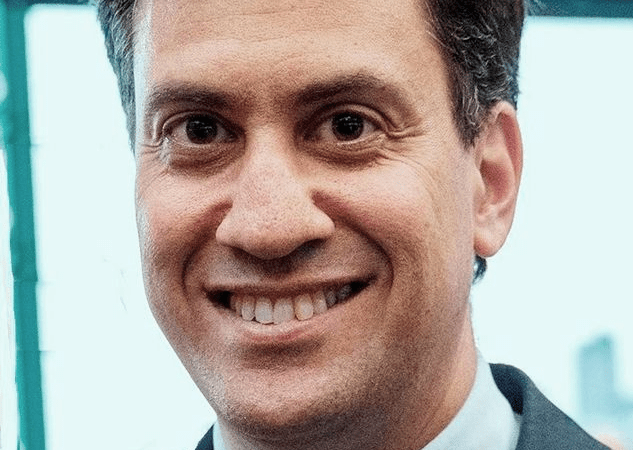
Main image: Source: Ed Miliband 2 June 2015.jpgflickr.com Financial Times, licensed under the Creative Commons Attribution 2.0 Generic license.
 Labour Hub
