
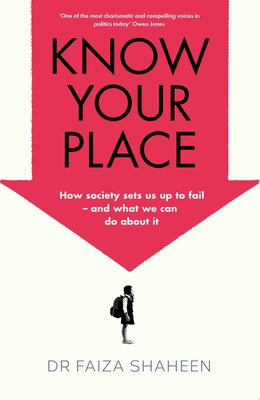
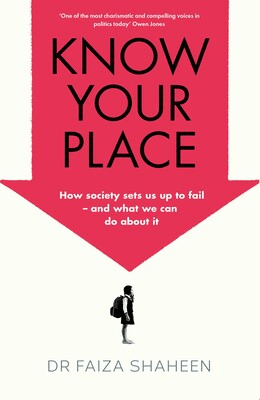
Mike Phipps reviews Know Your Place, by Faiza Shaheen, published by Simon & Schuster
In 2019 Faiza Shaheen stood for Labour – and narrowly lost – in her home seat of Chingford and Woodford Green in “the streets where my dad had punched racist skinheads to protect my pregnant mother.” She’s been selected by the Party to run there again at the next general election, one of the few candidates on the left to make it past Labour’s factional officials.
Shaheen went to Oxford University and is today a leading statistician with a jaw-droppingly impressive CV. She calculates that there was a 0.3% chance of someone from her background making it to Oxford. Her exploration of social mobility finds medicine and law dominated by people from private schools, which is not unexpected, but I was surprised to read that Britain’s top actors were also six times more likely to have come from that background.
As analysed before on Labour Hub, no government in recent years has really addressed social inequality. New Labour did make some attempt to alleviate poverty while still allowing the rich to get richer, but consequently there was no fundamental change in the imbalance. From a global perspective, more than two-thirds of what an individual will earn is determined by one factor: country of birth. How much ‘effort’ that individual makes is very low down the list. And wealth is even more unevenly distributed than income.
Global inequality is not natural, but designed. The Tax Justice Network calculates that £321 billion is lost to tax avoidance every year. Britain’s HMRC estimates that £570 billion of UK residents’ wealth is in tax havens. And of course it is the governments of rich countries that set the rules to allow such theft to occur, the same governments that are responsible for most emissions and most arms exports and which monopolised most of the vaccines during the Covid pandemic.
Shaheen’s complaint is not just about the injustice of inequality, but the lost opportunities: “we are missing out on a lot of talent across society and it is robbing us all.” The answer must include the wealthier paying more tax – and higher pay for the rest of us.
Part memoir about her family and upbringing and part polemic, this is a light and readable primer on inequality, a subject Shaheen know about from both personal experience and detailed study. She discusses class and in particular how ‘working class’ has gone from being a term to foster solidarity to a caricature of male, white Brexit voters, even though a higher proportion of the home-owning middle class actually voted to leave the EU.
She also looks at race: it’s still the case that minority ethnic applicants in the UK have to send 60% more applications to get a job than their white counterparts. Shaheen explores a wealth of evidence from education to the criminal justice system about how ethnic background contributes to limiting one’s opportunities in society.
If education id supposed to help overcome these structural inequalities, it is worth underlining that since 2010 schools and colleges have suffered the worst fall in income since the 1970s, with spending on classroom-based adult education and apprenticeships down one-third since 2009-10. The pandemic widened the education gap, with disadvantaged pupils less able to access remote learning.
Meanwhile teachers in England are among the most monitored and least consulted in terms of curriculum and assessment of any rich country. Their real-terms pay has fallen 17% in a decade and the profession is gripped by an ongoing recruitment and retention crisis. Furthermore, the academisation process prioritises corporate profits amid falling school budgets, rising class sizes and fewer qualified staff.
No exploration of inequality would be complete without examining the dramatic decline in the share of national income now going to wage-earners. Over half of those who live in poverty are in a household where at least one person has a job; and 41% of people on universal credit are actually in work. Yet, unlike top City bankers who are estimated to destroy £7 of social value for every pound of value they generate, low paid workers such as hospital cleaners or childcare workers can generate £7of benefit to society for every pound they are paid.
Shaheen’s conclusion is simple. Behind the façade of ‘social mobility’ is a toxic rat race, rigged by structural inequalities rooted in vastly unequal pay ratios, unaffordable housing and a concentration of ownership.
The author has some practical solutions: a maximum wage; limits on the ability of non-UK residents to buy property here; universal free child care (the average day nursery costs £137 for a 25 hour week, £189 in London); largescale investment in the green economy; public and shared ownership of assets to redistribute wealth; a solidarity tax on excessive wealth, to name a few.
Of course, many of these ideas are out of sync with the timid ‘realism’ being propagated by the current Labour leadership. But there’s also something else in this book which the leadership is short of, but which is vital to mobilising public opinion and winning elections: a sense of hope. This may explain why Faiza Shaheen generates so much more enthusiasm among her growing numbers of supporters than anyone on Labour’s front bench.
Mike Phipps’ book Don’t Stop Thinking About Tomorrow: The Labour Party after Jeremy Corbyn (OR Books, 2022) can be ordered here.
 Labour Hub