
By Tim May
On the eve of Guatemala’s elections, few predicted that the elite’s grip on power was at risk. It was seen as an inevitability that two business as usual candidates would make it to the presidential runoff, allowing the continued erosion of Guatemala’s democratic norms to continue unhindered.
That’s why it came as a shock on June 25th when Bernardo Arévalo – the centre-left candidate for Movimiento Semilla (Seed Movement) secured second place with 12 percent of the vote. He came in just behind the conservative front runner Sandra Torres, whose party the National Unity of Hope (UNE) gained 15 percent of the vote. Fearing that Arévalo could win the presidency in August’s runoff, the elites are doing everything within their power to interfere with the democratic process and prevent this from happening.
Historically the elite’s hegemony has faced few significant threats, and each time these have been successfully fended off. Guatemala experienced its first taste of democracy in 1944, when a revolution brought the socialist Juan José Arévalo to power in the country’s first free elections. The democratic transition was continued by Arévalo’s successor, Jacobo Árbenz. Both men pursued a socialist agenda of land reform favourable to the poor and Indigenous population, circumstances which the elite would not tolerate. With assistance from the US, a coup was orchestrated in 1954, bringing Guatemala’s so-called ‘ten years of Spring’ to an end.
The string of right-wing military dictators which followed reversed the progressive reforms of the revolution. They also terrorised the country’s Indigenous population during the 36-year long armed conflict, which left 200,000 victims.
The signing of the Peace Accords in 1996 did little to affect Guatemala’s entrenched racial hierarchy. Meaningful redistributive policies did not come to pass, largely due to the efforts of the powerful business coalition CACIF (the Coordinating Committee of Agriculture, Commercial, Industrial, and Financial Associations). CACIF forms one of the most visible instruments of the elite’s control. Its close alignment with politicians, the military, drug cartels, and public authorities maintains a system known as ‘the Pact of the Corrupt’.
In recent years, the greatest challenge to the Pact of the Corrupt were the actions of CICIG (the International Commission Against Impunity in Guatemala). Founded in 2006, this UN-backed anti-corruption task force was highly effective in uncovering and dismantling criminal structures at the highest levels of government.
CICIG’s most high-profile case was the uncovering of the customs corruption scheme known as ‘La Linea’ (The Line) in 2015. The scandal implicated 22 government officials, including then President Otto Peréz Molina and Vice-President Roxana Baldetti. When these allegations came to light, huge anti-corruption protests led to the government’s downfall and Molina and Baldetti’s eventual imprisonment.
At this point, Guatemala’s future looked bright, with the potential for real change on the horizon. Unfortunately it was not to be. Jimmy Morales, the new populist presidential candidate proved to be under the thumb of the Pact of the Corrupt. Despite his election slogan being “Neither corrupt nor a thief”, in 2018 CICIG found evidence of illegal campaign financing. In response to this investigation, Morales deployed tanks around CICIG’s office and terminated their mandate. Since then, the situation has gone from bad to worse.
Alejandro Giammattei succeeded Morales in 2020, and he continued his predecessor’s assault on the rule of law. During his term, the Pact of the Corrupt has co-opted Guatemala’s public institutions – the Public Ministry, Supreme Court, and Constitutional Court – and is using them to repress journalists, civil society leaders, and independent judges. Dozens of judges have fled the country to evade prosecution, and their persecution is being overseen by the attorney general, María Conseulo Porras.
Porras has been blacklisted by the US government for having “repeatedly obstructed and undermined anti-corruption investigations to protect her political allies and gain undue political favor”. In 2021, she targeted Juan Francisco Sandoval, the country’s top anti-corruption prosecutor. As head of FECI (Special Prosecutor’s Office Against Impunity), the country’s anti-corruption task force, Sandoval was leading investigations into corruption surrounding the government’s procurement of COVID-19 vaccines. After being dismissed from his post, he fled the country for fears for his life.
His dismissal triggered massive protests across the country calling for Porras and Gimmattei’s resignation. In May of this year, ElPeriodico – a major investigative news outlet which frequently reported on government corruption was shut down after its founder was convicted for what many consider to be trumped up charges of money laundering.

The Pact of the Corrupt’s hold over María Consuelo Porras – photo credit MP
In the run up to this year’s elections every square inch of roadside in Guatemala City was crammed with campaign signs. Even alongside mud roads in remote areas of the country, they were plastered over trees and rotting electricity poles.
Few of the candidates pictured resemble the country’s majority Indigenous electorate. Rather, it is the same white faces, fake smiles and empty slogans of change repeated over and over. The majority of the crowded field of 22 presidential candidates represent a continuation of the status quo. Amongst the most frequently recurring faces are those of Sandra Torres – the former first lady accused of corruption, and Zury Ríos, daughter of the late genocidal dictator Efraín Ríos Montt.

A roadside in Guatemala City – photo credit Tim May
One of the few political parties genuinely independent of the Pact of the Corrupt is the MLP (Movement for the People’s Liberation), founded in 2018 by CODECA – a grassroots peasant organisation committed to establishing a plurinational state and addressing Guatemala’s structural problems. Their presidential candidate, the Maya Mam leader Thelma Cabrera, was disqualified from the race by the Constitutional Court earlier this year on a bureaucratic technicality widely understood to be politically motivated. In the previous Presidential elections in 2019, Cabrera terrified the establishment when she came in fourth place with over 10 percent of the vote, despite a racist media campaign directed against her. Evidently, the Pact of the Corrupt feared Cabrera’s potential and sought to nip it in the bud.
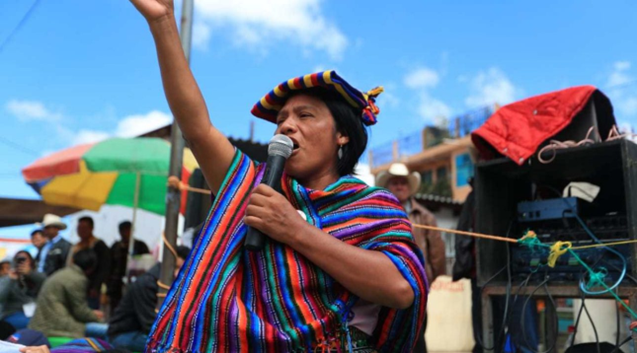
Thelma Cabrera – photo credit Mujeres Bacanas
Given the disqualification of Cabrera and other Presidential frontrunners, the electorate had an even greater cause to be pessimistic than usual. Their dissatisfaction could be seen in the vandalised campaign signage of corrupt candidates. It was also expressed at the ballot box, where protest votes were at an all-time high, with almost a quarter of them intentionally spoiled or left blank. Yet, their exasperation was also channelled towards Bernando Arévalo, the candidate of the Seed Movement, one of the few parties to have consistently stood up against corruption and Guatemala’s authoritarian backsliding.

A vandalised Sandra Torres sign – photo credit Johannes Weitnauer
Weeks before the election, Arévalo was polling at less than 3 percent of the vote, making his eventual result of 12 percent all the more surprising. Although voter turnout was low (60 percent), it was still up 7 percent from the 2019 elections.
Clearly the electorate saw in Arévalo the possibility of a different Guatemala. After all, he is the son of former President Juan José Arévalo, who had given the country its first taste of democracy in 1944.
The Pact of the Corrupt, however, had a different idea. Arévalo’s success provoked complaints from ten political parties, including Sandra Torres’s party the UNE. They argued of “inconsistencies, alterations and other discrepancies” in the results of the Supreme Electoral Tribunal, despite the election results having been backed by the European Union, which monitored the process.
The Constitutional Court responded to the complaints by suspending the electoral results, ordering the Supreme Electoral Tribunal to review tally sheets. In the space of just a few short years, the same public institution which had formerly safeguarded the rule of law was now actively eroding it, fulfilling the Pact of the Corrupt’s weaponisation of the justice system.
It has been a tense few weeks since election day. Sensing a possible coup, the citizenry has taken to the streets and social media to voice their discontent, and has been gearing up for much larger protests in the case of electoral theft. On July 10th, the Supreme Court of Justice announced its rejection of requests for a vote recount, giving the green light to the Supreme Electoral Tribunal to certify the results. This should have allowed Guatemalans to breathe a sigh of relief, but the Pact of the Corrupt had more tricks up its sleeve.
After further delays, certification of the election results was finally declared by the Supreme Electoral Tribunal at a news conference on July 12th. However, just minutes beforehand, Rafael Curruchiche, special prosecutor against impunity, announced the suspension of Seed Movement’s legal status. He cited irregularities in the collection of signatures at the time of the party’s establishment, a claim supported by the Attorney General’s Office.
These contradictory actions of FECI and the Public Ministry against the Supreme Electoral Tribunal are unprecedented. Arévalo now faces an uphill struggle to make it to the runoff, even though, as he has publicly contested, Guatemalan law prohibits the suspension of political parties during the electoral process. As the country enters uncharted waters, the only historic certainty is the extreme lengths the elites are willing to go to in order to guarantee their impunity.
Tim May works as a curator and researcher for Museo Na Bolom in San Cristóbal de las Casas, México.
Main image: Seed germinating. Author: Vinayaraj, licensed under the Creative Commons Attribution-Share Alike 3.0 Unported license.
 Labour Hub