

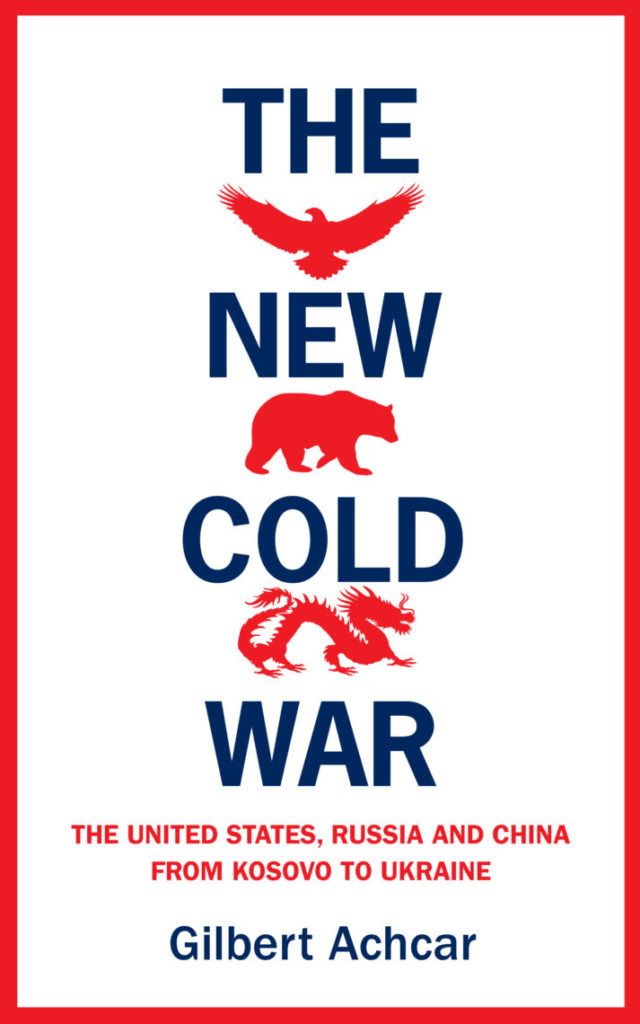
Mike Phipps reviews The New Cold War: The United States, Russia and China from Kosovo to Ukraine, by Gilbert Achcar, published by Saqi.
This thoughtful book by Marxist scholar Gilbert Achcar was written over a long period of time and covers a great deal of ground – this review won’t even attempt to deal with China. The most recent material, in the second half of The New Cold War, raises some interesting questions of great relevance to contemporary events.
First, how preventable was the rise of Vladimir Putin? “The Weimar paradigm irresistibly forced itself upon observers of the post-Soviet collapse of Russia,” suggests Achcar. “Weimar Germany’s degradation and the rise of Hitler were a direct result of the vindictive economic and military conditions imposed on the German side by the First World War victors.”
Indeed, John Maynard Keynes, who attended the negotiations that led to the Versailles Treaty, warned that the conditions demanded by the Allied Powers would “sow the decay of the whole civilised life of Europe.”
The Weimar analogy – the idea that a humiliating economic settlement could produce an extreme authoritarian and nationalist backlash – weighed heavily on the minds of some US policymakers immediately following the collapse of the Soviet Union. But it was sidelined by the US’s narrow promotion of economic shock therapy for Russia and its determination to extend its military hegemony, argues Achcar.
The IMF-blessed economic reforms plundered the former USSR, wrecking the economy and impoverishing the mass of people. When the Russian parliament became a centre of opposition to the policy, the then President Boris Yeltsin dissolved it and ordered the military to shell the building in 1993. The West backed Yeltsin’s suppression of democratic institutions, because it liked, indeed had imposed, the economic policy he was pursuing. This paved the way for the emergence of Putin’s authoritarian right wing nationalism.
There’s no doubt that the economic policies imposed on Russia by the West contributed significantly to this process. It’s less evident, in my view, that US-led military policies played the same role, not least because they did not impact on the life of ordinary people in Russia in anything like the same way as the economic destruction.
Which is not to say that critical opportunities weren’t missed in this area. Early on, Putin suggested that Russia might even join NATO and asserted, just days after 9/11, that “Europe will reinforce its reputation of a strong and truly independent centre of world politics soundly and for a long time if it succeeds in bringing together its own potential and that of Russia, including its human, territorial and natural resources and its economic, cultural and defence potential.”
Achcar sees this as an “olive branch” offered to the West, which is certainly one interpretation. But it also suggests that Putin understood that the West was about to expand its military operations and Russia could benefit from being in alignment with this, for its own purposes, for example in its repression of the Chechens, as the author acknowledges.
The problem remained that Russia’s relations to its neighbours remained essentially imperialist and predatory. The various ‘colour revolutions’ – in Georgia, Ukraine and elsewhere – that sought to break free from this arrangement are invariably denounced by sections of the Putin-supporting left as Western-orchestrated, designed to encircle Russia militarily, a flawed analysis that denies any agency to the principal actors in these processes.
Equally, from the standpoint of the opportunities available to self-interested Western capitalism, any military or diplomatic arrangement with Russia which left the latter’s hegemony over these states intact would be less than satisfactory, especially given the exploitable, mineral-rich nature of some of them. If opportunities for a grand US-Russia rapprochement were missed, it was not accidental.
For socialists, the central starting point is the human and social rights of the peoples in the states involved, which could not be sacrificed to great power bloc considerations, even when there remained arguably progressive aspects to the Soviet Union, let alone when an authoritarian, nationalist, Orthodox-oriented and neoliberal Russia was attempting to re-impose a neo-colonial framework on its former satellites. In this context, whether Russia was rationally motivated by fears of NATO encirclement when it attacked Georgia, Crimea and now Ukraine, may help explain Moscow’s thinking, but it justifies nothing.
Achcar’s book takes us through the ups and downs of the emergent new Cold War, including moments of genuine détente, such as the first two years of Barack Obama’s presidency. That was short-lived. “What changed everything were events in Russia itself ”, notes one analyst. “In 2011–2013, large-scale pro-democracy demonstrations took place in Moscow and other cities… that convinced President Putin he faced a real threat from democracy washing over from a successful, democratic Ukraine.”
His demonization of Ukraine’s democratisation as “Nazi” and his repudiation of the 1994 Budapest Memorandum, under which Russia had given a formal assurance against any use of military or economic coercion against Ukraine in exchange for its decision to give up its nuclear weaponry, paved the way for 2022’s invasion.
There was arguably a ruthless shrewdness to many of Putin’s earlier foreign policy decisions, for example his military assistance to Syria. But in Achcar’s view, “Putin’s decision to invade Ukraine on 24 February 2022 has spectacularly backfired.” It reinvigorated NATO – described by French president Emmanuel Macron as “brain dead” in November 2019 – set back Russia’s economy many years and diminished its credibility, all for no significant military gains, with Ukrainians more determined than ever to pursue an independent path. Arguably, this policy disaster hastens Putin’s demise – but it also makes him more dangerous and unpredictable.
All of which has real consequences – for Ukrainians especially. It’s estimated that Russia has struck civilian sites in the country over 30,000 times since the war began – 75 times a day on average. Russia’s abduction of children and the torture and killing of prisoners are routine. And Russia’s recent ending of an arrangement to permit the safe Black Sea export of Ukrainian grain “potentially threatens hunger and worse for millions of people,” according to the United Nations.
Russia’s invasion of Ukraine is a crime. But this does not exonerate the United States’ broader international policy, which, Achcar concludes, “continues to push, global relations in the worst possible direction, at a time when the world should be focused on fighting the greatest threats that humanity has ever faced short of a nuclear Armageddon—climate change and pandemics—as well as the socioeconomic consequences of global economic crises related to these same threats.”
The alternative, he argues, is a return to a rules-based order, founded on the United Nations Charter, “a major civilizational gain.” For relations between states, that is certainly a good starting point. For the destruction of militarist empires – on both sides of the globe – we will have to look to the struggles of people themselves.
Mike Phipps’ book Don’t Stop Thinking About Tomorrow: The Labour Party after Jeremy Corbyn (OR Books, 2022) can be ordered here.
 Labour Hub