
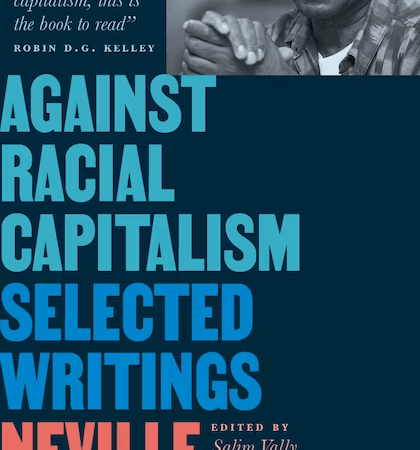
Mike Phipps reviews Against Racial Capitalism: Selected Writings, by Neville Alexander, edited by Salim Vally and Enver Motala, published by Pluto.
Steve Biko, the founder of the Black Consciousness Movement, who was beaten to death by South African state security officers in 1977, is said to have described a revolution as the mosaic of small acts. But we could also add that a genuine revolution, to be ongoing and successful, must be based on the political and theoretical contributions of a wider range of activists, intellectuals and participants than is often admitted.
The contributions of Neville Alexander, who died over a decade ago, are unlikely to be forgotten in South Africa. This new collection of his writings will hopefully help in more widely disseminating his ideas, which remain especially relevant in these troubled times.
The authors, in their Introduction, pay tribute to Alexander’s “attentiveness to others, his self-effacing sacrifice, and tireless commitment to a radical humanism which made him such an outstanding revolutionary scholar.”
Neville Alexander had these qualities in abundance. But in my experience, he was also a man of great magnetism and energy. A short discussion with him would leave you feeling enthused and reinvigorated. This is far from being a widespread quality on the socialist left.
Alexander wrote about racial capitalism, national identity and the importance of education in creating the new post-apartheid South Africa. He did so with a clarity that cut through existing theoretical constructs, as here:
“It is simply a fallacy to claim that Black workers are faced with two autonomous but intersecting systems of domination, viz. a system of ‘racial domination’ and a system of ‘class domination’. However valid it might be for specific analytical purposes to distinguish between the ‘racial’ and the ‘class’ elements that constitute the system of racial capitalism, it is impossible to transfer such a dichotomy on to the social reality in political and ideological practice, except in terms of, or for the purposes of, ruling class mystification of that reality.”
Alexander believed that “the eradication of racial thinking is identified as the next historic task facing the new South Africa.” The goal was to construct a national consciousness – not as an end in itself, but as part of a continuous project of forging a wider human understanding. So opposition to racist ideas is simultaneously about the quest for national unity, especially in the context of the divisive and racist practices of the apartheid regime.
Education would be central to this, Alexander argued, as it would shape the character of the historical community we want to build. One aspect of this was tackling the colonial-apartheid heritage of education ghettos – physical and ‘mental’ – which meant physically relocating institutions of learning into new special educational zones. This is radical thinking, but central to the new social cohesion and national unity which he believed had to replace apartheid-era racial divisions.
In 1992, Alexander founded the Project for the Study of Alternative Education in South Africa. In 1995, he led a task group to develop a national language plan. Among its goals were that all South Africans should have access to all spheres of society through the development and maintenance of a level of spoken and written language appropriate for a range of contexts in all official languages – a major issue given the large number of languages spoken and the hegemony of English in the public sphere.
He also founded the Workers’ Organisation for Socialist Action (WOSA) which was created to promote Black working class interests and leadership, organised around the principles of anti-imperialism and anti-racism.
Alexander spent ten years spent in prison on Robben Island alongside Nelson Mandela. He experienced considerable brutality there at the hands of the prison guards, including an instance when a beating by warders pierced his eardrum. In this selection, however, he writes about the frequent brutal mass assaults on all political prisoners, “which was a weekly, often a daily, occurrence… It is no exaggeration to say that a man’s life was totally and constantly at the mercy of the whims of crazed White males.”
Elsewhere he has written that his time in jail was also an “ennobling and enriching experience”, where most prisoners became “much better people”. Prison was an example of true democracy, where he learned to disagree with people while still respecting them and where the realisation that they all needed each other in a way formed the basis of a new nation. A strong sense of civic responsibility grew between prisoners and it was necessary for them all “to learn to say, ‘I am sorry’ or to say, ‘I was wrong’ without feeling humiliated.”
These years in prison reinforced a strong antipathy towards sectarianism and a keenness to look for the positives in other activists’ thinking. He was especially impressed by the work of the Black Consciousness Movement and wrote that after leaving prison, “It soon became obvious to me and my comrades that the activists of the BCM were the main group of political people among the oppressed who were trying, overtly and covertly, to organise them, mainly at the point of reproduction.”
In a speech here commemorating the murder of Steve Biko, Alexander paid tribute to the BCM: “they taught us that the struggle for liberation has to encompass all dimensions of society and of the individual.”
He emphasised the BCM’s work in developing the
“socio-political counterpart of the struggle against the slave mentality and for the decolonisation of the mind. Education for liberation meant that the young university and high school students had to roll up their sleeves, get down on their knees and help to promote that sense of self-reliance that is the beginning of all liberation and of all liberated zones. Today, as we commemorate the death of one of the most charismatic individuals of our struggle against colonialism, apartheid, and capitalism, it is essential that we recall these valiant efforts of the BCM to return not merely to the African source of ubuntu [human virtues] as a means of undermining the rampant individualism and destructive competition that are inherent in the capitalist system but more generally to all the springs of a true humanity.”
As time wore on, Alexander was withering about the lack of progress following the transition to majority rule in South Africa. “If anything, the post-apartheid state is more capitalist than its apartheid parent,” he noted in 2010. “The bourgeoisie, the self-same capitalist class of yesterday, is in command of all the strategic positions, no matter what the ‘democratic’ posturing of the politicians might be.”
Alexander’s fear was that, as the African National Congress-led government and its affiliates adopted an increasingly reformist stance and consumerism and individualism became ever more pervasive, the very idea of socialism would disappear entirely from public consciousness. Against this, “we have to find the ideological and organisational means to build the counter-society that insulates the oppressed and exploited from the undermining and disempowering values and practices of bourgeois society.”
In 2013, he went further:
“Only an inveterate denialist or a fool will maintain that the new South Africa as a political and social entity is not facing one of its deepest crises… Our real concerns are the palpable signs of social breakdown all around us: the ever more blatant examples of greed and corruption involving public figures, who are expected to be the role models for our youth; the unspeakable abuse of children, of the aged, and of women; the smug dishonesty, indiscipline, slothfulness of those who are paid to render public services; the lack of respect for life-preserving rules, such as those of the road; the unthinkable violence in so many communities, unknown even in conditions of conventional warfare; the boundary-crossing abuse of all manner of drugs in all layers of society; the massive number of deaths caused by AIDS, the trashing of the public health system; in short, the general mayhem and apparently suicidal chaos that ordinary people experience in their daily lives. These things are our everyday reality. Against this bleak picture, the signs of real progress pale into insignificance.”
Again, Alexander’s focus was on the unreconstructed post-apartheid state and its embrace of capitalism which had caused a widening of the gap between the elites and the masses and an exacerbation of apartheid-era racial divisions.
There is much more to engage with here. But Neville Alexander’s most apocalyptic warning is not in the pages of this book, despite its relevance to his work. “Things can fall apart very quickly. Our entire socio-historical fabric can unravel within a few weeks: it took less than a hundred days in Rwanda!” he wrote in “Afrophobia and the racial habitus” in Thoughts on the New South Africa (Jacana, 2013).
Alexander’s search for unity was given a new impetus in this warning against the spectre of racist, caste-based and religion-inspired genocide. His belief that the failure to resolve the national question and address class inequality, racism and patriarchy could contribute to destructive inter-ethnic violence and gender-based violence has sadly been borne out in parts of South Africa of late.
As Enver Motala, co-editor of this book, pointed out recently: “Unless the material conditions of life for all are radically transformed, building a cohesive nation will remain impossible. The situation is exacerbated by the failure of the ANC-led state to intervene in and resolve its internal leadership struggles compounded by elitist attitudes and aspirations to glamorous lifestyles amid the devastation of growing shack settlements, townships and former homelands, while the blight of corruption, fraud and outright theft continues to spread.”
It’s critical that the contributions of Neville Alexander and other South African revolutionaries be kept in the public consciousness. Earlier this year, Peter Jones, who was arrested alongside Steve Biko in 1977 and was the last comrade to see him alive, died. Jones too was brutally interrogated by apartheid regime police, but survived. Later he met with CLR James in London and other activists in the final decade of apartheid.
One recent tribute described Jones as a “a fearless revolutionary” who “mobilised communities across the length and breadth of South Africa, preaching the Black Consciousness message of self-reliance, pride and self-affirmation.” Jones was an activist with the Azanian People’s Organisation (AZAPO) an organisation of 60,000 members at its height.
It’s nearly thirty years now since the death Haroon Patel, another member of AZAPO and WOSA, founded by Neville Alexander. In the late 1980s he went on a speaking tour of UK colleges – facing considerable opposition from the official student leadership of the time, which was aligned to the African National Congress and opposed to AZAPO’s more militant stance.
The work of these comrades must continue to be honoured and celebrated. As the late Milan Kundera famously said, “The struggle of people against power is the struggle of memory against forgetting.”

Mike Phipps’ book Don’t Stop Thinking About Tomorrow: The Labour Party after Jeremy Corbyn (OR Books, 2022) can be ordered here.
 Labour Hub