
The left does not approach this notion in the right way, and because of this unnecessarily concedes too much to the right, argues Peter Rowlands.
The left rightly rejects the notion of patriotism that the right promotes, which is relatively uncritical of society as it exists, supports the institutions of monarchy and aristocracy and sees British history, particularly that of the Empire, as something to be proud of.
But the left largely fails to challenge this notion of patriotism, which it can and should do, by promoting an alternative version based on the widest degree of support for the interests of all members of the state, the real ‘public interest’.
A rigid class analysis is hardly necessary to establish that there was little attempt to address the concerns of the majority of ordinary people, at least before the late 19th century, before which most of them were denied the vote.
Various reforms did benefit some of the ordinary people, such as some of the Factory Acts, but most were aimed at protecting or improving the interests of the middle and upper classes. Examples would be education, as an industrial society needs people who can read and calculate, police, to protect private property and public health, as disease knows no boundaries.
But radical support for the Liberals helped to push them towards further measures, extending the franchise to most men in 1884 and increasing women’s rights, although not to vote. It was increasingly recognised by the Liberals that the state should provide for the welfare of ordinary people to some degree, and this was the basis of the policies of the first great reforming government, the Liberal government of 1905 –1916, supported by the new Labour Party,which introduced old age pensions, sickness and unemployment insurance, protection for trade union funds and a ‘people’s’ budget which saw tax increases for the well off and landowners.
In 1918, under the Lloyd George coalition, all men were given the vote at 21 and women at 30. In 1928 the Conservatives extended the vote to women at 21,their only major extension of the franchise, and done so because they thought, probably correctly at the time, that women were more likely to vote Conservative than men.
The 1920s and 1930s were mainly dominated by the Conservatives, so it was not until 1945 that the most important reforming government of all was elected, that of Labour of 1945 –1951.This established a comprehensive welfare state, based on free provision of health, education and welfare services, state control or ownership of .the major utilities, local authority housing, and policies based on full employment and a significant role for the trade unions.
Tory governments of the 1950s and 1970s didn’t try and reverse these policies, although they barely added to them. The Wilson/Callaghan governments of the 1960s and 1970s extended them, albeit constrained by economic problems.
The big change came in 1979, with the advent of the Thatcher and subsequent Tory governments, committed to the free market and opposed to the policies Labour developed in the 1940s, although it has never managed to eliminate them. The only respite was the Blair/Brown governments of 1997– 2010, which made progress on health and education, and on child and pensioner poverty, although it failed to reassert the basic social democracy of the Attlee and Wilson governments, and by supporting the invasion of Iraq arguably aligned itself with traditional patriotism which in its support for imperialism the left strongly, and rightly, opposed.
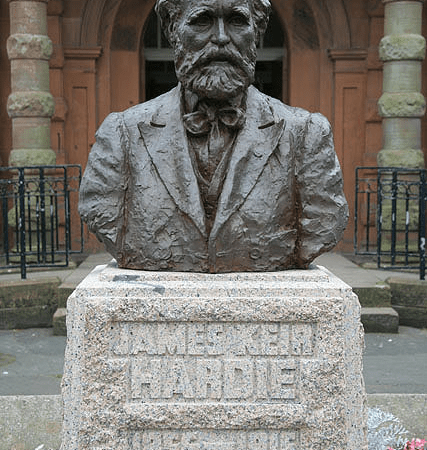
So who are our great patriots? Rather than Nelson and Wellington, they should surely b all those who fought for a better society, from the Peasants’ Revolt through the Levellers and Chartists, the trade unionists and socialists of the 19th century, and all that have supported the struggles of the left since then. It is in the 20th century and since that leaders of the left include such names as Keir Hardie, Stafford Cripps, Aneurin Bevan, Tony Benn and Jeremy Corbyn, and among prime ministers Harold Wilson, and above all perhaps Clement Attlee, Labour’s leader for 20 years who presided over the great advances made in the late 1940s, which are under so much threat today. ( I have not included Labour’s other PMs – MacDonald, Callaghan, Blair or Brown as while they all made contributions, they all compromised with the right to a degree that makes it difficult to class them as left patriots.)
If patriotism, as we argue, is nothing but support for the interests of the majority, then the left should recognise that. So those in the health service that we clapped for in the pandemic were not just worthy of praise, they were patriots, as opposed to those who unjustifiably benefited from the unregulated sale of medical equipment, unpatriotic acts about which there should have been far more opposition and exposure. Beyond that it is surely right to categorise any economic relationship based on unreasonable profit, that is exploitation, in employment, renting or lending, as unpatriotic, as it is against the majority interest.
If the left was prepared to look at patriotism in the way I have suggested then that could be advantageous, while helping to expose the false picture presented by the right. There is much to be gained here.
Peter Rowlands is a member of Swansea West CLP.
Image: The James Keir Hardie Bust. Source: From geograph.org.uk. Author: Walter Baxter, licensed under the Creative Commons Attribution-Share Alike 2.0 Generic license.
 Labour Hub