
By Saleh Mamon
Sudan’s internecine war which began on 15th April has passed the milestone of well over 100 days. Intense fighting across the country is causing immense destruction to life and property, displacing millions and disrupting the food supply and transport.
So far, at least 3,000 people are dead and over 6,000 more injured. But these are gross underestimates since bodies have been left to rot on the streets of the capital, in towns and in the countryside, and government services for the registration of deaths, the collection of bodies and burials have been abandoned.
For the injured, the prospects of medical treatment have receded since two-thirds of the health facilities in Khartoum, Omdurman and other combat zones have been damaged. The shortage of medical supplies and trained medical staff and their limited ability to travel to their place of work makes health care vulnerable and precarious.
An estimated over two million people have been internally displaced and 700,000 people have fled to neighbouring countries, mainly to Chad and also South Sudan and Egypt. In this vast country, fleeing to the border without adequate transport facilities has been full of peril, especially for women and children. Non-Sudanese have left for Saudi Arabia from Port Sudan with better management for their travel facilitated by money.
All this is the result of the intensified urban warfare by both the parties. The Rapid Support Forces (RSF) pre-emptively moved to take over the built-up areas of Khartoum and Omdurman, occupying residential, business and public buildings. Residents reported that the RSF were using people as human shields. The Sudanese Armed Forces (SAF) which has a monopoly of the air force resorted to bombing the RSF in residential areas. Hence there is a significant damage to residential properties.
While attention is focused on the centre, the destruction and violence in the South Western Darfur region, which has a quarter of the population, is horrifying. Town after town has been burnt to the ground, forcing tens of thousands to flee for their life. There has been deliberate and repeated attacks, mostly by the RSF and Arab militia on the ethnic Masalit population. Non-Arab intelligentsia, lawyers, doctor, journalists, human rights monitors and local leaders are targeted for killings. Both Human Rights Watch and Amnesty have called for an investigation by the International Criminal Court.
Within two months of the fierce fighting, Sudanese economists estimated the losses equivalent at $4 bn covering the cost of destroyed properties, income and job losses. Nearly 80 percent of the Omdurman market was wiped out and an entire industrial area in North Khartoum (Khartoum Bahri) which employed 100,000 people was destroyed. Within three months, the losses were running at $100 million per day cumulating to $9 billion.
On top of this the values of property and goods plundered has been estimated at $40bn. The ongoing fighting damaged and destroyed much infrastructure including especially the supply of drinking water, the power supply and many health and educational facilities. All sectors of the economy – exports, imports, investments, production and distribution – are severely affected.
Sudanese economists have issued a stark warning about the nation’s banking system, which they say is facing a “severe decline and may collapse entirely” as a result of looting, vandalism and the destruction of banks. The current banking crisis is further exacerbated by the fact that millions of workers in the public and private sectors have been without their salaries and wages since the war began in mid-April. Several institutions and companies have suspended operations and laid off employees.
The historical centralisation and concentration of the banking system in Khartoum have hindered banking operations and accessibility of funds in other cities and towns. Amid failing customer needs and waning confidence caused by looting and vandalism, economists anticipate that some banks may consider leaving the business even after the war ends.
Sudan’s soaring prices of goods and services and the fact that manufacturing has become limited and insufficient also contribute to the problems. In urban centres, many food markets and shopping centres have been destroyed. There is no doubt that food production at the farm level is affected. Food supply chains have been disrupted.
Civilians trapped in urban areas by the RSF and the SAF cannot travel to shop for food and their daily needs because of the danger of being hit by bullets or artillery shells. Daily life to get the basic necessities for survival are curtailed.
This collapse in the system is posing severe challenges to humanitarian organisations active in Sudan where the humanitarian situation has been at its worse since 2021 with nearly 16 million people, a third of the population, requiring food relief to survive. Sudan already has one of the highest rates of malnutrition among children in the world and now critical life-saving care for an estimated 50,000 severely acutely malnourished children has been disrupted.
The humanitarian needs now have accelerated with over 25 million – over half the population – in need of assistance. And worse yet, half of those are children, many of whom were in dire need even before this war broke out.
In June, a UN appeal for $2.57 billion for humanitarian support within Sudan this year was about 17% funded, and an appeal for nearly $500 million for refugees fleeing from Sudan was just 15% funded, a situation UN refugee agency chief Filippo Grandi called “deeply distressing”.
Soon after, a fundraising conference in Geneva hosted by Germany, Saudi Arabia, Qatar, Egypt and the United Nations received close to $1.5 billion in pledges to support relief, though it was not immediately clear if all the money was new or when it would be disbursed.
Generous as these pledges may seem, they total only half of what the UN estimates is required to address humanitarian needs in the country and its neighbours. In the face of the sheer scale of the humanitarian catastrophe that is unfolding, it is too little.
International aid to Sudan for this humanitarian tragedy is lagging behind, with donors showing little sense of urgency. In comparison, Ukraine got 13% more humanitarian aid than Sudan but 93 times more total aid when you count war assistance.
Before the current conflict, 174 national NGOs, international NGOs, and UN agencies had operations in Sudan, according to data compiled last December by the UN’s emergency aid coordination body, OCHA. As of late July, three months into the conflict, that number had dropped to 85.
Sudan’s conflict has had a devastating impact on local aid workers, even as they take the lead in reaching millions of people in need of assistance. Many have been forced to flee their homes or can’t collect salaries due to a shattered banking system. Now, some are losing their jobs as organisations suspend programmes in areas where they say they can no longer operate safely.
Barakat Faris Badri, operations director for the Sudanese Red Crescent Society, which describes itself as the largest humanitarian responder in the country, said his 100-strong team in Khartoum has been reduced to around half a dozen workers in Port Sudan: “People in Darfur and Khartoum, where the war is ongoing, in the midst of the shooting and the crisis, lost their livelihood source.”
The Norwegian Refugee Council also said staff who were suspended in April and laid off would receive the “equivalent of six months’ salary since the onset of the crisis and office suspensions,” which is the statutory compensation an employer must may on termination of contract in a Sudanese labour court.
In my article just after the conflict started, I explained the roots of the conflict as it emerged after the December 2018 revolution that brought down the al-Bashir regime. Both Burhan and Hemedti in the face of public protests gave way to a transitional government leading the civilian elections. However their real intentions was to restore the military regime which they eventually did.
The economic crisis and the pressure from their regional allies, the US and the African Union, forced their hand to come to a framework which would have led to a democratic government. But the two generals were at loggerheads about the integration of the RSF militia in the SAF command. They saw in each other an existential threat to their political and economic power and decided to fight for the supremacy to control the Sudanese state, its army and economy with no holds barred.
On 6th May, the US and Saudi Arabia commenced jointly mediated talks with the parties in the conflict in the city of Jeddah to achieve a permanent ceasefire. However, truces that were agreed were immediately broken.
One major problem is that there is no single battle front for the two parties. The war is highly mobile and involves rapidly changing centres of fighting. The RSF and SAF are shooting their way through truces, showing the limited leverage that Saudi Arabia and the US have to control the fighting.
Neither the army nor the paramilitary RSF seem far enough backed into a corner to take ceasefire talks in Jeddah seriously, which diplomats partly blame on rival regional powers aligning with different sides.
Bringing more regional players to support talks, such as Egypt, which sees the army as the best bet for a stable neighbour, and the United Arab Emirates, which has backed the RSF leader in the past, may be key to progress.
“Nobody will negotiate in earnest until they feel that the military balance is not moveable anymore,” said Rift Valley Institute analyst Magdi El Gizouli. “The internal dynamic of this war is a bit beyond what an external actor can really influence.”
But there is a much more fundamental problem. At the heart of it, the Jeddah process is deeply flawed because it lacks transparency and is shrouded in secrecy. It is repeating a flawed and repeated strategy in which the US and Saudi Arabian representatives have been a part of a botched political process previously. It has delayed humanitarian response to the unfolding catastrophe. It has completely excluded civilian voices that have been active for three years politically to steer the country towards a democratic transition. It has legitimised the warring factions.
All this shows that Sudan’s future will be determined by the US and its powerful bloc of allies: Saudia Arabia, the UAE and Egypt. They are paving the way for a military regime in Sudan possibly with a civilian facade in the coming decade that will serve the security interests of the US and the regional bloc. How the current military actors, the RSF and SAF, will be reconfigured in the new regime remains to be seen.
Tragically democracy will not be restored in Sudan despite the blood sacrifice of the Sudanese people. The Sudanese people will, through this bitter learning, have to build their struggle and resistance against imperialism to win their political self-determination.
Saleh Mamon is a retired teacher who campaigns for peace and justice. His research interests focus on imperialism and underdevelopment, both their history and continuing presence. He is committed to democracy, socialism and secularism. He blogs at https://salehmamon.com/
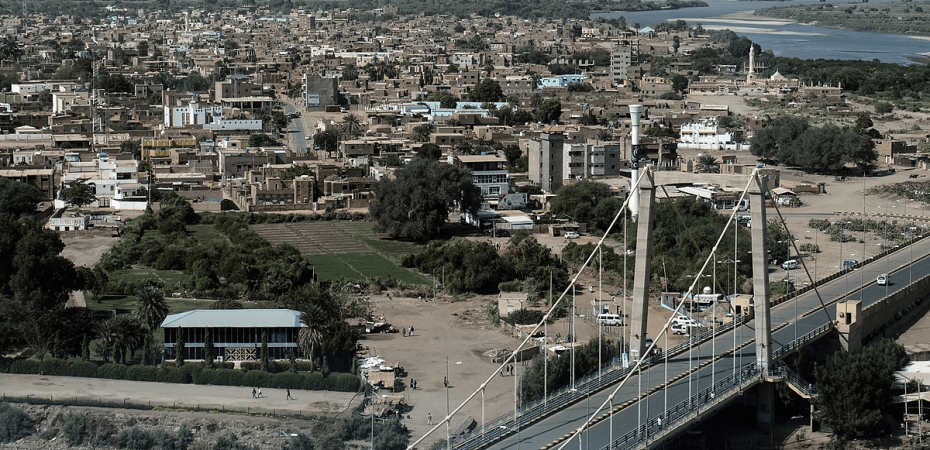
Image: Khartoum, Sudan. Author: Christopher Michel from San Francisco, USA, licensed under the Creative Commons Attribution 2.0 Generic license.
 Labour Hub