
Mike Phipps looks at the history of Russia’s most recent tactic in its war on Ukraine.
‘Double tap’. It sounds anodyne enough. But so did ‘Little Boy’, the name given to the atomic bomb that the United States dropped on the Japanese city of Hiroshima 78 years ago this month. It’s standard military practice to give the most horrific weaponry and battlefield tactics such harmless-sounding titles: it makes them sound more familiar and acceptable.
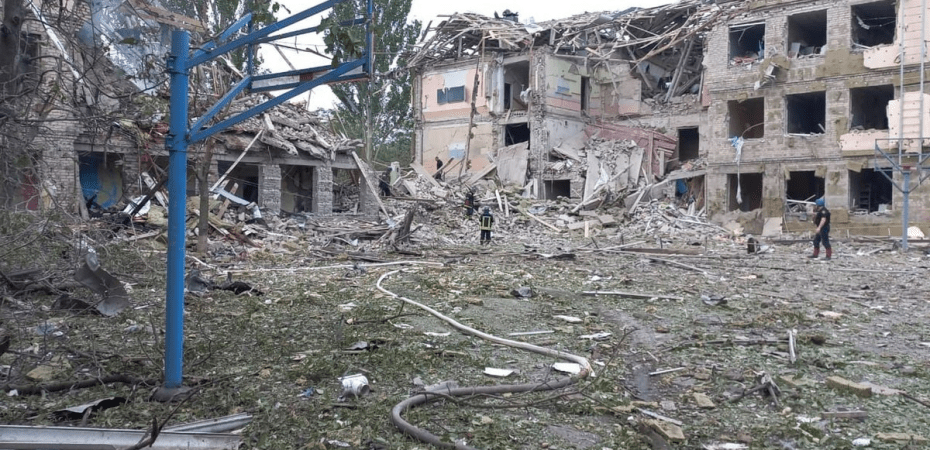
‘Double tap’ refers to the deliberate practice of following an air strike or artillery shelling with a second strike a few minutes later, with the intention of hitting response teams, helpers and medics rushing to the site. By deliberately targeting non-combatants, it is a war crime.
Ukrainian officials accused Kremlin forces of using this tactic in an air strike this week. On Monday evening, successive strikes in the city of Pokrovsk killed five civilians, one rescuer and one soldier, according to Donetsk Governor Pavlo Kyrylenko. Dozens more were wounded, most of them police officers, emergency workers and soldiers who had raced to the scene to assist residents. Russia’s firing of Iskander missiles, which have an advanced guidance system that increases their accuracy, hit within 40 minutes of each other.
The chief of Ukraine’s National Police, said of the rescuers: “They knew that under the rubble were the injured — they needed to react, to dig, to retrieve, to save. And the enemy deliberately struck the second time.”
The head of the Pokrovsk City Administration, Serhii Dobriak, described the attacks on the city as “a typical Russian scenario: 30-40 minutes between missiles.”
This is not the first time Russian forces have used this tactic. In the first two months of the war alone, several ‘double-tap’ attacks were reported in the bombardment of the northeast Ukrainian city of Kharkiv.
On April 17th 2022, the Australian Broadcasting Corporation (ABC) reported that it witnessed a double-tap attack in Kharkiv. An ABC team was following a local Red Cross unit when Russian missiles hit a nearby building. A few minutes later, after the Red Cross, paramedics, and Ukrainian troops arrived at the scene to help survivors, a second missile attack hit the building. Five civilians were killed.
It was a re-run of an attack a month earlier when Russia launched a cruise missile strike at a government building in the city’s Freedom Square. A few minutes later, when rescuers arrived to look for survivors, a second rocket hit the building. At least ten people were killed by the strikes which the Ukrainian government called a “war crime” and “state terrorism.”
The Organization for Security and Co-operation in Europe says such attacks are a violation of international law. Moreover, they have been widely used elsewhere by the Russian military – in Syria, where Russia regularly targeted civilian locations, including schools, hospitals and markets. One ‘double tap’ attack in Idlib which killed 39 people was the subject of a detailed BBC investigation, which concluded that it had found evidence of a war crime. Another report last year suggested that dozens of such attacks had been carried out by Russia and Syria.
These crimes need calling out for what they are. But they are not the exclusive preserve of the Russian military. The tactic was widely deployed in the Western-backed Saudi bombing of Yemen. In one notorious bombardment in October 2018, 140 civilians were incinerated in a packed funeral hall in Yemen’s capital.
The US too stands accused of the same crime. Ten years ago, the Atlantic reported: “Human-rights groups have alleged for some time that the United States kills people in drone strikes, waits for rescuers to arrive, and deliberately targets them too, and that we target and kill mourners at the funerals of drone-strike victims.”
In February 2012, the Bureau of Investigative Journalism looked at multiple attacks in Pakistan by CIA drones on rescuers attempting to aid victims of previous strikes. It reported: “Of the 18 attacks on rescuers and mourners reported at the time by credible media, twelve cases have been independently confirmed by our researchers.” Months later it looked at further evidence and concluded that “double-tap strikes had been revived.”
In one incident alone, eighteen people, including children, were killed in a ‘double tap’ drone attack in July 2012 in Pakistan’s North Waziristan province. A detailed report released the same year found that just one in fifty victims of ‘surgical’ US strikes in Pakistan hit known militants – the rest bombed civilians.
A respected US legal opinion argued that such attacks, by virtue of their indiscriminate nature, are likely war crimes under international law and under the War Crimes Act of 1996, a US law that criminalizes carrying out, or ordering to be carried out, grave breaches of Common Article 3 of the 1949 Geneva Convention.
Under a headline “Double-Tap Warfare: Should President Obama Be Investigated for War Crimes?”, it argued that, to conform to international law, the US should cease the use of double-tap drone strikes immediately and that it is legally and morally required to investigate the use of such strikes to determine if war crimes have been committed.
Israel too stands accused of these crimes. A detailed report from an Independent Medical Fact-Finding Mission in the Gaza Strip in 2014 concluded that “‘double tap’ or multiple consecutive strikes on a single location led to multiple civilian casualties and to injuries and deaths among rescuers.”
Returning to Ukraine, the use of ‘double tap’ strikes is just one of a range of unlawful military tactics deployed by Russia. Others include the deliberate targeting of civilian locations, including Ukraine’s healthcare system, its use of sexual violence, the abduction and deportation of children and torture of detainees.
Some analyses argue that Russia’s policy in Ukraine amounts to genocide. Such crimes are regularly documented in the weekly Bulletin of the Ukraine Information Group, available here. To receive the bulletin regularly, email 2022ukrainesolidarity@gmail.com .
Mike Phipps’ book Don’t Stop Thinking About Tomorrow: The Labour Party after Jeremy Corbyn (OR Books, 2022) can be ordered here.
Image: Russian bombing of a school in Kramatorsk, July 21, 2022. Source: https://www.facebook.com/photo/?fbid=421090610058834&set=a.293060042861892. Author: State Emergency Service of Ukraine, licensed under the Creative Commons Attribution 4.0 International license.
 Labour Hub
[…] to the scene were killed in subsequent strikes, known as ‘double taps’ in military parlance. As previously reported on Labour Hub, the Organization for Security and Co-operation in Europe says such attacks are a violation of […]
[…] evidence that Israeli is using double-tap strikes to hit rescue workers in southern Lebanon. ‘Double tap’ refers to the deliberate practice of following an air strike with a second strike a few minutes […]