
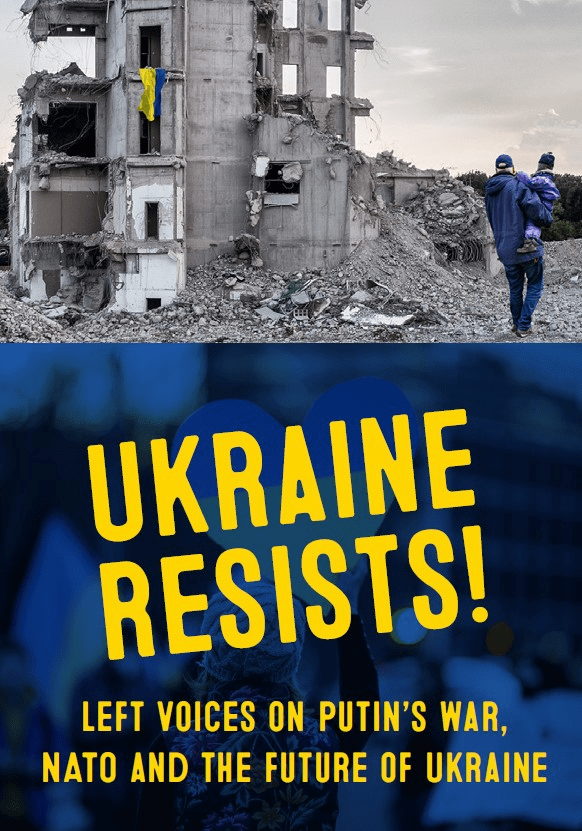
Mike Phipps reviews Ukraine resists: Left Voices on Putin’s War, NATO and the Future of Ukraine, published by Resistance Books
This is a second collection of contributions, this time from the Australian-based Resistance Books, which foregrounds seldom-heard Ukrainian voices, principally interviews that were originally published in LINKS International Journal of Socialist Renewal and its sister publication Green Left.
Ukrainian socialist Yuliya Yurchenko locates events in Ukraine in the context of the power dynamics between Russia and Ukraine, rather than supposed Western coups. Hanna Perekhoda, another socialist, sees continuity between Putin’s claim that Ukrainian national identity is the result of a conspiracy plotted by those who want to weaken Russia and the same assertion advanced under the Tsars.
She also destroys the myth that Ukraine’s 2018 law prioritising the Ukrainian language in public life somehow constituted a war on Russian speakers. This is definitely not a war between two irreconcilable identities, she explains:
“Faced with Russia’s invasion and the inhuman treatment of civilians by the occupying army, the inhabitants of the country feel themselves to be first and foremost Ukrainians, including those who speak Russian. People in Kherson are greeting Ukrainian soldiers and celebrating the liberation of the city, and in 99% of cases they do it in Russian. Thousands of Ukrainian soldiers defending their country are Russian speakers.”
Social Movement Chair Vitaliy Dudin confronts another ‘misunderstanding’ – that far right nationalists exert a dominant influence in Ukraine. His assessment is that their limited, over-stated influence is in decline and will shrink further as more ordinary Ukrainians take up arms.
Social Movement activist Vladyslav Starodubtsev goes further, arguing that the war has revolutionised Ukrainian politics. This is partly out of a recognition that Western support for Ukraine, far from being the decisive determinant in the conflict, has from the outset been limited and conditional. US intelligence suggested Russia would be in Kyiv within two days of the start of its invasion, and NATO members pursued a policy of appeasing Russia based on this expectation. This underestimation of Ukraine’s will to resist should also be a warning to those on the left who peddle the idea of rewarding Russia for its aggression.
The recognition in Ukraine that the West has its own interests, particularly when it comes to post-war reconstruction, is leading to a growing awareness that Ukraine’s own government is undermining the war effort, by its promotion of a neoliberal, oligarchical, pro-business agenda which is entirely at odds with people’s needs. Counterposed to this is “people organising themselves as volunteers in the army, in the factories, everywhere, all of which has built a strong sense of solidarity and cooperation among society. People have found new ways to cooperate, new ways to organise, and they feel a lot more empowered.”
Feminist activist Viktoriia Pihul explains how the work of feminist organisations has switched from educational to primarily survival and humanitarian work. “Voluntary work has become not something from the world of activists, but something close and understandable to almost everyone,” she says. “Feminism in Ukraine is now a grassroots movement.”
Agricultural expert Mykhailo Amosov discusses the terrible impact of the Russian occupation on Ukraine’s agriculture: “farms have been completely destroyed and livestock animals killed due to indiscriminate shelling by Russians troops… about 10 million hectares of land has been lost for agricultural activities due to landmines, shelling, bombardments, etc.” Six months into the war, the estimated cost of the damage was already $30 billion.
Contributions are also included from Russian activists. Socialist Ilya Matveev reminds us that Ukraine signed the Budapest Memorandum in 1994, handing over its nuclear weapons to Russia in return for security assurances that Russia would not attack Ukraine, an agreement that was violated as early as 2014.
Feminist Anti-War Resistance discuss the devastating impact of forced conscription within Russia, with ethnic minorities and poorer regions and republics disproportionately targeted, with people often seized in the middle of the night.
There are voices from further afield as well. Zofia Malisz, from the Polish left-wing party Lewica Razem (Left Together), argues that to see Eastern European countries as essentially authoritarian or far-right nationalist is to dismiss Eastern Europe agency and disregard the emancipatory and democratising impulses of the people. Razem saw Russia’s invasion as an existential threat to Ukraine and were very disappointed with progressive organisations elsewhere which fudged the issue.
Hisyar Özsoy, Halklarin Demokratik Partisi (People’s Democratic Party, HDP, Turkey) Foreign Affairs Commission co-spokesperson, explains that while his party strongly opposes Russia’s invasion, the Turkish government is exploiting the conflict not only to increase its regional influence but to secure greater Western complicity in its repression of the Kurds. Other international contributions here are less interesting, good on ‘line’, less so on active involvement in this existential struggle.
The main problem with anthologies of this kind is the speed with which they are superseded by events. We now have a far clearer idea, for example, of what post-war Western-led reconstruction in Ukraine might look like.
Wisely, the compilers have focused in this book on the central arguments for unconditional solidarity with Ukraine, which need to continue to be made in a global left still considerably contaminated by campist politics and Putin apologism.
Mike Phipps’ book Don’t Stop Thinking About Tomorrow: The Labour Party after Jeremy Corbyn (OR Books, 2022) can be ordered here.
 Labour Hub