
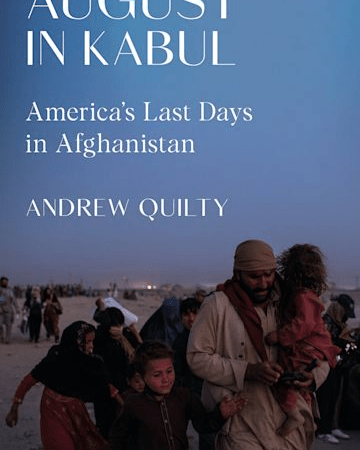
Mike Phipps reviews August in Kabul: America’s Last Days in Afghanistan, by Andrew Quilty, published by Bloomsbury
Journalist Andrew Quilty had left Afghanistan to attend a friend’s wedding in France on the first weekend of August 2021, when Afghan provinces began to fall in quick succession to the Taliban. On August 14th, he flew back to Kabul, believing there were still weeks before the city would fall. As he landed, there was no indication of the chaos that would engulf the airport just 24 hours later.
In the days that followed, families would wait for hours on the tarmac under the burning sun – and these were the lucky ones who would fly out. Others died waiting and on August 26th, 180 were killed when an ISIS suicide bomber detonated a device at the airport gate.
Quilty, one of the few Western journalists to stay in Kabul after its fall, steps back from the story of those last hectic days to document how the tactics of the US-led occupation inflamed the local population and strengthened the Taliban. He looks at the night raids that primarily targeted old men, women and children, the summary executions and the torture, the on-the-ground implementation of CIA Director’s exhortation to his Agency to be “aggressive, vicious, unforgiving, relentless”.
There’s a gripping, hour-by-hour narrative of the events on the chaotic day of August 15th, when mounting panic drove more and more people to flee to Kabul airport and when police and military personnel swapped their uniforms for civilian clothes and disappeared into the crowds. Even the presidential helicopter could not get to the airport for a while, because the US controlled the airspace and were prioritising the evacuation of their own personnel.
Everyone was intent on saving only themselves – even the pilots were flying out of the country. By the end of the day, the office of the President, who had escaped a few hours earlier, was in the hands of the Taliban. Their seizure of Kabul faced little resistance, such was the universal military collapse.
The US understood the importance of controlling airfields and airspace to evacuate their people. At Kandahar, units working for the CIA achieved this ruthlessly, by “running people over with tactical vehicles, shooting them; even, according to a Marine who watched on, aghast, executing people.”
It’s shocking stuff. But the great strength of this book is its unsentimental telling of the human stories behind the military action, principally those of Afghans on both sides of the conflict. This was a tragedy primarily for Afghanistan, not US prestige.
One of those stories is of Nadia, a young woman who dreams of going to university but instead is forced to flee the escalating violence towards her from male members of her family, who decide that they must hand her over to the Taliban for marriage, for their own self-protection. When she finally does make her escape, her father is imprisoned and beaten by the new regime.
Afghanistan’s fall to the Taliban was not the result of some ‘mistake’ in US policy, as other books have suggested. It was not a failure of American nerve, nor the result of the incompetent execution of a broadly sound policy.
The US dropped over 300,000 bombs on Afghanistan, killing an estimated 70,000 civilians, over 40% of them women. Quilty himself notes: “Civilian deaths from bombs dropped and missiles launched from aircraft became almost commonplace.”
In the last five years, 40% of all civilian casualties from airstrikes in Afghanistan – almost 1,600 – were children. As this site reported last year, “This callous disregard for ordinary lives was a hallmark of the twenty-year intervention, irrespective of which US President or UK prime minister was in charge.”
The occupiers also wasted a great deal of money. One recent report found that, “A staggering $19 billion spent by the U.S. government to reconstruct Afghanistan has been lost to fraud, waste, and abuse in the last decade.”
Yet today Afghanistan is one of the poorest countries in the world. Around 50% live in poverty and most lack clean water, electricity or infrastructure. It’s worth remembering, as Kathy Kelly reminds us, “that, during 2013, when the United States spent an average of $2 million per soldier, per year, stationed in Afghanistan, the number of Afghan children suffering malnutrition rose by 50 percent.”
It’s worth recalling too that, “On October 3, 2015, when only one hospital served vast numbers of people in the Kunduz province, the U.S. Air Force bombed the hospital at 15 minute intervals for one and a half hours, killing 42 people including 13 staff, three of whom were doctors. This attack helped greenlight the war crime of bombing hospitals all around the world.”
Humanitarian intervention, women’s rights and democratic governance were all peddled as rightful justifications for the Western intervention in Afghanistan from its inception over 20 years ago. This book, focusing on the manner of the West’s exit, underlines how false that was. By foregrounding the stories of ordinary Afghans who must now pick up the pieces, it makes for compelling reading.
Mike Phipps’ book Don’t Stop Thinking About Tomorrow: The Labour Party after Jeremy Corbyn (OR Books, 2022) can be ordered here.
 Labour Hub