
By Eleanor Woolstencroft
As the climate crisis escalates, the privatised energy sector continues to enjoy ludicrous profits from the extraction of oil and gas, remaining a driving force in increasing fuel poverty. Meanwhile, their workers are forced to confront spiralling levels of inflation and the ever looming threat of climate catastrophe.
While they still remain an improvement on the Conservatives, Labour isn’t doing nearly enough. If Keir Starmer is serious about empowering workers, avoiding runaway climate change, and implementing policy to that effect, then he must commit to full public ownership of energy, along with significantly improving workers’ rights.
The Labour Party’s recent backtrack on their New Deal for Workers is a discouraging sign for those who hoped that they would take on corporate greed. Workers across all sectors deserve fair contracts, good working conditions, and equitable pay. However, the energy sector is too influenced by shareholder greed to meet the basic needs of their workers. As profits soared, oil and gas operators refused to give their workers a reasonable pay raise, triggering threats of strike action and a series of 24, 48, and 72-hour work stoppages on oil and gas rigs in early 2023. A Labour commitment to the original New Deal for Workers would bring workers’ rights and the climate crisis back to the forefront of the Labour agenda.
Shareholder value has a strong influence over corporations. Privatised energy companies are driven to extract profits as shareholder dividends, rather than reinvesting them in the renewable infrastructure, workers, and the future. With this in mind, it is clear that the inadequacy of infrastructure in the energy industry is a direct result of privatisation and shareholder greed.
Under democratic public ownership, shareholder interference would be eliminated, allowing financial decisions to be guided by workers and concerns for sustainability, instead of profit. Directing investment into the public sector could bring about significant decreases in energy bills and an increase in energy security.
That’s why Labour’s (now watered down) £28 billion Green Prosperity Fund is worth far more if invested in the public sector. If spent in the private sector, taxpayers’ money will go straight into the pockets of shareholders, handing them even more power, instead of into change that benefits workers and the planet.
Although investment in sustainable energy has already created 12.7 million jobs worldwide, only 247,000 of those jobs (2%) are in the UK. The profit margins on the sale of oil and gas mean shareholders will always be unwilling to give up their staggering fortunes in exchange for a transition to renewable energy. With continued private sector domination, exploration into sustainable energy, and therefore job creation, will always be an afterthought of the industry.
If Labour are really serious about creating the jobs of the future through a just transition, then they must remove incentives for profit-making by nationalising the whole energy system. This would force the industry to face the realities of the climate crisis and act accordingly, with major expansions in the sustainable energy sector, creating thousands of new jobs across all regions of the UK, and allowing for a just transition to green, sustainable energy.
Transitioning to renewables will not only create jobs, but provide new opportunities for workers currently employed by the fossil fuels sector. However, the private sector’s track record shows that if left up to it, workers will once again be left behind. To ensure a just transition for all, the phasing out of fossil fuels and the introduction of renewables must be accompanied by significantly improving workers’ rights.
In 2021, British Gas attempted to fire and rehire thousands of their employees then proceeded to triple their profits the next year. During the pandemic, oil and gas companies cut over four thousand jobs in the North Sea, yet went on to accumulate record profits for their shareholders. This shows the private sector’s willingness to enforce tougher contracts, poorer pay, and worse conditions on their employees in order to maximise their profit. The only way to ensure a just transition to green energy is by banning these exploitative practices and giving workers the power to resist changes that erode their pay and conditions.
Empowering workers goes beyond the workplace, protecting society at large. Currently, the private energy sector drives the greenwashing of polluting industries. The UK’s second largest energy supplier, SSE, claims to be working towards net zero by 2040, but increased the amount of CO2 they emitted per kilowatt hour from 2020 to 2021. Simultaneously, they increased their profits from £590 million to £2.42 billion. And they cannot be held to account.
Democratic public ownership would encourage workers to play a collective role in decision making, creating democratic accountability, giving rise to greater transparency around decision making on pay, conditions, and their carbon emissions. By opening up decision making, power holders are forced to prioritise their workers and sustainability efforts.
Without full public ownership of the energy sector and significantly improved workers’ rights, workers and the environment will continue to suffer. The profit-driven private sector has had almost 40 years to decarbonise since privatisation, but in 2022, nuclear and renewables still only accounted for 54% of fuel used for electricity generation. With a 1.5 degree rise predicted before 2040, the climate crisis is not waiting for the private sector to come to its senses. And neither should workers.
As long as the private sector controls the energy sector, workers’ rights in this sector will never be a priority, with profit always put first. Keir Starmer doesn’t seem to understand this fact, despite the clear evidence. The transition to renewables must be centred around workers, creating new jobs and opportunities in the industry, while directing profits towards workers’ pay and conditions. However, it seems Labour are happy to side with bad bosses instead of workers. By backtracking on the New Deal for Workers, they are enabling private companies to continue to make profits off the back of exploitative working terms and conditions.
Instead, Labour must back workers and commit to full public ownership of energy. Public ownership allows for targeted investment in renewable infrastructure for rapid decarbonisation and makes way for democratic decision making within the sector, enabling workers to hold decision makers to account. Public ownership is the only way to decarbonise while giving workers the stability, pay and opportunity they deserve.
Eleanor Woolstencroft is an activist with Labour for a Green New Deal.
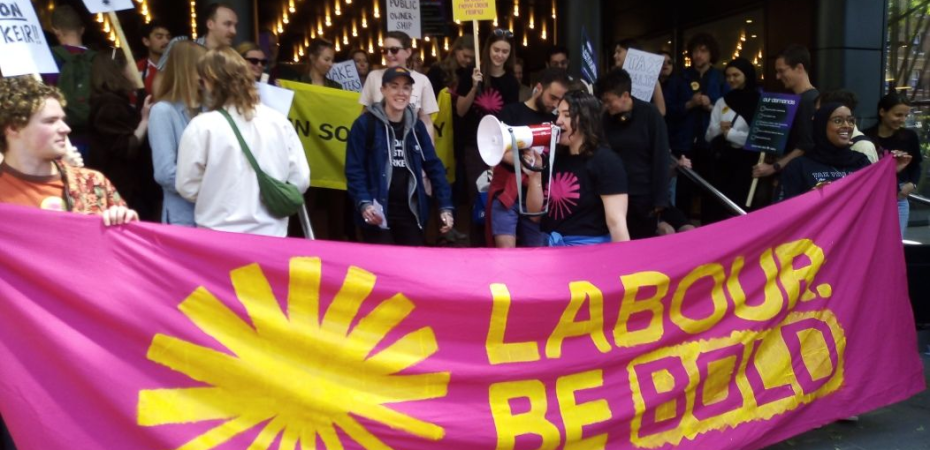
Image: c/o Mike Phipps
 Labour Hub