
By Eleanor Woolstencroft
As the next general election approaches, Labour members and leadership must use this Conference to show vision and ambition on climate change. In the aftermath of the hottest September on record, Labour must show voters it is serious about this crisis. Until now Starmer’s Labour has taken an atomistic approach to climate policy that has failed to deliver the radical policy required. This Labour Conference is an opportunity to put that right with a bold climate agenda fit for government.
The Conservative government’s recent announcement, rolling back on net-zero, was a cowardly attempt to shift public opinion back away from climate action. It’s in this context that Labour needs to be bold. The climate crisis isn’t waiting for public opinion to sway, so neither can Labour.
The climate crisis demands a holistic approach, including a recognition that every industry and sector can contribute to innovative solutions. That is the great appeal of the Green New Deal: a plan to mobilise every area of the economy for the dual aims of decarbonisation and eradicating inequality.
By abandoning those principles and treating climate policy as discrete, Labour is all the weaker as it neglects the possibility of triggering huge economic and social prosperity, and handing power back to workers and communities instead of the drivers of the climate crisis. Without this holistic and transformative approach, there is a risk that new legislation will simply force changes on working people rather than confronting the elite few that caused climate change.
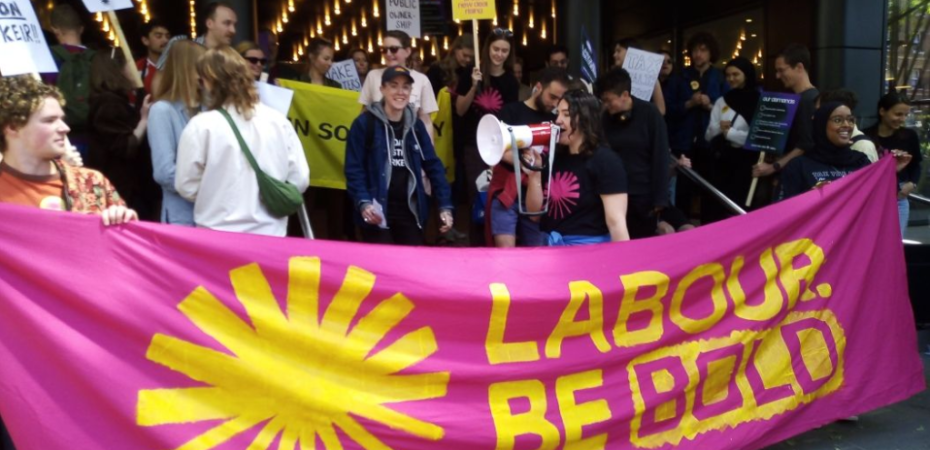
At Labour for a Green New Deal, we’ve been clear that public ownership has to be at the heart of Labour’s climate agenda. Fossil fuel companies continue to make extortionate profits at the expense of the planet as the chaos of the market fails to deliver a clean energy transition. However, Labour’s leadership refuses to commit to a solution. Without a commitment to full public ownership of energy, energy and gas, companies will continue to escalate the climate crisis, while private citizens foot the bill.
A number of Constituency Labour Parties (CLPs) have sent motions supporting the public ownership of the entire energy system, but Conference will not be allowed to debate them.
Fortunately, Unite the Union has also proposed a motion to Conference calling for public ownership of energy which should be debated and voted on. Together these make the argument that we can decarbonise and achieve justice for workers through the same measures. By leaving the transition to the market, we risk an unjust transition with workers left behind.
Ultimately, climate motions at Conference must recognise the fact that the private sector has no interest in decarbonisation – only the advancements of its own profits. Labour’s commitment to no new oil and gas and GB energy must be preserved and strengthened, but it must also go further. 66% of the public support public ownership of energy, and Labour must seek their support.
As the general election nears, Labour policy on climate change must be stronger. Only Labour in government can deliver on climate, but current policy suggests it won’t. As more and more people are plunged into poverty and millions are displaced by extreme weather events, Labour cannot afford to delay any longer. At this conference, it must commit to stronger climate policy, or not only risk electoral defeat, but climate catastrophe.
Eleanor Woolstencroft is an activist with Labour for a Green New Deal.
Image: c/o Mike Phipps
 Labour Hub