
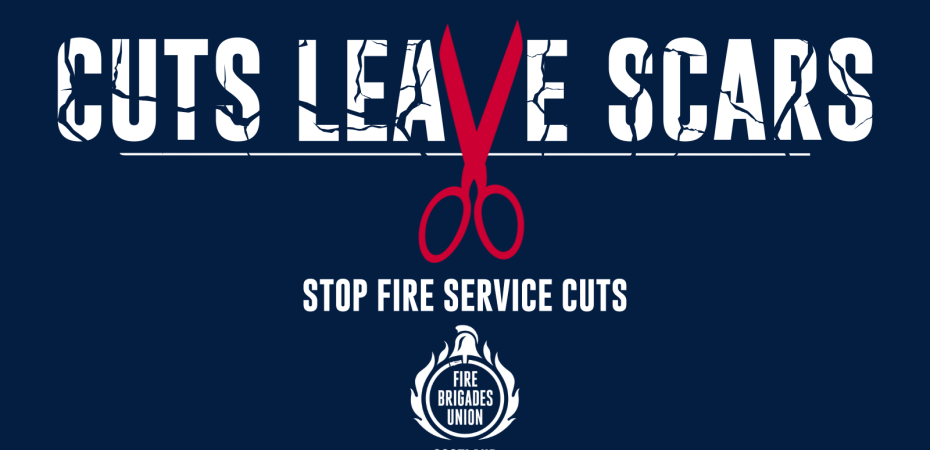
The Fire Brigades Union has today announced its intention to begin consulting firefighters across Scotland on strike action in opposition to a devastating package of cuts imposed by the Scottish government.
A projected five-year flat cash budget until 2027 has already removed ten whole-time fire engines, while 150 retained fire engines are regularly unavailable due to significant recruitment and retention problems. The Scottish Fire and Rescue service has announced that its own projections mean it will need to save a minimum of a further £14 million next year, which would result in the loss of a further 339 firefighters and 18 fire engines, with more to come. Scotland has lost 1,200 frontline firefighters since 2012.
The move marks the first formal step towards firefighters taking strike action. This was agreed unanimously by the union’s Scottish committee this week. A formal strike ballot could follow.
It comes as the SNP gathers for its party conference in Aberdeen this weekend, and will pile pressure on First Minister Humza Yousaf to intervene.
The FBU will also be holding a demonstration at Holyrood on 26th October.
Since the creation of the Scottish Fire and Rescue Service (SFRS) April 2013 the fire and rescue service in Scotland has suffered tens of millions of pounds of real terms cuts.
The resource budget set for SFRS in 2023/24 is £308.6 million, a £31.6 million real terms cut over that ten year period. However, using the 2012/13 resource budget figure of £290.7 million as a starting point, the FBU calculate that an overall £56.8 million real terms cut has been inflicted upon SFRS over the last 11 years.
On 13th September 2023, in giving evidence to the Scottish Parliament Criminal Justice Committee, the SFRS Chief Fire Officer indicated that the impact of the resource-based spending review in 2024/25 alone would see additional cuts of between £14 million and £26 million being required. At the lowest end of this scale this would see a further 339 firefighter jobs requiring to be cut, alongside a further 18 fire appliances.
The impact of sustained real-terms budget cuts to SFRS over the last decade is clear. The Service’s own statistics lay bare the reduction of over 1200 firefighter posts in Scotland since the creation of SFRS.
To capture the impact of these cuts , the FBU has commissioned a major report into both the legacy and future of the SFRS. A combination of real-terms budget cuts, insufficient recruitment, a crisis in the retained duty system service, a decline in training resilience and resourcing and the necessity of responding to the climate emergency has created the perfect conditions for a devastating Firestorm. A Firestorm report briefing session will be held on 24th October at the Scottish Parliament.
Additionally, firefighters will also be holding a mass member #CutsLeaveScars rally on Thursday 26th October outside of the Scottish Parliament building. The event will see firefighters from across Scotland descend on Holyrood to call for an end to the savage cuts imposed on the SFRS over the last decade and for the Scottish Government to invest in the future of the Service to make it fit meet the challenges of the 21st century.
John McKenzie, Fire Brigades Union regional secretary, said:
“The cuts we are seeing imposed by the Scottish government are a threat to the lives, homes and livelihoods not just of firefighters but of everyone in Scotland. They will rob Scotland of the firefighters and equipment we need to keep our communities safe.
“Speaking to firefighters across Scotland, it is clear to us that there is a determined mood among members. After ten years of cuts, our service cannot take any more. The public will not forgive the SNP Government if they allow this to end in strike action.”
Matt Wrack, Fire Brigades Union general secretary, said:
“As the SNP gather for their party conference, firefighters have a message for the Scottish government. These cuts are a threat to the safety of everyone in Scotland, and the Fire Brigades Union has a duty to oppose them.
“Firefighters do not move towards strike action lightly. The intransigence of the Scottish government has led things to where they are now, but it still has time to reverse course. The Scottish government needs to listen to those in the front line of this vital service.”
 Labour Hub