
Our Party Conference correspondent gives a personal view of Labour’s annual gathering earlier this month
Which was the first election you followed? A friend and I used to refight Twickenham, 1979. Sir Toby Jessel, knight of the suburbs, verses Dave Wetzel, bus driver and conductor: the people’s champion.
It was a contest live with incident. Dave had 10,000 records pressed onto thin plastic – the social media of their day – on which he was accompanied by songs from Italian partisans and the Spanish Civil War. Was that “treating” the voters? The returning officer was consulted. Distribution resumed. Sir Toby responded by blasting classical music from his election car.
The seat went the way of too many in that general election. Twickenham’s loss was London’s gain. Co-ordinating bus, rail and underground in Ken Livingstone’s GLC, Wetzel laid the foundations for a city you can navigate without a car.
The Coalition for Economic Justice held a fringe meeting on the Monday of Conference. Andy Burnham was ‘invited’. It was chaired by Dave Wetzel. To a teenager, anyone over the age of 20 seemed ancient. The Dave Wetzel must be long gone, surely. Perhaps it was a family name, his son or grandson?
A kindly woman stopped me at the entrance: “I’m afraid Andy Burnham isn’t coming.” I said I’m here for Dave Wetzel. “Why?” I explained my interest. “Well, other than that you thought him dead, I’m glad you weren’t too rude about… my husband.”
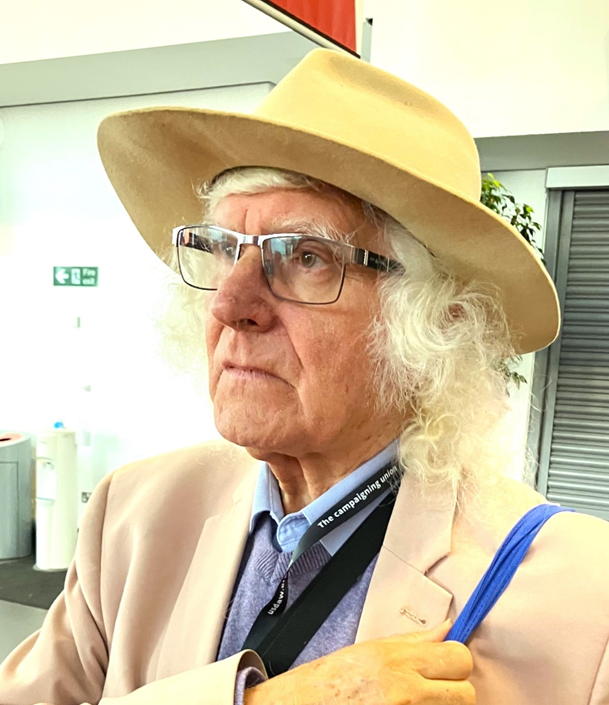
Dave Wetzel, transport pioneer
Heather and Dave Wetzel (82) are still in the saddle, still campaigning for a better tomorrow.
Beyond Conference gates, in the World Transformed, the young and keen led and attended workshops on organising a workplace, picket line and banner making.
And so we roll through the generations. At an earlier Conference, the late Barbara Castle told me about her political education in the Clarion Cycling Club, driven by very much the same spirit as drives the World Transformed.
Policies change. In 2023 they did not change for the better. People change less. Squeaky ones, with ill-fitting suits and a career focus have begun to appear, much as they did in the early Blair years. They represent, though, very much a minority. Most have good intentions. That continuity gives hope, even in perplexing times.
Keep hold of that hope, for we’re about to enter the hall.
Flag Days
And, well, you can hardly avoid it, let’s focus on the flag. Those in the hall had little choice but to. A hoarding painted with a giant union flag dominated the stage. Long, flowing and wooden, it could be read as a commentary on rather too many front bench speeches.
Smaller flags sprinkled the building. Soon, one will flutter from your membership card.
What did delegates think of them?
It’s an inclusive national emblem: the heart beats faster when you see, say, Sir Mo Farah brandishing one.
Why should we leave it to the Tories – a party notorious for putting British interests second to those of off-shore capital? Still less to the BNP and their like.
North London sensibilities oughtn’t to get in the way of winning Red Wall votes.
But isn’t this sort of flag-waving really un-British? Who, even on the Red Wall, has a flag pole? Nationalism is the most insidious of evils. It made for an uncomfortable background.
Discipline
All the newspapers reckoned ours the most disciplined of conferences. The press hunts in a pack. But, when I interviewed campaigners and diplomats – who had attended all three conferences – all gave the same answer. The Liberals were chaotically democratic. The Tories were chaotic.
The other parties had ideas. We really didn’t. The only big new thing that came out of Conference was Keir Starmer’s brave pledge to build in your back yard. The Green Belt is a great Labour achievement; and we mean to build on it – as John Prescott once almost said. But we marched in step, heads down, ready for government.
That ethos was seen in all of the organisational and structural votes. Delegates, both from unions and constituencies, voted in loyal line. All six of the topics Labour to Win (Luke Akehurst) wanted were selected for debate. None of Momentum’s. All constitutional amendments – most of them limiting debate or democracy – passed by a large margin.
These votes were held early; and some delegates may not have been altogether aware of their options. In simpler and more substantial votes – on the nationalisation of rail and energy for example and particularly in those that came late in Conference, when delegates had found their feet – some broke ranks.
Still, in most votes that mattered, the leadership had a substantial majority in both union and constituency section.
BAME, LBGT+, Disabled and Youth Officers
Let’s examine one of these changes. The unpaid volunteers who form a constituency’s Executive Committee do most of the work and make some of the decisions that keep local parties going. If (a big if) they all turn-up, there are about 14 of them.
Last month Labour’s board, the NEC (National Executive Committee) decided that 14 is too many. The NEC (membership 39) reckoned that smaller committees make better decisions. Most equality officers lost their vote.
Why? The group currently controlling the NEC does not get many votes from minority people. Is that relevant? One hopes not. Sadly, a straight majority of BAME delegates we asked put the change down to simple racism.
Is there a better explanation? In the most depressing debate of the week, nobody could come up with one. Rather, electoral success was said to depend not so much on slimming these committees – the minority representatives will still be there, sitting somewhere beneath the salt – but on depriving them of a vote.
Flat-footed, petty, needlessly offensive.
Over my years we’ve been told that Scottish voters don’t really matter, because they have nobody else to vote for. What we now call Red Wall voters didn’t matter because, well, they weren’t going to vote Tory, were they? It’s the floating and aspiring lower middle classes – Mondeo Man and Worcester Woman – who decide elections. How often have we let short-term decisions seed long-term disaster?
In my London borough, we feel particularly what gestures like this say to people of colour. Over the years BAME people have voted solidly Labour. They continue to do so even when their class position suggests they might look elsewhere. They’ve worked their socks off for the Party and got precious little in return. But, well they’ve got nobody else to vote for, have they?
CAC v NEC
In theory, Conference reigns supreme. All else, machine, leader, lords, MPs are its inferior. In practice its powers wax and wane. Leaders in government commonly ignore it, as do some out of power. For example, last year Conference voted in favour of PR.
This year delegates voted to reduce Conference’s influence. The subjects it permits itself to debate were narrowed. Much policy making has been delegated to the National Policy Forum: essentially a consultative, rather than an authoritative, body.
Still, there are times when Conference’s latent power and its solid union base have mattered. As, for example, when Ramsey MacDonald split the movement.
To preserve its independence the Conference has its own board – the CAC (Conference Arrangements Committee). This year NEC officers overruled the CAC.
The question was at root whether the NHS should rely on private health care providers and whether Labour MPs should take donations from them or their allies. Or, more exactly, whether NHS motions should come in one bundle or in two. But really the issue wasn’t what mattered. What mattered were NEC people bounding through the Chinese wall that shields the independence of Conference.
There was a sharp intake of breadth. The NEC’s ruling was upheld; but everyone agreed that such a thing should never happen again. No, never. A precedent had not been set. But, of course, one unprecedented non-precedent might easily be followed by more unprecedented non-precedents.
Obscure as it might sound, this matters. It ought to matter as much to those passionately in favour of private health care as to those who are not. For the group now in control of the NEC will not always be ascendant. Once torn, Chinese walls are not easily untorn.
PPCs
We heard from a lot of prospective parliamentary candidates. Let’s be generous and imagine that they are too busy pounding the streets to spare time learning how to speak. We are told that effort has been made to select ‘quality’ candidates. We aren’t told what that quality is. Going by what we heard, it is homogeneity.
The journalist Michael Crick has been cataloguing them. Almost all are right wing. Many have worked for an MP, pollster, lobbyist or think tank (preferably Tony Blair’s). Many are related to an MP. Quite a few score a full house.
Even here though, there are chinks of light. A campaign group that polled them on condition of anonymity found some variety of views. Successful candidates know what they have to say in order to become successful candidates. That doesn’t necessarily represent what they think, or at least the totality of what they think.
Local Government
On happier ground, foreign visitors – of whom there were many this year – were struck by the vigour and practical buzz around local government, mostly apparent on the fringe. Here councillors, experts and enthusiasts beavered at ways of ameliorating present conditions and preparing for a (marginally) brighter future.
The Tories have pared local government funding to the bone and beyond. There is no indication that a Labour government would increase it. We haven’t even promised not to decrease it. But while Rishi Sunak likes to shift funds away from areas of deprivation towards places like Tunbridge Wells, a Labour administration will surely redistribute in favour of those who need it most.
The Left
The wash-up meeting of the Campaign for Labour Party Democracy did not glow. Jess Barnard noted that Labour to Win were better funded and better organised than the centre and left. They marshalled the delegates more effectively and they won the votes that counted.
That’s not altogether surprising. Young and first-time delegates are driven by a commendable and overwhelming urge to remove a woeful government. If unity, achieved by toeing the line, is the price to pay for that, they’ll pay it. Give them a concrete choice, though, say, between private and nationalised energy, and quite a few will vote with their hearts. The hardened will argue that such are second level questions. First we win: then we debate. With such a complex structure to the Party, so many committees and initials, did they altogether realise that they’d voted to dismantle some of the machinery that might give such a debate purchase? By the end of Conference some had.
Machinery or no machinery, some balancing factors are beginning to become apparent. Labour to Win claim that they “are committed to building the broadest possible coalition with everyone of goodwill.” Yet the group in control of the NEC are the opposite of broad. As they advance, they narrow. Impeccable opponents of Jeremy Corbyn no longer fit. Lisa Nandy has been serially demoted. Yvette Cooper is endlessly briefed against – this year, more than ever. Ed Miliband is just about tolerated because his policies on climate change, diluted and delayed as they have been, are the closest we get to something coherently different to the Tories. But how long has he got? As those in the centre and on the centre right are driven out, so the scales shift.
Ultimately, Conference rests on the shoulders of trade unionists. At the 2021 Conference Keir Starmer tried to cut too deep into union power, with too little preparation. The unions revolted and prevailed. This time they kept, mostly, in line. The workplace improvements Angela Rayner offered are limited but worthwhile. Perhaps the austerity Rachel Reeves pushes will not be quite as severe as she promises. But next year, and the year after?
Looking back on fifty years of the Campaign for Labour Party Democracy, Ruth Hayes from the National Women’s Committee compared democracy within the Party, and with it the influence of the left, to the tide. “We advance a bit. We go back a bit. We advance a bit.”
By the door as we leave, Dave Wetzel is talking buses at the Liverpool stand. Liverpool, following Manchester is following him in co-ordinating public transport. Bringing in proper – municipal – buses, serving passengers, not privateers. Bit by bit, change happens.
Images c/o author
 Labour Hub