
By Mike Phipps
It should not, you might think, be difficult for a human rights lawyer to understand what human rights are, what international humanitarian law is and what war crimes are. But Keir Starmer’s recent difficulties with these concepts in relation to Israel’s bombardment of Gaza do not stem from a deficiency of legal understanding. They are caused by his determination to approach the whole issue from a narrowly political standpoint.
Get out the vote
To be brutally blunt, Starmer is not remotely interested in the human rights of Palestinians. If he has modified his original commitment to the Israeli state’s tactics since the war on Gaza entered its most recent phase, it is because of two calculations.
One is the fear of losing Muslim votes at the next general election. Over 250 Muslim Labour Councillors signed a letter last week calling for an immediate ceasefire. Two dozen Labour Councillors have also quit the Party. Most ominously, according to recent Muslim Census results, 59% of Muslims intend to either Not Vote or Vote Independent at the next election. Fewer than 5% currently plan to vote Labour, compared to over 70% who voted Labour at the last general election.
These developments have no doubt influenced the slight shift in Starmer’s declared position, which now includes support for a ‘pause’ in the bombing – but not a ceasefire. The leadership’s ham-fisted attempts to build bridges to the Muslim community in response to its strong antipathy to Starmer’s line included the now notorious photo opportunity for him at the South Wales Islamic Centre. The local imam was unaware that the visit was to be exploited for propaganda and public relations purposes and the Centre subsequently issued a statement which said that Starmer’s social media post “gravely misrepresented” the nature of the leader’s visit there.
Writing in The Guardian, Nesrine Malik observed, ”The debacle is symbolic of the tone deafness and remoteness of the upper ranks of the Labour party. The episode left those involved traumatised and unwilling to comment further on the matter, which means the severity of the aftermath has not been fully grasped.”
Following Washington
The second factor influencing Labour’s stance is the view of the United States. President Biden called for a lull in Israel’s bombardment and confirmed his commitment to a two-state solution. Sunak and Starmer quickly followed suit. There will be no further shift until Washington gives the signal.
Don’t take my word for it: Keir Starmer himself reportedly told a Muslim Labour MP that the Party was waiting for the US to call for a ceasefire before they could endorse such a position.
In fact, this is – apart from the refreshing period of Jeremy Corbyn’s leadership – the default position of the Labour leadership on Middle East conflicts. Tony Blair, although using different justifications to those of George W. Bush, was in lockstep with the White House over the invasion of Iraq twenty years ago. In fact, he wrote to Bush eight months in advance of the Iraq invasion to offer his unqualified backing for a war long before UN weapons inspectors had completed their work. He said: “I will be with you, whatever.”
Robin Cook resigned from Tony Blair’s Cabinet in 2003 over the impending invasion of Iraq – but he was the only one to do so. Clare Short, who was highly critical of the war, refused to do so, lulled by Blair’s reassurances that as Secretary of State for International Development, she would have a major role to play in Iraq’s reconstruction. (She did not.) She resigned a couple of months later, long after the government crisis had passed, as Liz Davies recalls in her Labour Hub podcast here (27:56 mins).
In her 2004 book, An Honourable Deception (Free Press, 2004), Clare Short wrote of the massive February 2003 demonstration against the Iraq War: “We had the biggest demonstration against war there has ever been in British history. I was there in spirit.”
But as I pointed out in my October 2005 Labour Briefing review of the updated version of this “plodding, self-important memoir”: “No you weren’t, Clare: you were attacked from the platform by several speakers for preferring office to principle.”
Tony Blair’s fulsome support for Bush’s plan for regime change in Iraq is sometimes seen as an aberration. It wasn’t. Even in Opposition, Labour has a history of unswerving support for supporting US policy in the region.
Neil Kinnock’s war
The US-led military action in the 1990-1 Gulf War, following the Iraqi invasion of Kuwait, is a case in point. The Labour leadership of Neil Kinnock supported the US-UK military mobilisation from the outset. In the first parliamentary debate, only veteran left wing backbenchers Tony Benn and Eric Heffer spoke out to expose the government’s true motives for involvement in the war – oil – and its hypocrisy over human rights, democracy and international law.
In his last speech to the House of Commons, Heffer, who had terminal cancer and died some months later, spoke of “the damn hypocrisy of some of those involved. The Secretary of State for Defence says that we stand by the law… What law did America call up when it invaded Grenada or Panama? What law did it call up when it undermined the elected president of Chile and helped to get him murdered? What law did it call up when it assisted the Contras in violent means against the Nicaraguan Government? What sort of law is that? That is not law; that is interests. That is imperial interests.”
As Richard Heffernan and the late Mike Marqusee point out in their definitive and ever-relevant analysis Defeat from the jaws of Victory: Inside Kinnock’s Labour Party (Verso, 1992), the 1990 Labour Party Conference was subsequently stitched up to prevent Tony Benn even from speaking, Kinnock’s spin-doctors claiming he was a “vain old man”. Nonetheless, a motion calling modestly for UN authorization for any military action still won 80% of CLP votes, but was defeated by trade union block votes.
Kinnock faced down misgivings within his Shadow Cabinet and opposition from within Labour’s National Executive over his stance. When the war finally started on January 18th 1991, he pledged his complete support, arguing at internal Party meetings that this was vital if the Party was to win the next general election. (It didn’t).
Kinnock even opposed moves within the Party to limit its support to the US-led Coalition expelling Iraq from Kuwait, but not going further. Just twelve hours after he won his position of rejecting a ceasefire at the Party’s NEC, the US Administration said it had achieved its primary aim of removing Iraq forces from Kuwait and declared… a ceasefire. Western forces had dropped 88,000 tonnes of TNT on Iraq, causing a quarter of a million fatalities.
Suez
There are also parallels between the current conflict in Israel and Gaza and the Suez crisis of 1956. In that episode, the Labour front bench, under right winger Hugh Gaitskell, along with the left led by Aneurin Bevan, not only lambasted the Tory government of Anthony Eden for its secretly planned, illegal invasion of Egypt: it organised largescale public opposition to it. Speaking to tens of thousands of people in a packed Trafalgar Square in November 1956, Bevan said: “They have offended against every principle of decency and there is only way in which they can even begin to restore their tarnished reputation and that is to get out! Get out! Get out!”
Eden was indeed forced out by the Suez adventure. From the standpoint of the Opposition, the crisis did a great deal to heal the split between the Bevanite left and the right: only the previous year Gaitskell had been trying to expel Bevan from the Labour Party. Imagine today if Starmer not only took the moral high ground in favour of international law and human rights but was able to unify his fractured Party in doing so, rather than presiding over the car crash of resignations and public outcry against his woeful line.
Writing recently for the i newspaper, Andrew Fisher suggested just that: “Starmer has a chance to put this right. He could re-unify the party by joining them and the international community – the United Nations secretary-general, the UN General Assembly, aid agencies like Oxfam and Save the Children, human rights groups like Amnesty and Human Rights Watch – in backing a ceasefire and a political process for peace and justice.”
So why won’t he?
The big difference between the current situation and the Suez crisis is that in 1956 the US also had misgivings about Britain’s invasion of Egypt and applied pressure to reverse it. So in a sense, Labour’s position did not differentiate from the Atlanticist orthodoxy of the day. Today, the US, in the teeth of opposition from virtually every NGO operating in the region, still opposes a ceasefire.
Ideological differences
Of course, Labour has at times been ideologically at odds with US strategy, such as when it supported unilateral nuclear disarmament during the 1980s, when the Party was a long way away from office. Again it was the once staunch unilateralist Neil Kinnock who as leader openly subverted the policy until union block votes finally overturned the commitment at Labour’s 1989 Conference.
Perhaps the most significant rift between Labour in office and the US – and not over the Middle East at all – was when Prime Minister Harold Wilson refused President Johnson’s request for material support for the USA war on Vietnam. Yet even the verbal moral support he provided was enough to provoke fierce public opposition to the 1960s Labour government, with 100,000 people protesting more than once on London’s streets in 1968.
When Ed Miliband was leader of the Opposition, from 2010 to 2015, the Party leadership was a little more outspoken on the Middle East. In August 2014 he condemned Israel’s ground incursion into Gaza as “wrong and unjustifiable”. So why won’t he speak up now?
Miliband’s decision to whip a vote calling on the government to unilaterally recognise Palestine broke the cosy consensus on the Middle East. It also provoked public hostility from sections of the Jewish community, long before Jeremy Corbyn took the helm.
Is it too late to change one’s mind?
Under Keir Starmer, there is a new emphasis on tailing behind the American line on the Middle East in a manner unseen since Blair and Iraq. That’s all the more ironic and indefensible given that senior Blairites of that era have now changed their mind on the war that defined Blair’s premiership.
On October 24th Owen Jones pointed out that recently Tony Blair’s former foreign secretary Jack Straw “conceded the Iraq war was ‘in retrospect, a mistake – I mean there’s no question about that’, with a casual tone more befitting someone who took the wrong turn off a motorway than someone who played a leading role in a war that killed hundreds of thousands of people.”
To that we can add the hindsight of Blair’s Defence Secretary Geoff Hoon. As I wrote when reviewing his political memoir, See How They Run (Unicorn, 2021), on this site, “Hoon now recognises that Saddam Hussein ‘probably’ did not have any stocks or programmes for developing chemical or biological weapons, but the thing is, you see, almost everyone believed he did. ‘It was this confusion that led to the allegation that the war was fought on a lie.’ Yes, it’s as pathetic as that.”
If things went wrong, it was down to poor US policy decisions and the scale of Iraqi expectations, Hoon says in his book, which conveniently lets himself and his government off the hook. But the reality is that the US often gets things wrong, as this recent overview underlines. The long US occupation of Afghanistan where the US dropped over 300,000 bombs, killing an estimated 70,000 civilians, over 40% of them women, is a spectacular example.
Again, Labour did its bit in propagandising to get Western forces into Afghanistan. When Britain sent 3,000 troops to the country in 2006, Labour Defence Secretary John Reid told Parliament that he hoped they would accomplish their mission “without a shot being fired.” In fact, they went on to participate in some of the fiercest battles since World War Two.
Labour’s slavish support for the US line in these conflicts goes beyond its support for NATO and the ‘special relationship’. It is hard-wired into the Party leadership’s political outlook and leads to some its most excruciating and convoluted public stances. It’s never been moral and it’s increasingly not popular. Members and supporters have a huge responsibility to demand a break with this approach – right now, over Israel and Gaza.
Mike Phipps’ book Don’t Stop Thinking About Tomorrow: The Labour Party after Jeremy Corbyn (OR Books, 2022) can be ordered here.
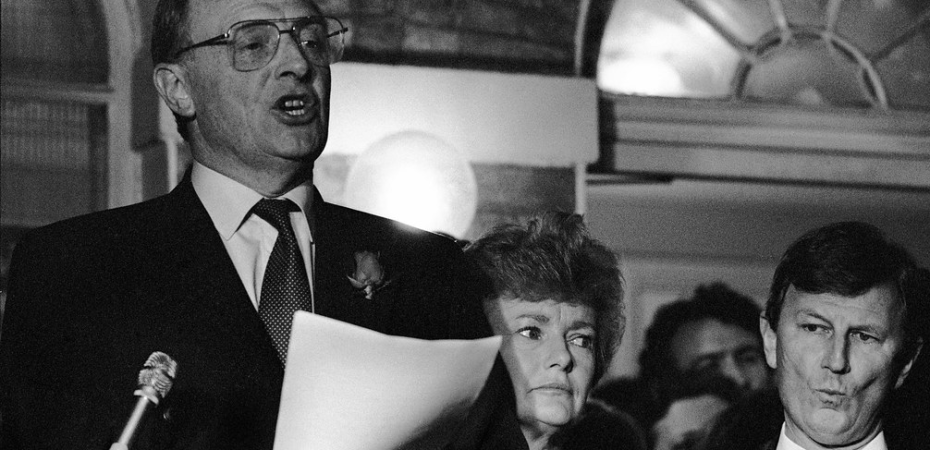
Image: Labour Leader Neil Kinnock conceding the 1992 UK General Election. https://www.flickr.com/photos/fotografiejc/7207045580. Creator: John Chapman. Licence: CC BY-SA 2.0 DEED Attribution-ShareAlike 2.0 Generic
 Labour Hub