

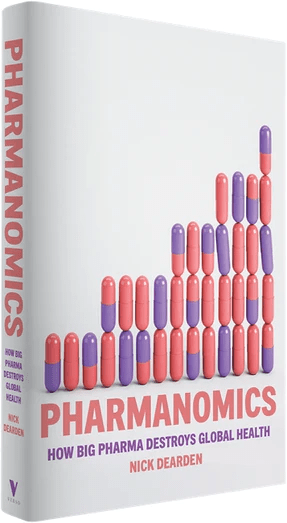
Mike Phipps reviews Pharmanomics: How Big Pharma Destroys Global Health, by Nick Dearden, published by Verso.
The Covid pandemic was good news for the big pharmaceutical companies. It allowed them not only to repair their very tarnished reputations but also to make vast profits.
Profiting from Covid
Boris Johnson may have attributed the development of a Covid vaccine to the benefits of free market capitalism, but for decades the pharmaceutical sector has shown a near-complete indifference to coronaviruses and long regarded any vaccine development as unprofitable. Although vaccine research has a reasonably high level of success, the financial returns are simply not big enough to warrant the effort. Instead, the biggest spender on pharmaceutical research by a long way is the US government, which threw billions of dollars at the drug corporations to develop a vaccine, who then got to control its price and availability.
Companies making vaccines largely ignored COVAX, the international body set up to ensure all countries got a reasonable amount of the vaccines on offer, and chose instead to sell their vaccines almost entirely to the world’s richest countries. They were making an estimated $1,000 per second from just two vaccines.
“It started to dawn on policymakers that a small handful of for profit corporations with no public accountability could decide how many vaccines could be made in a given year, who got to buy them, and at what cost,” notes Nick Dearden in the Introduction of this carefully researched case study of a particularly unpleasant form of parasitic capitalism. “They got to dictate, in other words, who lived and who died in the most serious public health emergency in living memory.”
The alleged behaviour of some of these companies was extraordinary. Pfizer was accused of denigrating the vaccines of one of its competitors, with a potentially disastrous impact on vaccine hesitancy. It was accused of blatant profiteering, trying to charge the United States $200 for a vaccine course that cost $13 to produce. It was accused of bullying governments, forcing them to change their national laws to protect Pfizer’s profits and of stringing lower-income countries along, holding out the possibility of vaccine sales they had no intention of delivering, simply to improve their bargaining position with richer countries.
It’s not just Pfizer. Moderna’s Covid-19 vaccine was developed entirely with public funds “but its CEO, Stephane Bancel, became a billionaire after privatising that knowledge.” It also refused to transfer the knowhow behind the Spikevax vaccine to the World Health Organisation, preventing the production of many more doses, thereby prolonging the pandemic and costing countless lives.
Johnson & Johnson licensed vaccines to be made through a South African company, but then insisted that they were exported out of South Africa, just as that country was entering a major Covid-19 outbreak, and sent instead to the already highly vaccinated rich world.
In September newly disclosed Covid-19 vaccine procurement contracts that the South African government signed with pharmaceutical companies included “overwhelmingly one-sided” terms that favoured drug companies’ profits over public health, according to a review conducted by a coalition of experts and advocates. The South African government’s contracts with Pfizer, Johnson & Johnson subsidiary Janssen, the Serum Institute of India, and Covax online, revealed how Big Pharma “held South Africa to ransom.”
A history of profiteering
Lucrative profiteering in this sector is not new. In 2015, Turing Pharmaceuticals acquired a simple-to-make but lifesaving anti-parasitic medicine, used particularly by Aids patients, and then raised its price by a staggering 5,000%, leading its CEO to be labelled “the most hated man in America”.
Big Pharma increasingly does not develop the drugs it deals in. It acts as a “parasite on public research and public health systems,“ says Dearden, “a super-efficient vehicle for channelling public resources into the pockets of the already super-wealthy.”
The strength of these companies is not their research expertise, but their ‘intellectual property’ – patents and trade secrets – allowing them to control supply, production and (sky-high) prices over a wide range of medicines. The result is a “system of monopoly capitalism, with inequality so extreme and the power of big business so great that it threatens to overwhelm what remains of our democratic rights.”
The UN agrees. Recently, its Committee on the Elimination of Racial Discrimination (CERD) adopted a decision under its “early warning and urgent action” procedures, stating that developed countries’ “persistent refusal” to waive Covid-19 vaccine intellectual property rights, such as patents and trademarks, constituted a violation of non-discrimination guarantees under international human rights law.
Big Pharma’s parasitism takes other forms. Like many other sectors, it is massively involved in financial speculation, often to the detriment of medical research. And when there is ‘research’, it is often simply “geared towards increasing the value of the company’s intangible assets by making negligible changes to drugs so that patents can be renewed and lengthened, thus suppressing competition.”
The opioid crisis
Viewers of the recently televised documentary All the Beauty and the Bloodshed, about ground-breaking New York artist Nan Goldin’s campaigning work, will be well aware of the opioid crisis in the USA. By 2017, 200,000 people had died from issues arising from OxyContin, a drug to which Goldin herself had become addicted. It was, she learned, formulated, marketed, and distributed by a company owned by the Sackler family, who were a major source of philanthropic funds for art galleries and museums across the world. The film showcases Goldin’s activism, as part of the pressure group Prescription Addiction Intervention Now, in successfully persuading art institutions to break links with the Sacklers on account of its connection to the opiate crisis which gripped America.
There’s a history to this: drug companies, from the 1970s on, encouraged large numbers of people with perfectly standard levels of anxiety to take strong medicines such as Valium, with little research done on their addictiveness, which proved to be considerable.
OxyContin too proved highly addictive, despite what company sales reps told doctors. Within five years, it was generating over a billion dollars a year in sales. As the opioid epidemic became a major issue in the US, the company looked to take its lucrative earner into overseas markets – “using the same discredited tactics… including telling doctors that OxyContin is less addictive, pushing ever larger doses of the drug, disguising sales staff as medical professionals, using outdated figures that were subsequently debunked, and giving doctors gifts.”
Lobbying power
If governments are not as bothered by these behaviours as they should be, it’s down to the industry’s formidable clout. In 2021 at least $36 million was spent on lobbying by Big Pharma in Europe alone and there is often an unhealthy revolving door between government and the industry.
Today Big Pharma is keen to break into the huge Chinese market. Historically, it ignored poorer countries, where high-priced medicines were rarely affordable, although the absence of regulation was an attractive feature for some. There is also the tendency to offload useless or expired medicines on less wealthy counties, often in the middle of humanitarian disasters. “This was usually cheaper than paying to dispose of the medicines properly – particularly as the companies involved could earn tax relief, as well as adulation for their altruism, by claiming they were donations.”
Companies have also been accused of taking advantage of epidemics in poorer countries to experiment on patients with untrialled drugs, sometimes with fatal consequences.
Reputational damage
The threat of massive reputational damage to the image of these companies can produce some important victories. By the early 2000s, HIV/Aids was having a catastrophic effect across southern Africa, with as many as 4.5 million – or one in nine people – living with HIV in South Africa, and 1,700 people being infected every day. Big pharma priced its HIV medicines at $10,000 per patient per year, unaffordable to most health care systems or patients in the Global South. South Africa figured it could cut the cost by 90% and was threatened with a massive lawsuit from 39 drug corporations, until the latter were forced to back down by the power of campaigning in South Africa and internationally.
There was a big push too from campaigners to suspend intellectual property rights on all medicine and equipment that could help with Covid-19. It was a central plank of the People’s Vaccine campaign and would have enabled poorer countries to develop their own vaccines for a fraction of the price being charged by Big Pharma. The more poor countries saw a minority of rich countries buy up all the vaccines available, the more they started to back the proposal, which also had widespread popular support in richer countries.
The sheer scale of the inequality involved, the devastating effect of the virus in poorer countries, the growing recognition that new variants could develop in countries with low vaccination rates, which could be a threat in the wealthier countries, and the election of a less nationalist, corporate US president paved the way for “a political earthquake”: a vaccine waiver. Big Pharma was disgusted – and pushed back, muddying the waters with briefings about the real problem being ‘vaccine nationalism’ – and even more absurdly, ;vaccine hesitancy in poorer countries (in fact, in Ethiopia, for example, 98% of people said they would take the vaccine).
The emergence of the Omicron variant highlighted new inequalities. It was revealed that in the six weeks leading up to Christmas 2021, the most vaccinated parts of the world – the UK, the EU and United States – had received more vaccine doses than all African countries had received for the whole year. The week after the variant was announced, Moderna’s CEO personally made more than $800 million, as Moderna’s shares skyrocketed on the assumption that people would need more vaccinations.
Public universal healthcare
Dearden also has some telling points to make about private healthcare, particularly in poorer countries where the behaviour of providers comes close to extortion. Public, universal healthcare has a far better record of giving everyone access to care, at the same time as reducing poverty and inequality. Sri Lanka has provided free, universal healthcare since the 1930s. The country added twelve years to life expectancy in just seven years from 1945, and its low rates of maternal and child mortality rival those of its rich neighbours. Sri Lanka’s health system achieves better outcomes than almost any other country in its income bracket – and at lower cost.
The Indian state of Kerala can tell a similar story. And Thailand, bucking the neoliberal trend, introduced universal healthcare in 2002, 80% delivered by the state, resulting in a rapidly falling maternal mortality rate, and increasing life expectancy. From this standpoint, corporate capital’s relentless assault on public healthcare is not just against the public interest: it’s neocolonial.
Hope
Despite the depressingly familiar story of greedy, rapacious capitalism, this is a hopeful book. Burned by Big Pharma’s hostility to attempts to produce cheaper drugs to deal with HIV/Aids long before Covid struck, South Africa is now working with the World Health Organization on projects to help poorer countries produce their own biological medicines, including insulin and cancer treatments, “a potentially momentous development.”
In Britain too, Jeremy Corbyn put pharmaceutical reform firmly on the agenda at Labour’s 2019 Conference when he highlighted how outrageous prices meant that patients were being “denied life-saving medicines by a system that puts profits for shareholders before people’s lives.” Even former Tory peer and top Goldman Sachs economist Lord Jim O’Neill, who now sits as a crossbencher, has called for parts of the pharmaceutical industry to be turned into a public utility.
US President Biden’s 2022 State of the Union address called for price caps on some common drugs in a passage that almost appears to have been inspired by Jeremy Corbyn’s 2019 speech. Insulin is available for as little as $32 a vial in Canada, but can cost $300 a vial in the United States. Biden suggested capping the price at $35.
Such ‘radicalism’ immediately ran into problems in Congress, and not just from Republicans: “one obstructive Democrat senator who disavowed her party’s platform on the issue has taken over $500,000 from the pharmaceutical and healthcare industries over the years.”
In August, the Biden administration unveiled a list of the first ten prescription drugs that will be subject to direct price negotiations with Medicare, a key step toward curbing the pharmaceutical industry’s exorbitant pricing policy. Socialist Senator Bernie Sanders, Chair of the Senate Health, Education, Labor, and Pensions Committee, welcomed this as “an important step forward in taking on the greed of the pharmaceutical industry and their 1,800 paid lobbyists in Washington, D.C.” He added that “much more has to be done”, noting that the median annual price of medications approved by the Food and Drug Administration last year was over $222,000.
Individual states too are taking the initiative to look into the public manufacturing of insulin, which is already pressurising companies to slash their prices. “These seeds of change have implications beyond the pharmaceutical industry,” concludes Dearden: “the state is back.”
“Why should the public contribute tax money to the development of most of the drugs we use while our citizens then cannot afford those same drugs?” he asks. Put like that, the case for the reform of the industry is unassailable: “a research system that uses funding, legislation and public ownership to prioritise the public interest; a patent system based on the dispersal of knowledge and collaboration as widely as possible; a manufacturing system that is internationally dispersed and free from monopoly power.”
The question remains: do governments have the courage to make this happen? If not, how we do pressure them to make sure they do?
Mike Phipps’ book Don’t Stop Thinking About Tomorrow: The Labour Party after Jeremy Corbyn (OR Books, 2022) can be ordered here.
 Labour Hub