
Sevda Aksoy looks at the turbulent first century of the Republic of Turkey, and the ongoing internal tension between Western-style democratic values and Islamist politics.
The Republic of Turkey, now identifying as Türkiye, celebrated its centenary on 29th October 2023 in a surprisingly subdued way, overshadowed by events in the Middle East.
While Turks are proud of their 100 years as a modern nation, and many are especially proud of economic, cultural and political successes they attribute to current President Recep Tayyip Erdoğan, others felt deep disappointment at their perceived diversion from the founding principles of the Republic. There is a prevailing sense of resignation to defeat, not only in elections, but for their civil liberties, their children’s education and their economic aspirations.
This is not a new division in Turkish society: for much of its century the republic has been fraught with political division, economic turmoil, violence and ideological struggles.
The Republic of Turkey was founded by Mustafa Kemal Atatürk’s followers in the Turkish National Movement after World War I, which ended with the partitioning of the defeated Ottoman Empire by the victorious Allies at the Treaty of Sevres, 1919. The Turkish War of Independence (1919-1923) followed until peace and Turkey’s current borders, were established under the Treaty of Lausanne.
Atatürk led Turkey into a deeply Westernised 20th Century vision of the modern state known as Kemalism, whose ideals were republicanism, populism, national unity; sovereignty; pride in Turkish citizenship; secularism, reformism, and nationalism. Atatürk was a beloved strongman: as a war hero he had the power to effect huge social changes, establishing a completely new order with state institutions and education, Latin script, women’s rights and increased prosperity, and severely curtailing religious influence. Since Atatürk’s time, Turkeyhas followed a conflicted, erratic path between Kemalism, and its Islamic heritage.
Atatürk aimed to make modern Turkey a significant world power. A century later, a different strongman beloved to partisan followers, leads Türkiye with a different vision but the same, ultimate aim. This has impacted the country’s foreign relations and continues to do so; but the impact on ordinary Turks has been much greater. Turkey has undergone repeated economic, political and social turmoil, swinging between Kemalism, nationalism and Islamism. Political forces have squeezed out leftist, then liberal, values and options for the Turkish population.
Western commentators may deplore Turkey’s recent slide into repression of press freedoms and civil society, mystified at the 2023 re-election of a President who has overseen inflation levels of 80-100% and an earthquake disaster which killed at least 50,000 people. EU and US politicians seethe with frustration at the current President’s vacillation between Russian and NATO alignment. Some 50% of the Turkish electorate themselves oppose Erdoğan. However, his survival and success are rooted in the rise of Islamist political ideology and the failure of Western politics domestically and abroad.
In the 21st century, deeply anti-American views have spread across the Turkish socio-political spectrum. Though neutral in World War II, the new social democracy of Turkey, nervous of Soviet demands for bases on the Dardanelles, sent troops to Korea to support NATO, and became a full member in 1952. The USA immediately established a major Cold War frontier airbase at Incirlik, safeguarding Turkey’s external security and NATO’s border.
Nowadays NATO membership is seen both by Turks – and by the West – as more of a bargaining chip rather than a collective endeavour. Recent pro-Palestinian protests across the country included targeting an American airbase in fury at USA foreign policy. Presidential rhetoric has fomented anti-Western expression, but politically opposed Turks are also disenchanted. It is commonly believed that American influence on Turkish politics – either directly on the military or through the International Monetary Fund – has underpinned much of the country’s turmoil.
Typical Western perceptions of Turkey as a beautiful land of cheap holidays and historic ruins ignore the harsh reality of the recent past. Mid-20th century Turkey saw huge political instability. The army, self-designated guardian of Kemalism, and deeply embedded in Turkish society, ousted elected governments in 1960, 1971 and 1980 and less directly, in 1997.
In 1960 PM Menderes was ousted by an army coup and executed. The 1950s Menderes government relaxed some rules on religious worship but repressed the press and had also orchestrated ‘deep state’ forces leading a 1955 pogrom against the Greek minority in Istanbul. In 1963 a new constitution was set up with elaborate checks and balances on government, but it also legalised strikes.
Throughout the 60’s, electoral power swung between the centre-left CHP (Republican People’s Party) and centre-right AP (Justice Party), but Kemalist ideology was always in the ascendant. The state intervened to support industrialisation and move the economy away from agriculture-based exports. There was economic growth but unemployment and poverty continued. Many rural workers moved to cities in Turkey and to Western Europe. (See Turkey’s Economy Under the Generals – MERIP for a left-wing review of the period.)
In 1971, economic recession, high inflation and devaluation gave rise to mass protests and demonstrations, stoking conflict between workers in labour unions, left-wing students, and politicians on the one hand, and the growing right-wing, often violent, nationalist movements of Islamist Necmettin Erbakan, and Grey Wolves leader Türkeş, often supported by poorer Turks. The pro-Socialist ideas of leftist groups were eyed with suspicion by the USA, at a time of intense Cold War rivalry. When the army ‘Coup by Memorandum’ took place that year, installing a more Kemalist regime, leftist political parties and labour unions were closed with leaders penalised or executed. The army’s Kemalism, perceived to be backed by the USA, was arguably more about power than republican values.
Upheaval did not end there. Turkey changed Prime Minister changed 11 times in the next decade. The invasion of Cyprus in 1974 brought a brief sense of national unity in the face of international condemnation, but economic conditions, exacerbated by the need to import oil, caused repeated currency crises and the failure of successive coalition governments.
Armed factions of the revolutionary left and ultra-nationalist right conducted endless demonstrations, strikes, robberies and street battles. Thousands died. The economy shrank. There were shortages of basic foodstuffs as producers and wholesalers held back stocks. Caught between these groups, I fled before the army took over in 1980.
During martial law which followed, tens of thousands of leftists and trades unionists were killed, imprisoned or ‘disappeared’. The left in Turkey has never recovered from the purges.
The army brought in a new Constitution, which prohibited women from using the hijab head-covering in most state institutions. Kemalism was focused on secularism, not democratic rights.
Later, the army installed as Prime Minister TurgutÖzal, who had a declared antipathy to protectionism and active participation of the state in the economy. He privatised allegedly inefficient state services, lifted exchange controls, liberalised imports and pursued free market policies. Favourable IMF and OECD funding to develop industrial production, and improved links to the international banking system were seen by many as a not-unwelcome American-led strategy to develop Turkey as a capitalist market, but by others as a very unwelcome method of political control. Inflation fell, bringing economic and political stability, and the long overdue goal of bringing water and electricity to every village was set. (See U.S. Relations with Erbakan’s Turkey | The Washington Institute,1986.)
As President, Özal now promoted a new fusion of Westernisation and Turkish Islamism, developing new mosques, Islamic banking and encouraging pious, provincial entrepreneurs. Right-wing, Islamist and nationalist groups were proscribed for years by the army but then gradually rehabilitated and allowed to proselytise, although they were monitored closely.
Ultimately this stoked conservative and rural voters’ support for outright Islamist, avowedly anti-Western parties such as the previously banned Erbakan‘s Welfare party (1995-8) and later, his ideological heir, Erdoğan’s AKP (Justice & Development Party – See Hudson Institute’s acerbic item Erbakan, Kısakürek, and the Mainstreaming of Extremism in Turkey | Hudson).
There were other reasons for rising Islamist support. The 1990s coalition governments were plagued with corruption scandals, often involving deep state activity, and under PM Tansu Çiller, there was an explosion of hostilities with the PKK’s (Kurdistan Workers Party) militant campaign for Kurdish rights. Distrust of the Westernised Kemalist legacy grew, fostered by Islamist political movements whose support was culturally rooted and intensified by income inequality between social groups and the influx of rural poor into the expanding cities.
In 1997 the army again intervened with a list of recommendations for the education system and bans on Islamic political groups. PM Erbakan had to resign. His pious Muslim supporters felt alienated and persecuted, and as the ban on women wearing the headscarf in universities and public offices intensified, so did resentment against ‘Westernisation’.
Subsequent coalition governments struggled with volatile growth and a weak banking sector. 2000-1 saw bank and business failures, currency depreciation and GDP shrank by 5.7%. (See Growth and economic crises in Turkey leaving behind a turbulent past (europa.eu).)
The political reaction to this chaos was the 2002 electoral victory of the Islamist Justice and Development. [Adalet ve Kalkınma] Party set up by Erdoğan, former Mayor of Istanbul, and ostensibly led by PM Gül. In 2003 Erdogan took over as PM, now leading the AKP.
Economic growth boomed over the next five years with increases in investment, production of motor vehicles and white goods, exports and domestic consumption. At the same time, EU accession was in negotiation, requiring legal reforms, and a stricter IMF-imposed financial regulatory framework was in place.
With only 34% of the vote, the AKP had to harness a wider range of political support to start to roll back decades of the resented Kemalist military, bureaucratic and bourgeois elites’ domination of Turkish society. At that point society seemed to be liberalising: restrictions were eased on women wearing headscarves in state buildings and on the use of Kurdish language in Kurdish-dominated south-east regions. AKP support expanded from its base of conservative, provincial businessmen, the declining but still substantial rural population and the rapidly expanding urban poor, to a wider polity grateful for clear economic progress and initially mild, liberalising reforms. The AKP also encompassed members of the separate Islamic Fethullah Gülen movement.
When Abdullah Gül was nominated as President in 2007, the military again tried to intervene, but the AKP had sufficiently strengthened its political base to resist their demands. The AKP ordered the arrests and mass trials of some 300 officers, generals and some journalists. The Islamists now wielded more power than the Kemalists.
A confident AKP now clamped down on criticism of the government on social media and news outlets, both print and television. For example, in 2009 Doğan Holding group, a media and manufacturing giant perceived as a major opposition voice, was fined a massive US$2.5 billion for unpaid taxes, sending a clear message to other critics. The allegiance of the judiciary and state bureaucracy shifted from the military to the AKP as new appointments were made. Members of the Fetullah Gülen’s well-educated Hizmet movement were rapidly promoted in the army and in civil institutions, despite divergences in ideology from the AKP.
In 2008-9 the global financial crisis hit Turkey hard: industrial production fell 40%, GDP fell 4.6% and unemployment rose to 15%. (See The Ups and Downs of Turkish Growth, 2002-2015 – P.pdf (mit.edu).)
However, from 2011, Turkey sustained a decade of growing GDP, tourism and construction, huge infrastructure investment and rising consumer demand facilitated by easier finance. The popularity of the AKP was entrenched. (See The impact of financial development on income inequality and poverty – PMC (nih.gov).)
In 2010 EU accession stalled, with politicians and citizens of both the EU and Turkey disenchanted with talks. The EU balked at infringements on civil liberties and the endemic corruption in business where profitable public procurement contracts went to AKP supporters.
The Gülenist movement also opposed several of Erdoğan’s actions: blocking their access to those lucrative state contracts, liberalising the use of Kurdish language, anti-Zionist rhetoric, mooted rapprochement with Iran and finally, omitting Gülenist candidates from the AKP party lists for the 2011 elections. (See ANALYSIS: Dissecting Turkey’s Gulen-Erdogan relationship | Middle East Eye.)
In 2013 this antipathy came to a head when a corruption scandal broke, implicating leading AKP figures. An AKP government decree dismissed police officers and prosecutors leading the arrests. Gülen described this as a ‘judicial coup.’ AKP reshuffles and resignations followed. Turkey’s power struggle was now within the Islamist movement.
The scandal came on top of a huge youth-led protest about the destruction of Gezi Park in Istanbul, in the summer of 2013, and the excessive force police used to end the sit-in. It was really the last stand for civil liberties. Subsequent protests such as those for the 2014 Soma mine disaster with 300 fatalities, under employers linked to the AKP, were easily swept aside.
After their 2013 disputes, the AKP leadership sought to disempower the Gülenist movement, repeatedly referring to them in AKP-dependent TV and print media as a ‘parallel’ state within the machinery of the Republic, particularly in the army, police and judiciary, and through their schools and charities. Prosecutions of individual Gülenists mounted.
When a faction of the Turkish military attempted a coup in July, 2016, 300 people died but an outraged citizens’ uprising narrowly saved Erdoğan. He blamed Fetullah Gülen’s movement and designated it a terrorist organisation (FETÖ). Subsequently hundreds of thousands of Gülen followers were sacked, prosecuted and jailed, gutting the army, judiciary, police, schools, universities and bureaucracy of Hizmet contacts. Banks and businesses owned by Hizmet supporters were repossessed by the state and handed over to Erdoğansupporters.
Neither secular Turks nor AKP supporters had sympathy for the Gülenists who faced harsh sentences on often flimsy evidence. The AKP set the agenda for TV and print messaging and engendered immense nationalist sentiment. This time the abortive coup was not seen as a Kemalist vs Islamist struggle; instead, most Turks suspected US support for a Gülenist coup. (See The Big Split: the Differences That Led Erdogan and the Gulen Movement to Part Ways (turkeyanalyst.org) 2012).
Secularists should have realised that their civil liberties were now further at risk, but the dominant narrative in Turkish society was the culpability of the West, particularly USA foreign policy, for alleged interference in Turkish domestic politics, and for widespread death and destruction in Islamic nations: notably Iraq, Afghanistan and Syria.
In terms of economic and social impact, Syria has been the most significant conflict for Turks nationally, intertwined with the intractable horror of three decades of hostilities with the PKK in the Kurdish-majority provinces of the south-east. The war in Ukraine has also produced some unexpected and unwelcome consequences for Turkey. The catastrophe of the ongoing Palestinian conflict will further shape future relations between Turkey, NATO and the world, with implications for European foreign policy. In a multi-polar political world, these issues require separate analysis.
It is not surprising that the Islamist AKP has consolidated power. Besides reconfiguring constituency boundaries and arranging charity to supporters galvanised through the Diyanet’s Ministry of Religious Affairs mosque network, it has also bolstered national pride and broadened prosperity: enormous infrastructure projects were realised across the country and the health sector transformed to world class levels. Pensions and minimum wage levels have been consistently raised and ownership of cars, property and consumer goods greatly expanded. Even though the Turkish Lira has collapsed and inflation has soared under his policies, there was still huge support for Erdoğan and the AKP in the 2023 elections.
To begin to understand and work with a newly outwardly-identified Türkiye on international issues, Western politicians need greater awareness of how the country’s turbulent first century has lowered its expectations of how Western values can deliver economic benefits and social cohesion domestically, and how that will shape its foreign policy.
Sevda Aksoy is a pseudonym.
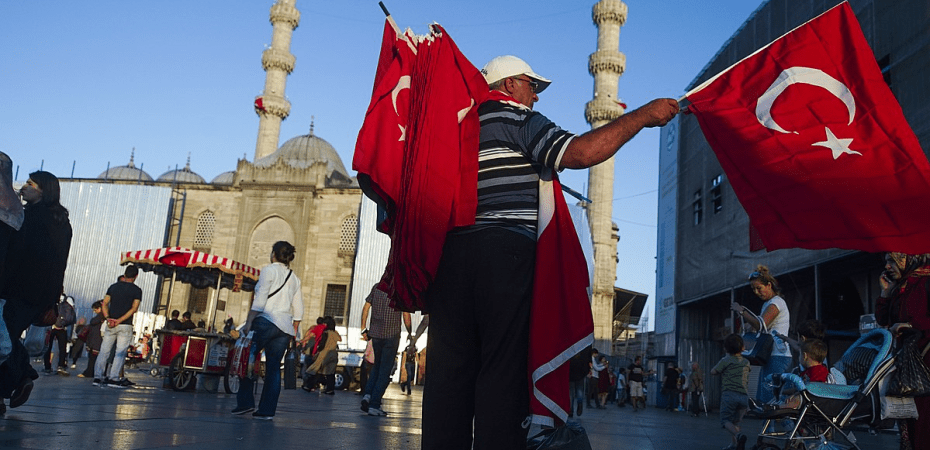
Image: Man selling the national flag of Turkey at during after-coup demonstrations of President Erdogan supporters. Istanbul, Turkey. Author: Mstyslav Chernov, licensed under the Creative Commons Attribution-Share Alike 4.0 International license.
 Labour Hub