
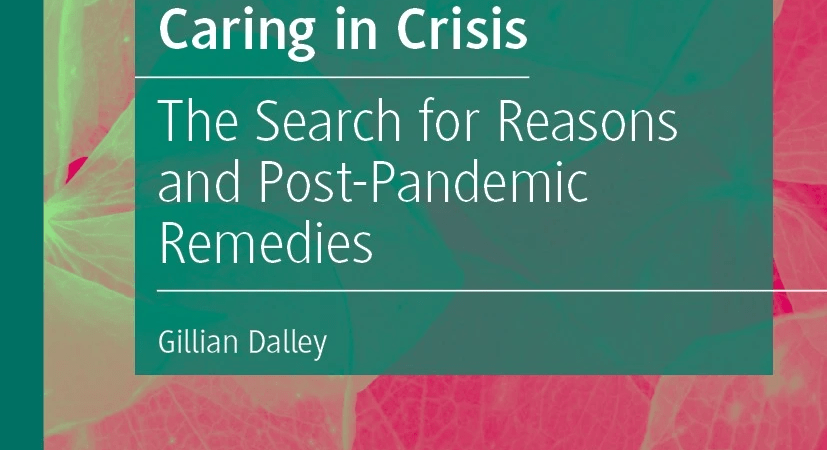
By Gillian Dalley
Three Prime Ministers ago, we were told by the first of them, on winning the 2019 general election, that social care would at last be fixed. But even now, with both him and his immediate successor already gone, the third of them – in tandem with his sidekick the Chancellor of the Exchequer (himself a former Health & Social Care Secretary) – has maintained the delay and cancelled the changes proposed four long years ago. Thus, PMs Johnson, Truss, Sunak and CoE Hunt are all complicit in creating the delayed – and arguably worsening – state of social care that exists today. So, no surprise there, then.
But what this means for us all is that the state of social care – described in my book Caring in crisis published last year (and issued in paperback this year) – has simply got much worse. Four substantial problems continue to dominate: the near collapse of the social care market; a deteriorating relationship with the NHS, still reeling from the Covid 19 crisis; a decline in quality exacerbated by a severe shortage of staff, post-Brexit; and public outrage remaining a source of concern to politicians especially in the lead up to a general election.
It is important to remember that around 84% of social care is located in the private, profit-making sector and is therefore highly vulnerable to market conditions. The public sector is responsible for a mere 4% of social care provision, the remainder provided by the voluntary/charity sector)
Back in 2017, the Competition & Markets Authority (C&MA) reported on the increasing numbers of social care companies, especially care homes, going out of business, including the two largest. At the same time, local authorities were facing increasing demands from people for assessment of their care needs and financial support. The crisis was growing.
Reporting recently, the National Audit Office (2023) has drawn attention to the increasing burden this pressure creates for local authorities faced with squeezes on budgets, raising questions about their financial sustainability, and with no planning for any future ‘system reform’ beyond the immediate plans. The King’s Fund (2023) reporting on the state of social care currently confirms much the same that C&MA found six years earlier, before the pandemic took hold.
More people are requesting and waiting for social care but fewer are actually receiving care. Costs to local authorities of purchasing (commissioning) care from the private companies providing it have increased; likewise staff vacancies have increased (10%); satisfaction is falling; pay for staff compares negatively with other types of employment – with consequences for vacancy rates.
Experience during the course of the Covid 19 pandemic demonstrated how dependent the health system, particularly the NHS, was on the availability of social care in times of crisis – particularly relying on care homes as a back-up to over-burdened hospitals and home care as a means of caring for people in their own homes when cut off from access to family support. But the country was ill-prepared – information on the scale and geographical availability of social care services, all in the private sector, for example, was not shared with public authorities – see the Cygnus report (PHE, 2016).
And while the pandemic had a major impact on standards of care, the issue of declining quality and availability of services for those assessed as needing care has continued. Staffing shortages remain a continuing problem. In addition, concern has also been expressed in the most recent Care Quality Commission annual report (2022-23) about the growth of unethical overseas recruitment practices.
A further sign of crisis has been the continuing public outrage expressed when people realise that social care, unlike the NHS, is not free at the point of need when they or their family members are confronted with the high costs they have to pay when care is needed. While there is a means test, it is generally regarded as neither fair nor generous. Anyone with savings of more than £23,250 (and including the value of their house) has to pay for social care. Promises to introduce new funding arrangements, such as putting a cap on life-time costs have been promised but such proposals have not been properly explored or tested – and indeed Caring in Crisis explains and argues against them.
So the country still has to wait for governmental decisions about the future to be re-introduced. However, in my view and as I argue, it is time to think more inventively about the future. Let’s take the opportunity to tackle all the problems so far listed by introducing new ideas, borrowing sometimes, yes, from the ideas and ideals that underpin the NHS – and adapted as needed to meet the undoubtedly different (in some key ways) requirements of social care.
Most of them are considered – and favoured – in Caring in crisis. These include:
- social care that is free – and available – at the point of need;
- a publicly-funded core service based in the local authority, accessible to all, doing away with the need for costly contract commissioning and monitoring of private services – and ensuring local management of a publicly-funded local service with a national oversight board to ensure standards across the country;
- abolition of local authority responsibilities to do with shaping and managing any private market;
- costs of accommodation to be separable from the costs of care, along with some consideration of introducing a new code of practice with regard to the attribution of responsibility for payment of those costs. Remember, in respect of residential care, social care is not hospital treatment. It is the means whereby people are enabled to live their daily lives as fully as possible in tandem with, or in spite of, their need for care. But this means complexity in terms of where and how the boundaries of personal responsibility and public support begin, mix and end;
- Along with a comprehensive social care workforce plan, a nationwide social care planning system needs to be established to ensure the supply of good quality services to meet the need for care and for staff training, distributed fairly across all areas of the country;
- An emphasis on innovation – through, for example, the establishment of a College of Social Care to ensure the generation, endorsement and spread of new, provenly effective, ideas;
- Availability of more elaborate facilities for those who choose and can pay for them themselves and subject to quality standards (mirroring the NHS/private position).
With a general election expected in the coming year, this may be the last time we have a chance to consider these issues fully in order to decide how to make a real difference to people’s lives. Let’s make the most of it.
References
C&MA (2017) Care homes market study (Final Report), CMA.
National Audit Office (2023) Reforming adult social care in England, DHSC HC184.
King’s Fund (2023) Social care 360, King’s Fund.
Public Health England (2017) Exercise Cygnus Report, 2016, PHE.
Gillian Dalley is a social anthropologist with research interests in health and social care, women’s rights, the development of quality standards in public services. She is a member of the Labour Party, and is chair of a ward in Islington North CLP. Her book Caring in crisis: the search for reasons and post-pandemic remedies is published by Palgrave Macmillan, Springer Nature.

 Labour Hub