
Nadine Finch analyses the Supreme Court’s Rwanda judgement.
The UK Government (and the official Opposition) are currently outliers in relation to respect for international law. This is clearly indicated by its policy in relation to the multiple breaches of humanitarian and criminal law being currently perpetrated in Gaza, the West Bank and East Jerusalem. But in many other areas of legislation and policy, international obligations are also being ignored.
It is in this context that the UK Government’s response to the Supreme Court’s judgment in the Rwanda case needs to be analysed.
The Supreme Court made it clear that its judgment was based on the law and the evidence before it and not on any political opinion that it may have. But the intrinsically political nature of the desire by the UK Government to ‘stop the boats’ and outsource the UK’s duty to determine asylum applications meant that it had to state this explicitly. In the political context of the Government’s assertion that the jurisdiction of the European Court of Human Rights poses a threat to UK sovereignty, the Court also had to stress that its judgment was not only based on the European Convention on Human Rights.
The issue before the Supreme Court was the narrow one of whether under the Migration and Economic Development Partnership, under which Rwanda would be responsible for determining asylum applications made in the United Kingdom, was lawful The Court decided that there were substantial ground for believing that there was a real risk that asylum seekers would be returned from Rwanda to their countries of origin, where their rights to life and liberty would be threatened. Therefore, the scheme would amount to a breach of the international principle of non-refoulement and a number of international treaties that the UK had ratified.
Legal judgments are not made by merely looking at legal texts. It is necessary to scrutinize the evidential basis upon which a legal decision must be made. The Supreme Court looked, in detail, at evidence from the legal teams for the Appellants and the UNHCR and the outcomes of a previous and similar agreement between Israel and Rwanda. On the basis of this wealth of evidence, the Supreme Court decided that the evidence indicated that the lack of legal infrastructure and experienced lawyers and judges and previous actions by Rwanda would create a real risk of refoulement, if asylum determinations were outsourced to Rwanda.
The UK government was very quick to assert that the Supreme Court had not found that returning asylum seekers to a safe third country was unlawful. But this was not the legal question that was before it.
States, such as those in the European Union, have created schemes to share responsibility for an influx of refugees in times of crisis. The UNHCR and other international bodies do not oppose this, but so-called ‘burden sharing’ is not the same as the scheme, devised by the UK, to externalise its international obligations under the Refugee and other international Conventions.
The manner in which the United Kingdom places countries on its list of ‘safe countries’, under the Nationality, Immigration and Asylum Act 2002, and from which applications for asylum are inadmissible, except in exceptional circumstances, may be challenged in the near future. Initially this list was made up of other members of the European Union on the basis that they had all ratified the European Convention of Human Rights and at least parts of asylum law which was in force across the Union. But now the Government seeks to extend the list to both India and Georgia. The number of individuals who are granted asylum from those states is not substantial, but neither is it negligible. In the year between April 2022 and March 2023, 17 individuals from India and 14 from Georgia were granted asylum. But this will be for another court.
The Prime Minister has also stated that it is drawing up a treaty with Rwanda to replace the current Agreement, that only has the status of a Memorandum of Understanding. Such a treaty would be an international treaty between the UK and Rwanda, but it would not have the effect of displacing or substituting for other international treaties ratified by the UK. These include the UN Convention on the Status of Refugees, the UN Convention against Torture, the International Covenant on Civil and Political Rights, as well as the European Convention on Human Rights, as stressed by the Supreme Court. The principle of non-refoulement is also a widely accepted part of customary international law, which does not depend on the ratification of any particular convention or treaty.
Furthermore, articles in a Treaty may promise to abide by international law but, if the legal infrastructure to do so is missing, this is in practice a hollow and unachievable commitment. One of the shortcomings in the High Court judgment on the Rwanda scheme, which was overturned in the Court of Appeal and the Supreme Court, was that the judges did not engage with the evidence before it, but merely relied on assertions by Government lawyers that Rwanda would not breach international asylum law. A treaty that was not based on facts would be another form of baseless assertion.
It is also far from clear that the Rwandan government believes in the need for reforms. In a statement issued after the Supreme Court judgment, it said that “given Rwanda’s welcoming policy and our record for caring for refugees, the political judgments made today were unjustified.”
The Prime Minister has also pledged to introduce emergency legislation to prevent generic challenges to removing individuals to Rwanda, by declaring that Rwanda is a safe country and seeking to disapply parts of the Human Rights Act with which he does not agree. This amounts to the executive, and potentially Parliament, preventing the judiciary from exercising its supervisory role under the unwritten British constitution.
There are already some judges who are considering the viability of their remaining within the judiciary, as a result of the contents of the Illegal Migration Act 2023. The proposed emergency legislation may put other judges in impossible constitutional positions. It has also been held in a number of previous cases that ‘ouster clauses’ may not be binding when they seek to exclude the supervisory jurisdiction of the High Court.
In addition, seeking to disapply parts of the Human Rights Act will not nullify the UK’s international obligations under the UN Convention against Torture, the UN Convention on the Status of Refugees or the International Covenant on Civil and Political Rights. Nor will it disapply international law that has already been incorporated into other domestic law, such as the Asylum and Immigration Appeals Act 1993, the Nationality, Immigration and Asylum Act 2002 and the Asylum and Immigration (Treatment of Claimants, etc) Act 2004.
The UK Government is keen to make stopping the boats a key issue in the forthcoming election and is willing to breach international law to do so.
Unfortunately, the Labour leadership is echoing the call to stop all boats without paying attention to the individual characteristics of the children, men and women travelling on those boats as their only viable route to sanctuary. It also needs to distinguish itself from this simplistic and populist pledge, if it is to truly portray itself as the defender of law in all its aspects. To pledge to crack down on criminal smuggling gangs and speed up safe returns fails to defend international law, which is under threat as never before.
Crucially, it also fails to defend those most at risk; those fleeing from persecution, death and torture and to acknowledge the extremely high number of asylum seekers who will be granted asylum. In the year to June 2023, 70% of applicants were granted asylum by the Home Office without an appeal. Judging by similar time frames, of the remaining 30%, 43% will win their appeals in the Immigration and Asylum Tribunal.
Nadine Finch is a former barrister who specialised in human rights law and is the author of several books on family, immigration and comparative law. She writes in a personal capacity.
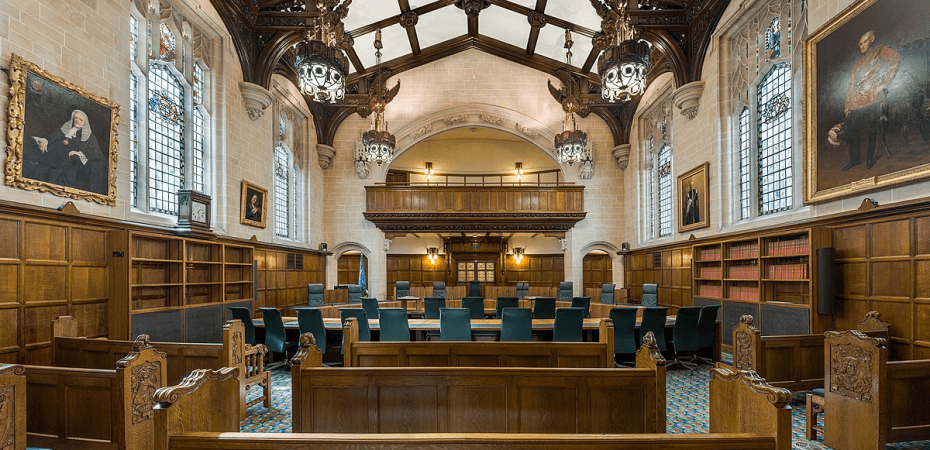
Image: Supreme Court of the United Kingdom. Author: Diliff, licensed under the Creative Commons Attribution-Share Alike 3.0 Unported license.
 Labour Hub