

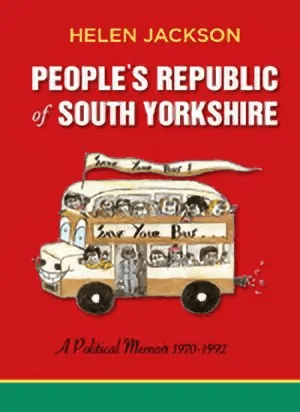
Helen Jackson introduces the second edition of her book People’s Republic of South Yorkshire, published by Spokesman.
What started as an historical story using the collective voices of many people in the 1970s, ‘80s and ‘90s has gone political, its lessons louder, its interpretation and my thoughts more urgent, as I hear them echoed widely.
The book’s final chapter ‘The Way Forward’ talks about Global Solutions to meet Global Needs. It describes the 1995 4th U.N. Status of Women conference held in China. The resulting Beijing Declaration and ‘Platform for Action’ was adopted unanimously by 189 countries. To the need for a common understanding of global impacts of gender inequality, climate change and pandemics must now be added humanitarian rules of warfare.
Most of my life has been governed by post-World War II efforts to establish through international agreement what is or is not permitted in times of war.
Last week’s UN Security Council voted to clarify and strengthen ‘International Humanitarian Law’. Its adoption by the Council with only three abstentions – the US, UK, and Russia – makes illegal Hamas’s brutal attack on the Festival and kibbutz close to Gaza as it also makes criminal the indiscriminate bombing by Israel of countless homes in residential and refugee areas of Gaza and, as I write, the wholesale destruction of its largest hospital, schools and other places of refuge, that have killed thousands of innocent civilians and children. In addition the refusal of Israel to allow the Red Cross, UNWRA, and other humanitarian agencies access to fuel, water and medical assistance is illegal.
In response to this dreadful human tragedy, it will be through local action, and after very hard talking that, gradually, recovery will be seen and recognised.
It is in longer term rebuilding following violent crises that an underlying calm, courageous, determined and community strength are most needed. There has been recent fruitless semantic debate about the difference between ‘ceasefire’, and ‘cessation of violence’. Of course both are essential, the sooner the better. Both are only achieved over time.
South Yorkshire, home to roughly two million people, bore the brunt of a series of closures of steel works in Sheffield and Rotherham that created a sudden increase in job losses and unemployment. Urgent action was needed. This was compounded in the rest of the area by a programme of pit closures which pulled the heart out of the rest of the ‘People’s Republic’ as we knew it. The miners’ strike led by Arthur Scargill in Yorkshire and Peter Heathfield in Derbyshire followed.
Peoples Republic reflects on how community strength and collective hard deliberation took place. This combined with an intensive programme of adult education, joint working through Sheffield Trades and Labour Council, respectful talks and action between employers and trades unions in the large Council-run Works Department, new business start up funding and training, especially focussed on women in non-traditional trades and technology, and eventually constructive working between private business interests and the public sector.
It was far easier to work between departments at a local and regional level than at a national one. Cheap fares supported the cost of living pressure on working class people or what’s known now as ‘levelling up’, They helped the older generation stay mobile while children, for 2p, were able to afford to travel around to favourite leisure facilities, and grew in independence. Likewise, David Blunkett, as the Chair of Social Services devised an innovative programme of Elderly Persons Support Units, in conjunction with the NHS Primary Care GP Medical Centres which brought together specialised Housing, Home Help Services, and Lunch Clubs, without the need for privatising and fragmenting these essential services for well-being.
Back then South Yorkshire’s united appreciation and pride in its public transport system, for example, proved so popular that South Yorkshire had a regular order with British Leyland in Lancashire for new buses every year. Tramlines were planned. Local Authorities like the GLC in London followed suit. Sadly such local government initiative became too popular. Margaret Thatcher’s government felt it had to respond to what they saw as a threat to their basic ideology of privatisation and she simply abolished regional county authorities along with the GLC.
I entered Parliament in 1992, and became Parliamentary Private Secretary to Mo Mowlam and her successive Secretaries of State. This year, 2023, has marked the 25th anniversary of the Good Friday Agreement and recent events have brought back memories. As PPS my first task, after talking with Mo two days after her appointment on her return from a walk-around visit to the market in Belfast, was to have a cup of coffee with Lady Mayhew and make useful contact with women across the region. Mo explained that she wanted me to get over to Northern Ireland as much as possible and talk to women in communities: “We can’t do this, Helen, without the women! They aren’t in the existing political parties but they must be part of the talks.”
The recent Israeli/Palestine conflict has shone a focus on what lessons might be learnt from those talks as years of bitter antagonism ended on Good Friday with a degree of agreement, or at least a plan for peaceful sharing of a region around the same size in population as Gaza itself.
So a first lesson is to involve everyone, however hard this may seem. Peace and democracy go together.
A second is patience and time. Talking about talks had taken nearly ten years. 25 years later we celebrate an initial agreement but are taking even longer to accept, implement and respect all its findings. Stormont is not yet in operation.
A third is the creation of momentum through deadlines. Easter was set. A deadline for taking part in talks was established which entailed a race against time for women to form their Party – NIWC; another deadline for the referendum vote to take place before the marching season pressurised both Parliament and the Dail to complete legislation with urgency.
A fourth I reflected upon was the involvement of the international community. The EEC helped through their ‘Peace and Reconciliation’, Hilary and Bill Clinton proposing that George Mitchell, from the US Senate should Chair the negotiations, while Finland and South Africa offered to head the sensitive issue of overseeing weapons disarmament. Finally both Irish and UK governments agreed the process together and adopted the outcome through a democratic vote.
The fifth has to put the focus on an absence of violence and killing. No formal talks could take place until there were ceasefires. The six Mitchell principles, which all the Talks’ participants had to agree to absolutely before formal Talks could begin, all related to the cessation of violence of every description from killings to threats and beatings.
It has been sad and tragic to watch the destruction and devastation of homes, schools, hospitals, access to aid and the basics of living in Israel and Palestine in recent weeks. Disregard, lessening and non-compliance with United Nations humanitarian laws is far more dangerous than the pressures of economic change we faced in the years covered by my book and which we faced down with the positive determination I described only three years ago.
Let us hope that local positivity returns to start to heal this international setback in the weeks, months and years to come to bring about a cleaner, safer healthier world.
Helen Jackson CBE was Labour Member of Parliament for Sheffield Hillsborough from 1992 until 2005.
 Labour Hub