
Labour Hub contributor David Osland joined Labour MP Margaret Greenwood and author Robert Verkaik at Durham Union on Friday, to support the proposition “This house believes that private schools do more harm than good”. This is an edited version of his speech.
It’s unusual for socialists to start speeches with an observation from a leading Tory.
But as Michael Gove has pointed out, at Oxford and Cambridge – and probably Durham, too – Old Etonians outnumber the children of parents on benefits.
And that matters. Because private education is not just another status symbol. Not just another positional good.
This is a zero-sum game; for one pupil to succeed, another must fail. And a competitive advantage conferred on just 7% of the population is necessarily a competitive disadvantage conferred on everybody else.
The concrete is crumbling in the roofs of 140 of our state schools. Real terms spending per pupil is less than in 2010. So much for ‘levelling up’.
Meanwhile, those who attended top public schools are 94 times more likely to reach a senior position in society than those educated anywhere else.
With Britain more unequal now than even in Victorian times, private schools exert a powerful gravitational pull. They remain the single most effective mechanism for the transmission of class privilege from one generation to the next.
They decisively shape their products. How they grow up, what sort of people they become, how they handle the positions of power they go on to monopolise.
Segregated education leaves many of our top politicians, senior civil servants, judges and journalists with no understanding of – not the slightest empathy with – the realities of life for ordinary people.
We debate this issue at a time when government has openly operated as an old school tie cartel for the best part of 13 years. Eton, Winchester and St Paul’s have become the in-house education system of the Conservative leadership.
The wrongheaded policies this government and its recent predecessors have inflicted on the weak and the poor cannot but reflect this unrelenting grip on power.
Public schoolboys gave us austerity. Slashed benefits for the disabled, introduced bedroom tax and Universal Credit, and ensured that working class students graduate £60,000 in debt.
In a fit of absent-mindedness similar to the one by which the British Empire was supposedly acquired, public schoolboys pulled Britain out of the European Union.
Then they boogied through lockdown, doling out PPE contracts and peerages alike to Tory donors.
And I’m sorry, but if you attended a school that charges more in fees each year than the annual salary of a classroom teacher, maybe don’t tell classroom teachers they earn too much.
We are debating the proposition that private schools do more harm than good. That is a minimal proposition, and I for one would take it to its logical conclusion. If something does more harm than good, it should go.
Let me tell you why. Firstly, private schools entrench a self-perpetuating cycle of privilege. Private education is the path to high income and wealth. High income and wealth is the path to private education.
Not for nothing were these establishments long ago branded the cradles of the plutocracy. They sustain, protect and perpetuate the power and advantage of Britain’s ruling elite.
Secondly, there is the argument from Pareto optimality. For each pound spent on a state school student, a public school kid gets three.
Looked at from the standpoint of overall educational needs, private education skews the distribution of resources. The money would be far more effective if directed where it would do the greatest good.
If socially-advantaged children attended schools that educate the rest of us, it would boost the self-esteem and confidence of other pupils. Standards would rise, because affluent parents would demand it.
And there’s more. Private schools hire state-trained teachers without contributing to the cost of training. That accentuates shortages in state schools, especially in hard to fill areas like STEM subjects.
That’s a de facto subsidy. And it’s not the only one. Ludicrously enough, most private schools are registered charities.
That leaves them exempt from VAT on fees. Exempt from business rates and corporation tax on their billions of pounds of investments. Even the six-figure donation Rishi Sunak gave Winchester was boosted by 40% gift aid.
Incredibly, the average place in a private school attracts more taxpayer support than the average place in a state school.
Some of the speakers on the other side of the proposition tonight style themselves free market right wingers. Shouldn’t they have the courage of their convictions?
As long as these businesses exist, let them pay their way. To quote Jeremy Hunt: stop coasting on the taxpayer.
Thirdly, private schools are deleterious to democracy. Detrimental to Britain’s cohesion and fairness. Intrinsically incompatible with the ideal of social mobility.
They render meritocracy – supposedly the goal of Labour and Tory governments alike – flatly impossible.
Education is one of the most effective means we have for reducing the chasm between the haves and have nots.
If we fail to use it to achieve this end, we produce a brittle society. We culminate in the kind of polarisation that gave us the riots of 2011.
Let me refute some of the claims made in favour of private education. Private schools do not provide substantial community benefit.
Giving bog standard comps on Teesside posh branding does nothing to increase educational standards.
So-called ‘partnerships’ with state schools amount to little more than allowing the oiks to use their Olympic-sized swimming pools, with perhaps a little lesson-planning on the side.
Defenders of private education argue that in a free society, parents have the right to dispose of their income as they choose.
They tell us that the law, in its majestic equality, allows everybody to put their son’s name down for Eton College.
But even from a classical liberal perspective, liberties may be restrained where their exercise is harmful to others.
There’s no right for the affluent to spend money in a way that constricts opportunities for the overwhelming majority.
We’re even asked to feel bad that buyers of social privilege pay towards state education through their taxes. And so they should, just as childfree people do. Just as non-drivers pay for roads.
Then there’s the fallacious insistence that private education is accessible to average earners. Mums and dads up and down the land cheerfully sacrifice holidays to give little Jennie the best start in life.
That’s nonsense. Families with kids in private schools spend more on holidays, not less.
The cost of private education from prep school to sixth form is at least a quarter of a million pounds. In some cases, twice that. It is radically unaffordable to the general population.
Bursaries and scholarships simply reduce fees for an already-privileged milieu. Just 1% of private school students pay no fees at all.
Keir Starmer has promised that Labour in office will ‘shatter the class ceiling’. Great stuff! All for it. But Labour will never make good on those words if it shies away from taking on the schools that prop that ceiling up.
That will mean more than ending the exemption from VAT. All such reform schemes mean the continuation of a two-tier education system; all two-tier education systems leave two-tier society intact.
In short, private education is a racket. It should be scrapped.
The closed shop has long been illegal for trade unionists; let us make it illegal for the wealthy too.
It’s time to put equality of opportunity for the many ahead of the opportunity of inequality for the few.
David Osland is a member of Hackney North & Stoke Newington CLP and a long-time left wing journalist and author. Follow him on Twitter at @David__Osland
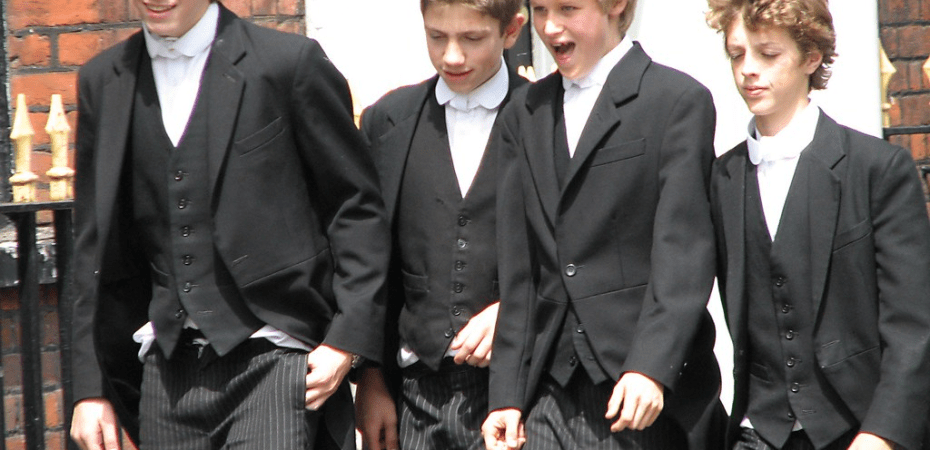
Image: Eton College https://www.flickr.com/photos/carlitos/206305247. Creator: ¡Carlitos . CC BY-NC-SA 2.0 DEED Attribution-NonCommercial-ShareAlike 2.0 Generic
 Labour Hub