

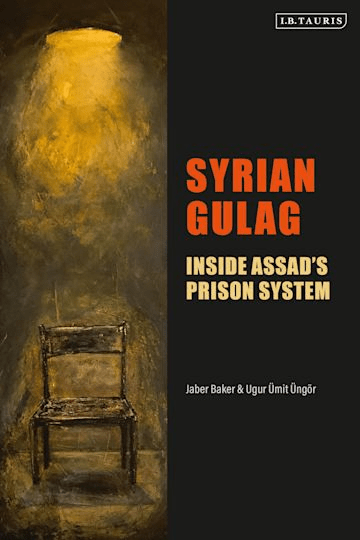
Mike Phipps reviews Syrian Gulag: Inside Assad’s Prison System, by Jaber Baker and Uğur Ümit Üngör, published by Bloomsbury
This book is an attempt to understand the Syrian prison system. It examines the history and methods of the Gulag created by the Assad regime since it seized power in 1970.
Syria is more than a ruthless dictatorship with no pretence of an independent judiciary. It has been called a “terrorist state” – not in the Western sense, but in the sense that it terrorizes its people. To claim, as the authors do in their Introduction, that “The prison network has become an intrinsic part of mainstream Syrian identity” may sound like an exaggeration. But it’s not.
By conservative estimates, “300,000 Syrians having been in prison at some point since 2011 (including those who died in prison), it amounts to about 1,200 prisoners per 100,000 of the population. This catastrophe is of an unprecedented scale in Syrian history: never before have so many people been arrested, imprisoned, tortured and killed in prison as in the past half century in general, and the past decade in particular.”
Nor is it simply a matter of numbers. Most people arrested in Syria are never heard of again: in many cases, the state will deny it has even detained them. Torture is widespread and intense, even for the most trivial of offences. One man who liked a social media post critical of the government was detained for three months during which he was brutally tortured.
The extreme levels of repression have few antecedents in Syria before Assad, the authors argue. As in Saddam Hussein’s Iraq, they are central to Ba’athism, which some on the left have naively characterised as a kind of pan-Arab socialism, but is more accurately an extreme nationalism with some fascistic aspects. Additionally, all personnel working in security in Syria are assigned by the military, ensuring unbreakable levels of loyalty and discipline. This control extends down to the issue of kiosk permits and the appointment of candidates for the Parliament.
The security system’s pervasiveness is reinforced by the numbers involved. For every 150 Syrians over 15, there is an intelligence operative, one of the highest ratios in the world. The power of these agencies is exercised by unparalleled levels of repression, imprisonment and torture, often random, sectarian and extremely vicious.
The Palmyra prison massacre, when Syrian paramilitary Defence Brigades entered the prison in June 1980 and killed a thousand prisoners in a single day is highlighted here. Yet amid the ferocious levels of repression, it is astonishing to read of acts of resistance – hungers strikes, mutinies and escape attempts.
This is undoubtedly a useful book, but it’s hardly one to recommend to even the most hardened reader. The sheer volume of first-hand accounts of torture may be necessary to underline the barbarity of the Assad regime but it makes for grim reading. Without going into details, it’s sufficient to say that torture was ubiquitous, extreme, varied, prolonged and life-threatening. It was not necessarily carried out to extract confessions or information, or even to secure compliance. Reasons become redundant when the perpetrators know there are no consequences to fear for whatever they do. One former detainee testified: “Every day they brought out dead bodies from solitary cells and the dormitories.”
For the authors, the explanation for this state of affairs is rooted in the regime’s politics. “Having declared much of the Syrian political spectrum illegitimate, it was a logical step for the Assad regime to target those dissident social and political movements en masse. The regime’s extermination of dissent is about extinguishing all activity in the realm of impermissible politics: prohibiting it from publishing and organizing, shooting it off the streets, beating it out of the person, exorcizing it even at the individual level – in Assad’s prisons, detainees were not allowed to discuss politics even in their prison cells. The regime aimed to remove every inkling of genuine politics from society, because it was and is at war with society. It is here that we understand how the Assad regime used the Gulag to shape and mould its society.”
The Argentinian social scientist Daniel Feierstein has argued that the Videla regime’s repression in the 1970s was aimed at “social re-engineering”, attempting “to achieve its objectives in a war that could not be won by military means alone but only through kidnappings, disappearances, torture, and the systematic destruction of the civilian population – in other words, through genocidal social practices.” Amnesty International concluded in a long report on one Syrian prison that the inhuman treatment, including torture, deprivations and weekly mass executions amounted to an extermination of detainees. The authors conclude that “Assad’s prison system does not merely exist to imprison, discipline, and punish, but to exterminate.”
Does it work? No: “survivors most often returned to anti-regime activism, knowing well they would be arrested and tortured.” And when the Syrian people rose up in mass protests against the regime in 2011, they knew well what was in store for them if they were arrested.
For supporters of Assad, enthusiastic torturing is a way of showing your commitment. With four different intelligence agencies competing against each other for relevance and resources, torturing and extracting confessions from enemies, real or imaginary, is presented as retroactive evidence of opposition to the regime, which itself legitimizes Syria’s vast prison estate. Holding detainees to ransom is also highly lucrative.
Superficial appraisals of the Syrian political situation misconstrue what is happening. The fact that public opposition to the Assad regime has recently declined does not signal less but more violence, because it allows the silent extermination in the Gulag to continue.
The authors conclude: “This impact is not just felt inside Syria. By now, the Syrian Gulag is a global phenomenon: its victims are spread across the world and its perpetrators are being indicted in Europe. Indeed, they are everywhere among us.”
This is true. In 2021, in a landmark, ruling, a court in Germany sentenced Eyad al-Gharib, a former Syrian government official, to four and a half years in prison over complicity in crimes against humanity in his home country.
As the Guardian reported at the time, a prosecution witness declared: “This decision is historic because it condemns the entire criminal system that is the Syrian regime. Gharib is one man but he was part of an organised machine with orders to arrest peaceful civilians, disappear them, torture them, kill them and hide their bodies in mass graves.”
Mike Phipps’ book Don’t Stop Thinking About Tomorrow: The Labour Party after Jeremy Corbyn (OR Books, 2022) can be ordered here.
 Labour Hub
[…] Labour Hub review commented: “The security system’s pervasiveness is reinforced by the numbers involved. […]