
By David Osland
The Nobel Peace Prize is named for the man who invented dynamite. In 1973, the accolade was somehow accorded to a man who did more to stimulate consumer demand for high explosives than for the cause of pacifism.
Henry Kissinger, who has died at the age of 100, picked up the award that year for his contribution to the ostensible end of hostilities in Vietnam. The fighting continued for another two years.
The judges would certainly have known that Kissinger undermined talks between the Lyndon Johnson administration and the Vietnamese in Paris in 1968, in the callous calculation that ongoing bloodshed would boost the electoral chances of Republican contender Richard Nixon.
They would also have been aware that he directed the clandestine saturation bombing of Cambodia, which killed 150,000 people, paving the way for subsequent mass slaughter at the behest of the Khmer Rouge.
Even at the time, the devastation was immense. Some of the ordnance dropped on his authorisation is still blowing people’s limbs off even now, half a century later.
As the late American celebrity chef Anthony Bourdain once joked: “Once you’ve been to Cambodia, you’ll never stop wanting to beat Henry Kissinger to death with your bare hands.” While one naturally deprecates violence, the sentiment is understandable.
Born Heinz Alfred Kissinger in Germany in 1923, his Jewish family fled the Nazis and emigrated to the US in 1938. After service in the US army in World War Two, he completed a PhD in the diplomacy of Castlereagh and Metternich at Harvard.
Had not the lure of politics intervened, he would almost certainly have built a distinguished academic career as a proponent of the realist school of international relations. It would have been preferable for humanity had he lived out his days confined to the academy.
Originally on the now long-defunct liberal wing of the Republican Party, Kissinger’s loyalties were entirely malleable. All of his allegiances seemed determined by a desperation to attach himself to whoever could advance his standing at any one time.
He is best known for his time as National Security Adviser and Secretary of State to Nixon, and subsequently Gerald Ford, from 1969 to 1976, a period that marked the apex of the Cold War.
Among his diplomatic achievements were an arms control agreement with the USSR and US rapprochement with Mao Zedong’s China. But the motivation of the latter was to deepen the Sino-Soviet split to American advantage rather than furtherance of diplomatic amity.
Kissinger’s ‘shuttle diplomacy’ after the 1973 Yom Kippur War between Israel and Egypt was a necessary precursor to the subsequent Camp David accords negotiated by President Jimmy Carter later in that decade.
But the black marks in the ledger are surely the most extensive, extending well beyond Indochina.
What stands out is the succour and aid consistently extended to thuggish authoritarians across the planet, provided only that their triumph dovetailed with Washington’s interests. In his worldview, human rights, or even human lives, were never even a secondary consideration.
Thus Kissinger backed Pakistan in the 1971 Bangladesh Liberation War, which the Pakistani military attempted to suppress with an avidity verging on the genocidal.
He was also a strong supporter of the coup against Chile’s democratically elected President Salvador Allende in 1973, in which the Central Intelligence Agency played an active role.
“I don’t see why we need to stand by and watch a country go communist due to the irresponsibility of its people. The issues are much too important for the Chilean voters to be left to decide for themselves,” he argued at the time, if nothing else revealing his contempt for democracy.
When the military took over in Argentina three years later, Washington backed the Videla regime, which proved just as torture-happy as Pinochet.
Kissinger had advanced knowledge of the Turkish invasion of Cyprus in 1974. Britain, which had military bases on the island, could have pre-empted the landing. But according to British Prime Minister James Callaghan, Kissinger vetoed such a move.
He also approved – at the very least – Indonesia’s 1975 invasion of East Timor, ushering in a murderous 24-year occupation by the Suharto dictatorship.
Domestically, he ordered the phone tapping of 17 people, ranging from journalists to members of the National Security Council. “The illegal we do immediately,” he quipped. “The unconstitutional takes a little longer.”
Kissinger’s death was marked by an immense outpouring of hero worship from his eminent ruling class fan club. Vladimir Putin hailed him as “a wise and talented statesman”, Emmanuel Macron as “a giant of history”, Olaf Scholz as “a great diplomat”.
Among the touching tributes came from Tony Blair, the former Labour prime minister who committed Britain to a junior part in the most unjust war waged by the US since the conflict in Indochina.
Blair expressed himself “in awe” of his role model. The admiration is unsurprising. In many ways, Henry Kissinger Associates, the consultancy he founded in 1982, was the model for the more dishonestly-named Tony Blair Institute for Global Change.
Both firms made their founders wealthy from peddling advice to whatever multinationals and governments of dubious propriety were able to come up with the wherewithal to pay for it.
In the media, most of the obituaries have been at best guarded, at worst positively glowing. Somehow they too have persistently managed politely to overlook the piles of corpses.
I don’t know if anybody has yet drawn up a definitive Kissinger body count. But his passing is more logically marked by execration rather than hosannas.
David Osland is a member of Hackney North & Stoke Newington CLP and a long-time left wing journalist and author. Follow him on Twitter at @David__Osland.
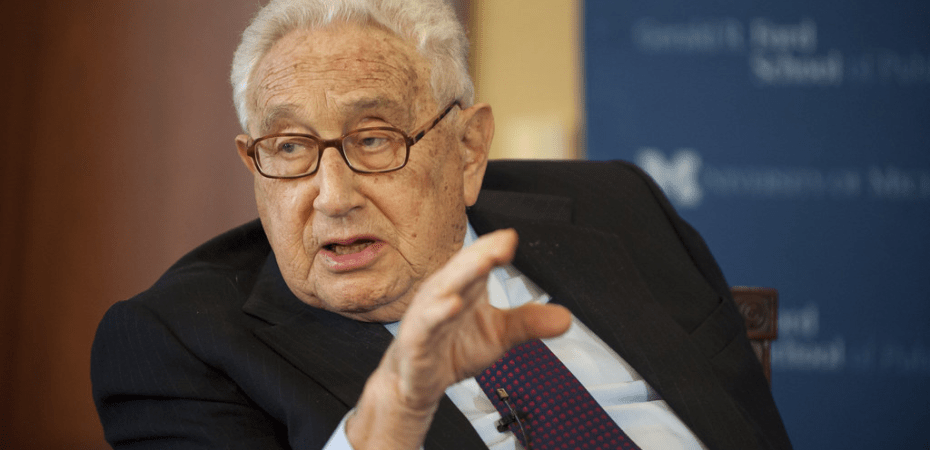
Image: https://www.flickr.com/photos/fordschool/10540645336. Creator: Gerald R. Ford School of Public Policy University of Michigan. Copyright: University of Michigan, Gerald R. Ford School of Public Policy. Licence: CC BY-ND 2.0 DEED. Attribution-NoDerivs 2.0 Generic
 Labour Hub