
The Chancellor’s Autumn Statement offers austerity to local government and nothing for council housing, argues Martin Wicks
“The Labour party has largely retreated to a similar pro-market and low-tax agenda as the Conservatives, but with an emphasis on equality of opportunity and choice. This is a mistake, and one that is amplified by the historic chance offered by the Tories’ poor standing in opinion polls. Whoever wins the next election either has to repudiate Mr Hunt’s disastrous cuts or enact them.” So said the Guardian’s editorial of November 22nd.
This is indeed Labour’s choice. If it implements a new phase of austerity, the housing crisis will not be resolved. Even before the Autumn Statement, Shadow Housing Minister Matthew Pennycook said that a Labour government would not increase the funding for the Tories’ Affordable Homes Programme which runs to 2026. This would mean no more funding for council housing.
The trap set for Labour by Chancellor Hunt includes a freeze of Local Housing Allowance from 2025. Not only has it been frozen at 2019 rates but councils placing homeless people in private sector temporary accommodation receive only the Local Housing Allowance rate for 2011. For example, for Hastings this means roughly a quarter of the actual cost, for Lincoln around a third. The difference has to be covered by a council’s general fund, the value of which has been depleted by austerity, inflation, and increasing demand for child and adult social services. Councils are warning that the spiralling costs of temporary accommodation are pushing some of them down the road to section 114 notices – a declaration that they will be unable to balance their budget.
Those councils without council housing, like Hastings, or Liverpool, are dependent on housing associations and the private rented sector, the latter becoming increasingly unaffordable. Some councils which still have council housing are using some of their existing stock as temporary accommodation for homeless people, in order to cut the cost of placements. While this is understandable, it means that those on the waiting lists will have to wait longer.
In a letter to Michael Gove on behalf of the Parliamentary Levelling-Up, Housing and Communities Committee, Clive Betts wrote:
“The single biggest issue driving increased homelessness… the freezing of local housing allowance rates does two things: it creates more people who are homeless, because their housing benefit cannot afford rising rents, but more importantly it means that local authorities cannot discharge their duty towards households once those people are homeless, because they cannot find them properties in the local area that are within the local housing allowance rates.”
For tenants, LHA is now estimated to cover the rent of only 5% of properties. People who lose a job, have an accident, or become ill, are facing homelessness unless they have savings, since even if they receive LHA they have to cover the gap between it and the rent.
Ultimately the homelessness crisis can only be resolved by ending Right to Buy and funding a large scale council house building and acquisitions programme both for those authorities that still have stock and those that don’t. The Labour Party National Policy Forum said that they would encourage councils without council housing to start building again, but without grant from central government, on a far greater scale than the Tories’ Affordable Homes Programme, it won’t happen.
An “existential crisis” for local authorities
Another choice for a Labour government relates to funding of local government general funds. Because Hunt is not uprating “non-protected” public services for inflation they will lose £19.1 billion by value. What does this mean for local government? LGA Chair Shaun Davies (Labour) said:
“The evidence of the financial strain on councils has been growing and it is hugely disappointing that today’s Autumn Statement has failed to provide funding needed to protect the services the people in our communities rely on every day. Adult social care remains in a precarious position, record numbers of households are in temporary accommodation and there are now more than 80,000 looked after children in England. The lack of additional funding in today’s announcement risks councils’ ability to meet this spiralling demand, provide critical care and support a healthy population with access to housing, training and jobs.”
The Chartered Institute of Public Finance said that “public services are broken and this Autumn Statement does nothing to fix them”. The Office for Budget Responsibility’s report explains that since 2010-11 local authority spending has fallen from 7.4% to 5% of GDP. It will fall further to 4.6% by 2028-29. With masterly understatement it says:
“Given local authorities’ statutory duty to provide a range of services where demand is likely to continue to grow, for example adult and social care, pressure on local authority finances and services will continue.”
Locally financed capital expenditure is expected to fall to £8 billion this year and then to £7.7 billion by 2028-29. Borrowing for capital expenditure is expected to decline from £11.5 billion in 2019-20 to £7 billion in 2028-29, to a large extent because of the big increase in interest rates. This includes council house building. Labour’s support for the ‘independence’ of the Bank of England means they have accepted increases in the borrowing rate. So for capital expenditure a council now faces a rate of 5.71% for a fixed rate maturity loan over 30 years (the loan is repaid at the end of the loan period). Just 18 months ago the rate was just under 2%. So the annual interest rate on a £10 million loan would be £571,000 as compared to £193,000.
To stave off section 114 notices, councils are using their reserves. The OBR points to a net increase of reserves by £2.3 billion in 2022-23. They estimate a further drawdown of £1.5 billion from reserves for this financial year. The reserves will run out sooner or later. A representative of the LGA told the Levelling-up, Housing and Communities Committee that:
“We are probably at an inflection point, where the number of authorities contemplating issuing 114 notices is becoming more general, as opposed to the specific reasons we have seen thus far… there is a general understanding that if not this year, next year, about half of the authorities will be in distress. That is a significant number.”
Labour’s fiscal straight-jacket
Rachel Reeves; arbitrary ‘fiscal rules’ constitute a self-imposed straight-jacket which will impact on the services that councils provide, including council housing. The idea that these ‘fiscal rules’ are ‘non-negotiable’ is the position of an ideologue. To suggest that ‘there is no more money’ available is only true if a Labour government leaves in place a regressive taxation system and lets the business oligopoly get off lightly.
Reeves has said there will be no tax increases apart from the specific ones they announced they would introduce, which are very small scale; ending VAT relief on private schools, abolishing the domicile rule for tax purposes aand taxing the ‘carry’ on private equity.
Richard Murphy’s Taxing Wealth Report lists tax changes which could raise significant sums of money. These include:
- Aligning capital gains tax with income tax, which might raise £12 billion a year.
- Restricting pension tax relief to the basic rate of income tax, which might raise £14.5 billion.
- Recreating an investment income surcharge (on unearned income) which might raise £18 billion a year.
There are other possibilities including taxing tech firms like Amazon and Facebook. But the leadership has rowed backed on that.
Retrofitting our council housing?
Just recently the BBC published the comments of ‘a senior figure’ in Keir Starmer’s office saying that a Labour government would be unlikely to achieve the £28 billion investment because of the state of the public finances. This is not the first time that this has been said. On a previous occasion ‘a senior figure’ said that if the Green Prosperity Plan conflicted with the ‘fiscal rules’ then they would “trump the plan”. On this occasion some Labour official said it was not true, that a Labour government would “ramp up” investment in the second half of the Parliament (repeating Rachel Reeves’ retreat from the commitment for ten years). Yet it seems difficult to imagine that ‘a senior figure’ from the leader’s office would talk to the BBC without agreement. Obviously there are differences at the top of the Party.
The £28 billion includes £6 billion for insulation and retro-fitting, though this is nothing like sufficient even to retro-fit the council housing stock. The Local Government Association reckons that at least £23 billion would be required. Underfunded Housing Revenue Accounts simply don’t have the resources to carry out this work. This is one reason why the LGA called for a review of the council housing ‘self-financing regime’ introduced in 2012.
We cannot afford not to do what is necessary
The idea that tackling the environmental crisis and the housing crisis are tasks that can be put off because of arbitrary ‘fiscal rules’ or that they are dependent on whether economic growth is sufficient is patently false. What would have been the response if a Chancellor had said we can’t proceed with the Spitfire programme because we can’t afford it, it’s not a costed programme? Decarbonising existing housing, including our council housing stock, is not an optional extra. The eradication of living conditions which are unhealthy and threaten people’s health and sometimes their lives, is a necessity. If you don’t do that, you allow landlords to ruin tenants’ lives and bank up future costs to the NHS.
Neither action to decarbonise our economy nor the resolution of the housing crisis can be left to the market. Only state action can resolve these problems. If the Atlee government could launch the NHS and build a million council homes under far worse economic conditions than today, why can’t radical action be taken today?
In the run-up to the general election, Labour Party members, affiliated unions, tenant unions and housing campaigners should be demanding of Labour what is necessary. That means no return to austerity, but a governmental programme which funds decarbonisation and a large scale council house building/acquisition programme. If local authorities are starved of funds by a Labour government then, even though Housing Revenue Accounts are ring-fenced from general funds, there will be little prospect of a renaissance of council housing. Tax policy should be determined by social needs, not ‘fiscal responsibility’. If economic activity is left to the market then maximisation of profit comes before social needs. ‘Fiscal responsibility’ and Bank of England ‘independence’ have enabled the business oligopoly to fleece the public sector and the general population for decades.
Is a Labour government going to watch as local authorities run out of money and be unable to provide statutory services? Is it going to send in more commissioners as more and more councils issue section 114 notices?
What a Labour government ought to do to come to the rescue of local authorities and begin to resolve the housing crisis, should include these things.
- Increase funding for local authorities so that the £19 billion cut is not implemented. Fund local authorities (as previously) on the basis of annual estimates of needs.
- Not implement the freeze on LHA from 2025. Instead increase it to the 30th percentile. Cover the full cost of rent paid by local authorities for temporary accommodation.
- Increase the AHP funding available for building council housing.
- End Right to Buy, as in Scotland and Wales.
- Review the ‘self-financing regime’ with a view to funding HRAs adequately to improve the quality of homes.
- Implement an emergency programme for decarbonisation of all council homes.
If Labour does not address these issues in government then the multiple crises will deepen and it may well be a one-term government. As Barnsley Council Leader Stephen Houghton told Labour List in July, “Labour must reverse council cuts and base funding on need, not local wealth… Giving public services the funding they need is crucial to underpinning a functioning society, while helping to tackle issues such as poverty, inequality and insecure housing goes to the very heart of our mission as a movement.”
Martin Wicks is Secretary of the Labour Campaign for Council Housing.
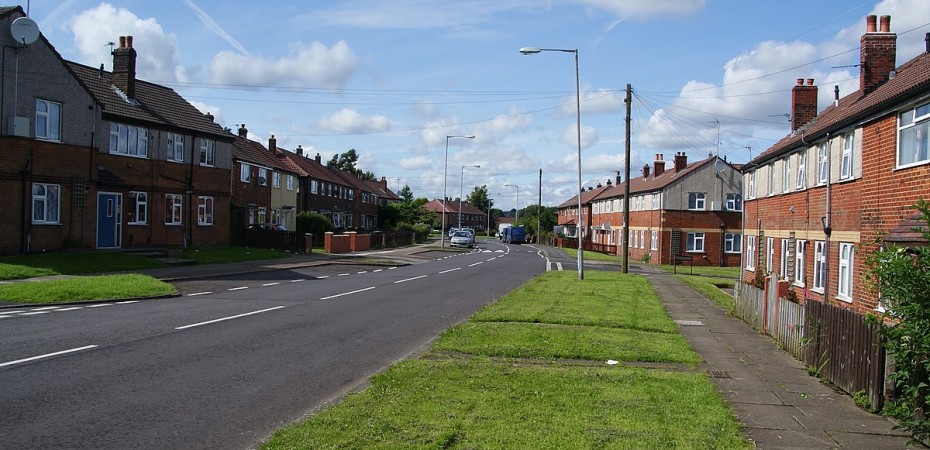
Image: Council housing estate on Deepdale Road, Breightmet. Source: Geograph Britain and Ireland. Author: Bill Boaden, licensed under the Creative Commons Attribution-Share Alike 2.0 Generic license.
 Labour Hub