
By Vincent Gomez and Lynne Jones
The recent Resolution Foundation Report attributes the dire state of the UK economy to a decade and a half of falling real incomes and a generation and a half of high inequality. This, they say, is a “toxic’’ combination posing risks not only to our prosperity but to our social fabric. Living standards are now set to decline further, even as the tax take increases. They argue that we must stop living off our past and invest in our future, which will require much higher and sustained public investment to both address the legacy of underinvestment and deal with the challenge of net zero.
It would be good to hear politicians making these important points!
Of course, we cannot expect to hear them from the right, whose belief in unfettered market forces is quite undimmed by the practical experience of what market-based ‘reforms’ have done to the UK.
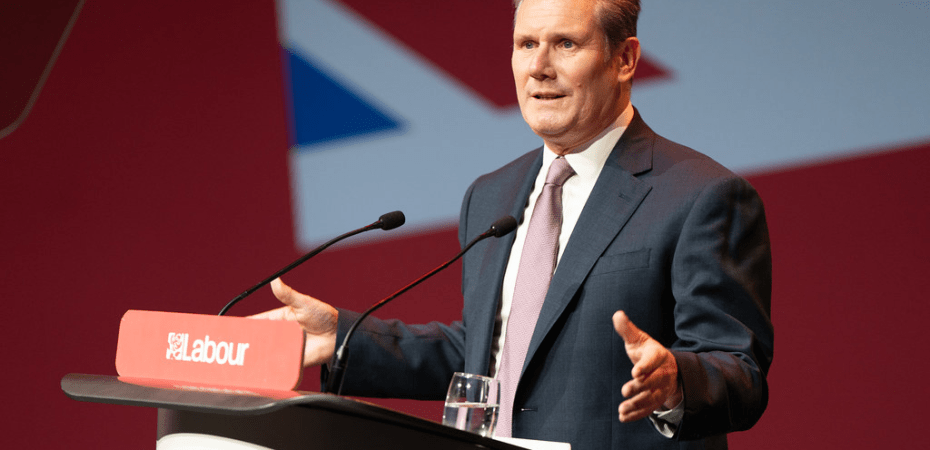
Unfortunately, we do not hear them from opposition parties who, in their effort to give no red meat to the media, have steadfastly refused to say anything that might be seen as controversial and turned against them. This means that even obvious – and obviously important – facts about the nature of money and how it is created get no mention. Indeed, Keir Starmer’s speech at the launch of the Report quoted, with approval, Thatcher’s mantra: “There is no such thing as public money – only taxpayers’ money.”
Invoking some vague concept he called ‘securonomics’, Starmer said he would approach the public finances – spending decisions – like “it’s spending the precious pounds of the people we serve – which it is.”
That is not only wrong, but dangerous! He is right to suggest that resources should always be deployed wisely and carefully, which has been far from the case in recent years. However, by not challenging and actually endorsing Thatcher’s claim that spending can only be financed by taxpayers’ money, Starmer is perpetuating the economic framework responsible for the state we are in today. No wonder Martin Wolf Financial Times Chief Economics commentator remarked afterwards that, “What will happen under him (Starmer) will make no appreciable difference… The system we run is just not capable. A change in Government without a comprehensive rethink of our economic system is going to get us nowhere.”
The UK is, and has been for over 50 years, the sovereign issuer of a fiat currency which means it can take advantage of the ability to invest without necessarily requiring additional taxation or worrying about future debt.
The Bank of England, like other central banks, is capable of creating money – and has done so recently and in huge quantities via Quantitative Easing (QE reached £895 billion). As Alan Greenspan stated to a House Committee back in 2005: “There’s nothing to prevent the Federal Government from creating as much money as it wants…. The question is, how do you set up a system that ensures that [there are sufficient real assets to purchase]. Cash is nice but it has to be in the context of real resources created.”
More recently in 2020, we saw that the UK was the first developed country in the world to adopt direct monetary financing to fund government spending during the coronavirus crisis when the Bank of England expanded the Ways and Means facility to accommodate lockdown spending by central government.
Governments are not like households and a moderate deficit is to be celebrated, not feared. To explain: The law of sectoral balances implies that the sum of Government surplus plus Private sector surplus plus Foreign surplus will always be zero. The UK runs a trade deficit, meaning that the Foreign sector has a surplus. That means that the sum of the other two sectors is negative – and if the Government runs a surplus as well, then the Private sector is condemned to a significant deficit. It is that which is not sustainable.
Even more importantly, future debt is a non-issue. Today’s debt is around 100% of GDP and this has caused much hand-wringing. But in fact much of this debt is – thanks to £895 billion of QE – debt which the government ‘owes’ to the Bank of England, an entity which it owns. It is ‘debt’ which the government ‘owes’ to its own subsidiary. It may be a political issue, but it is not an economic problem.
Constraints on government spending, such as the ‘fiscal rules’ adopted by the Government and now to be ‘iron clad’ by Labour, are artificial and self-imposed. It is the exact opposite of being ‘responsible’ to follow them when this deprives us of the investment we need.
It is time to tackle these myths and misunderstandings and – as Greenspan suggested – address the real constraints!
The UK Government can and does vote money into existence. But they cannot vote, for example, scientists, construction workers, nurses, childcare places, etc., into existence. Debt resulting from any public spending today cannot lead to bankruptcy for our children.
Taxes are therefore nothing to do with giving the Government money or ‘balancing the books’. The primary roles of taxation are to:
- control inflation;
- create demand for Government currency;
- alter the distribution of income; and to
- incentivise or disincentivise certain behaviours.
Tax rises can be needed in order to control inflation, but are not inevitable for public spending increases that will create those tangible assets we so desperately need!
When Governments run a deficit, the money doesn’t disappear but, ends up as a surplus somewhere in the private sector. In our unbalanced economy it ends up highly concentrated in a few hands.
So we need a fairer tax system to fix this, especially ensuring that earned income is not taxed at a higher rate than wealth and unearned income. This would give opportunities for tackling the “fiscal drag” affecting those on low and medium to high incomes. There is no reason to suppose that taxes on ordinary working people need to be raised – on the contrary!
The real issues for future generations are the continued whittling away of the UK’s social contract and the threats arising from our ongoing failure to invest adequately in measures to deal with the climate emergency. We have changed or interpreted laws differently during the Global Financial Crisis and the pandemic. We can do so again.
As John Maynard Keynes said in 1942, “Assuredly we can afford this and so much more. Anything we can actually do, we can afford… We are immeasurably richer than our predecessors. Is it not evident that some sophistry, some fallacy, governs our collective action if we are forced to be so much meaner than they in the embellishments of life?”
In 1945, UK Government debt was 250% of GDP, yet post-war governments followed this wise advice. The next Labour Government could do the same.
Vincent Gomez is a former investment banker and member of the Bank of England’s Citizen’s Forum. Lynne Jones was Labour MP for Birmingham Selly Oak from 1992 to 2010. Both are members of 99-percent.org.
Image: https://www.flickr.com/photos/190916320@N06/53240561562. Creator: Keir Starmer | Credit: Labour Party Copyright: Labour Party. CC BY-NC-ND 2.0 DEED Attribution-NonCommercial-NoDerivs 2.0 Generic
 Labour Hub