

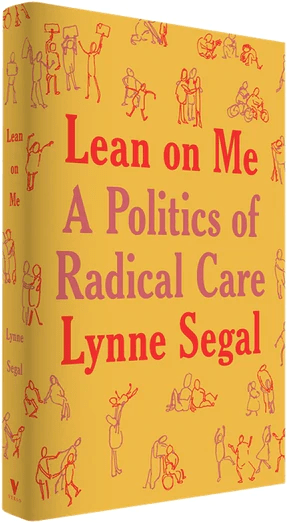
Mike Phipps reviews Lean on Me: A Politics of Radical Care, by Lynne Segal, published by Verso.
Many socialists writing in the aftermath of Covid have pointed out how it took a pandemic to remind us of the importance of the role of the state in securing a healthy society. In her new book, Lynne Segal goes further and underlines how coronavirus demonstrated our mutual interdependency – locally, as seen in the rapid growth of Mutual Aid groups, but also nationally and internationally: “our failures to deal with it globally prolonged its duration.”
This failure means the pandemic resulted in a deepening of inequality globally, revealing further how ‘rugged individualism’ is an outlook which can only ever work for a tiny minority, invariably wealthy -and usually parasitic on broader society.
Or put more bluntly: “Nothing is more damning of our failures to care about our carers than the fact that the majority of women under sixty-five who died from COVID-19 in the first year of the pandemic were social care and domestic employees.”
Lean on Me is partly a memoir of Lynne’s early life in 1970s London as a young mother, covering her activism in the Women’s Liberation Movement and socialist politics. As such, it also revisits some central debates of the time, in particular the role of the traditional family in thwarting “alternative models that truly enable gender equality, sexual diversity, and, above all, more flexible and responsive forms of social support and care.”
“We hoped,” says the author, “that these reflections might stimulate cultural shifts, moving beyond, or setting aside, traditional conceptions of motherhood as the unique archetype for care itself.” Despite the backlash such ideas provoked, the embrace of such alternatives did help eradicate the stigma attached to child-rearing outside of the traditional family unit.
Yet escaping the norm still remained elusive for many. In the age of neoliberalism, it was reduced to “the idea of mothers making individual ‘choices’, and thereby veiling a reality in which many women find it impossible to believe, or even imagine, that there might be alternatives to the existing dysfunctional patterns of domestic responsibility underpinning gender inequality.”
Segal also looks at changes to the education system in the last fifty years and how inclusivity and creativity have been replaced by managerialism and competitiveness. The endless testing and narrowing of the curriculum have left British schools near the bottom of the European rankings for creative learning. Higher education too has been hit by the same market ethos, which has also contaminated the content of courses: from direct experience in her own field, for example, the idea that we are social beings was from the outset rejected by mainstream psychology.
Lynne and her co-thinkers challenged these ideas: for example, “Gender relations could now be shown to intersect with all areas of human thought and action, from which they had hitherto been largely excluded.” But at the same time as these ideas became more widely accepted, the growing marketisation of higher education also took over, with the introduction of fees and the cutting of grants.
“In the crusade to conjoin pedagogy with market logics,” Segal notes, “universities must provide data on the outcomes of graduating students, not in terms of the knowledge, personal satisfaction, or confidence acquired, but in terms of expected subsequent incomes.” The resultant defunding of humanities courses has been labelled “cultural vandalism”.
There are some thoughtful observations here as well about the impact of neoliberalism on feminist thinking. Segal mentions the resurfacing of the old Wages for Housework campaign, a supposedly militant initiative that first appeared in the 1970s.
“What is so peculiar about the reappearance of this demand,” argues Segal, “is that paying for domestic services is now actually the norm for many people, women and men alike, while doing nothing to overturn existing gender inequalities and positively amplifying ‘racial’ ones. In my view, paying for domestic services is now helping to secure, not disrupt, capitalist hegemony.”
Nothing underlines our mutual dependence on each other as much as the issue of disability. Segal writes passionately about the onslaught on welfare entitlements following the financial crisis of 2007–08 and the ensuing thousands of deaths every year, some by suicide, among those falsely declared ‘fit to work’. If a social model for disability has both shifted perceptions of disability and empowered activists, it has also underlined how we are all vulnerable to frailty and impairment – especially as we age. This is worth some reflection in a society where 60% of women over age 75 live alone and two-fifths of all older people say that the television is their main company.
Over ten years ago, the British Medical Journal stated that there were up to 40,000 preventable deaths of older people annually and yet during the pandemic old people in care homes were treated as expendable, a product of both long-term privatisation and funding cuts and short-term government policy. Both are fixable.
If greed and egotistical individualism were hallmarks of the Thatcher era, a society that gives the biggest rewards to those who care about other people the least seems to be one of its legacies. Conscious cruelty towards the most vulnerable in society has become a driving force of government policy, through welfare cuts, benefit sanctions and more. It’s hard to find any other explanation for the instruction to London police to destroy the tents of homeless people who sleep rough on the capital’s streets in winter.
Yet, on a global level, Segal is optimistic. The drive to “reconstruct the world in common” around universal values – where for example the lives of Palestinians or other people of colour are not seen as worth less than those of anyone else – is taking some surprising forms. Even in the US, which combines spectacular inequality with the world’s highest incarceration rates, there are significant developments: following a mass campaign, Los Angeles adopted a “Care First, Jail Last” strategy, promising “treatment and services to those in need, instead of arrest and jail”. This is all the more important when one considers the centrality of incarceration to maintaining the existing economic and social order.
Here, the government’s punitive regime towards people seeking asylum stands in stark contrast to the willingness of ordinary people to help them. Segal salutes the work of volunteer activists, but it should be added that increasingly, notwithstanding the demonization of migrants by government and mainstream media, record numbers of UK citizens see migration as beneficial.
Segal is clear that the fight for a more compassionate society requires some major political changes: “a new social contract that promises certain universal entitlements, including some form of minimal income guarantee, for people in or out of work, and above all access to essential universal care to meet personal welfare needs and create sustainable communities.”
These are not abstractions, but ideas rooted in movements for fairer pay, democratically run services and climate justice. Segal urges us to link them up and amplify them – it’s sound advice.
Mike Phipps’ book Don’t Stop Thinking About Tomorrow: The Labour Party after Jeremy Corbyn (OR Books, 2022) can be ordered here.
 Labour Hub