

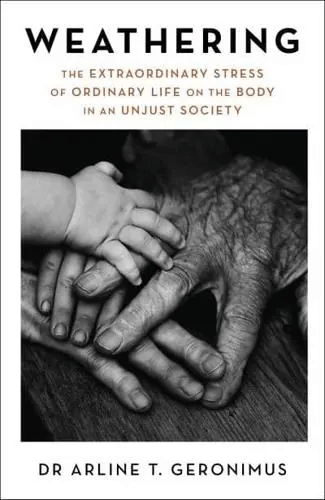
Mike Phipps reviews Weathering: The Extraordinary Stress of Ordinary Life on the Body in an Unjust Society, by Dr Arline T. Geronimus, published by Virago.
The premise of this book is explained in the first sentence of its Introduction: “After almost forty years of research in public health and a lifetime of wrestling with questions of racial and class injustice, I have concluded that a process I call weathering, a process that encompasses the physiological effects of living in marginalized communities that bear the brunt of racial, ethnic, religious, and class discrimination, is critical to understanding and eliminating population health inequity.”
The author’s research shows that “pervasive racist and classist ideologies activate biological processes that wear out the physical and mental health of people of color across all economic classes, if to different degrees.”
More specifically, “Weathering damages the cardiovascular, neuroendocrine, and metabolic body systems in ways that leave people vulnerable to dying far too young.” Diseases that are exacerbated by stress constitute the single biggest cause of excess deaths among America’s black and poorer white communities. The causes of such stress for people in high poverty urban areas may range from the inability to get a good night’s sleep to lack of heating, poor air quality or militarised policing.
Geronimus refutes the argument that a genetic predisposition to certain diseases plays a central role since “these are not the ones that account for the lion’s share of population differences in health and longevity.”
A particular concern of the author is the high maternal mortality rate in the US – the worst among all high-income countries. It’s getting worse and the rate among Black mothers is twice the overall level and rises the older the mother is. In this context, there’s a logic to getting pregnant at a younger than average age.
Correlating socially traumatic incidents with medical outcomes can be challenging but it’s not impossible. Geronimus notes that in the aftermath of a major immigration raid by armed federal agents on one Iowa workplace, which led to nearly 400 arrests and had a huge impact on the Latinx community, the percentage of babies born too early and small to Latina women hit a ten year high.
Geronimus looks at other areas of public policy that are likely to contribute to weathering, such as Bill Clinton’s 1996 welfare reform which cut aid to poorer families. Other policies have had an impact, by proliferating demeaning stereotypes of marginalised communities, reducing their income or adversely affecting the kin networks that members of these communities rely on.
If “weathering is the result of repeated or chronic activation of the physiological stress response over years or decades,” as the author argues, then measures that improve the quality of life of those affected will disrupt this process. This means prioritising equity over privilege in a range of policy areas, especially health and education.
Some of the fixes are presentational and low-cost. But the bigger ones require systemic change and this involves the full involvement of the people most affected: “Do nothing about us without us.” This takes on extra relevance in the US where the last decade has seen a systematic reduction of voting rights for marginalised people, a development that recent restrictive Tory legislation is likely to bring to the UK.
Geronimus makes some perceptive observations on the climate emergency. One of the key causes of greenhouse gas emission in the US is suburbanization and urban sprawl, a process which is driven largely by racial residential segregation. ‘White flight’ to the suburbs required new road building and further stigmatised the investment-starved inner city, exacerbating inequalities in education, housing, health and environment. Gentrification ‘solutions’ that fail to address the needs of a city’s poorest inhabitants are unlikely to work on any level, including reducing emissions. “All our futures are linked,” concludes the author.
This is an important book, but one weakness, perhaps in a quest to be accessible, is its use of a lot of anecdotal material, which is interesting, but falls short of being top-grade evidence for the arguments presented.
Mike Phipps’ book Don’t Stop Thinking About Tomorrow: The Labour Party after Jeremy Corbyn (OR Books, 2022) can be ordered here.
 Labour Hub