
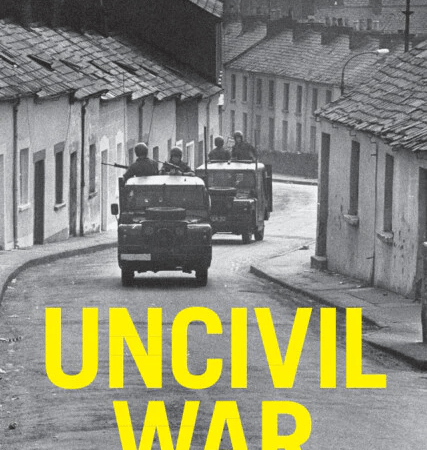
Geoffrey Bell reviews Uncivil War: The British Army and The Troubles, 1966-75, by Huw Bennett, published by Cambridge University Press.
I once interviewed the late Patrick Mercer, then a Tory MP, but more importantly an ex-British army senior officer who served nine tours of duty in Northern Ireland. He admitted that the British army became part of the problem in Northern Ireland. He said that it was only towards the end of the conflict that it began to “empathise” with the Catholic community. I asked him, as a solider, that if he had been born in an Irish Catholic area whether he would have joined the IRA. He said that he would have.
Huw Bennett’s meticulous academic study of the early years of the British army in “the Troubles” gives substance to such observations. He quotes a British civil servant in 1975 saying how the army nicknamed Northern Ireland deployment as “Paddy-bashing”. The book shows how accurate that was. The more famous examples are explored. These include the army-imposed curfew in the Falls Road in July 1970, internment, the torture of internees, the army murders of civilian in Ballymurphy in August 1971 and Bloody Sunday. With these and much more, the familiar story of death and destruction by the British army in Ireland unfolds.
For the most part, the army’s victims were Catholics, and, as Bennett’s research and analysis shows, the targeting of that community was a conscious decision, made as soon as the army began active service in August 1969. It was allotted “control” of Catholic areas, the police, or Royal Ulster Constabulary, the Protestant ones. Given that the RUC was 90 percent Protestant and had a long record of sectarianism, it is hardly surprising the loyalist paramilitary organisations were allowed to prosper. Throughout the period he covers, Bennett frequently uses the word “appeasement” when he reports and explains government, police, and army attitudes to violent loyalism.
The army, he says were “partisan” against Catholics and for Protestants. The soldiers hunted down suspected members of the IRA, or just suspected sympathisers, or just ordinary civilian Catholics. They had their homes wrecked in searches, were beaten up, robbed, sexually assaulted and murdered. All of this was known, tolerated, and even encouraged by the generals and politicians.
By contrast, the official attitude towards loyalists was tolerance. Bennett quotes the Tory secretary of state William Whitelaw in July 1972 saying the army should only move against the loyalist paramilitary Ulster Defence Association as “a last resort”. He quotes a British general in May 1972 declaring “at all costs we must remain friends with the Protestants.” He records how when an army unit came across, by accident, a meeting of the leadership of the then banned loyalist sectarian murder gang the Ulster Volunteer Force and arrested them all, it was told to release them by a civil servant in the Northern Ireland Office.
So, who was in charge? There were often arguments between the British government, the unionists in Northern Ireland, the civil servants, and the army about the preferred repressive tactic to secure the shared aim of quelling the Catholic rebellion, but most of the time the army generals led. It is, for example, remarkable that the army imposed the Falls curfew without consulting the government.
All of this raises issues concerning the nature of the British state, the authority and control of the army and the ideological mindsets that operated. Bennett does not always resolve these issues, but that his book points to them gives it an importance beyond Ireland.
For Ireland, he debates whether or not it is best to see the whole operation as a typical colonial exercise. He prevaricates somewhat, but gives plenty of examples of anti-Irish racism in the politicians and soldiers. He also notes that many of the repressive methods employed replicated those used by the British in Kenya, Aden and elsewhere. He quotes the army itself. Here is the second in command of the British Light Infantry, which served in Northern Ireland between 1968 and 1970: “To the average British soldier they [the northern Irish] were no different to the Chinese in Hong Kong, or the Arabs in Aden, or the Malays in Singapore. They were wogs. They were not British people”.
The only occasion the Labour Party objected to the consequences of such attitudes was over the torture of internees. Apart from that, bipartisanship in repression and the strategic insistence that defeating the IRA took priority over political change, reform or civil liberties was endorsed by the Party. This, rather obviously, was both morally wrong and also self-defeating: as in other parts of the world the greater the repression, the greater became the resistance.
The now known active collusion between the army and loyalist sectarian killers is beyond the time frame of this book. But in dealing well with appeasement of loyalists, Bennett starts to provide an explanation why the bloody partnerships between the “security forces” and loyalists developed. This has a contemporary relevance with the Tories’ current legacy legislation, which aims is to stop the sort of investigation and analysis Bennett has undertaken. Indeed, in the book’s appendix he records attempts made by the state and its institutions to obstruct his research and to withhold evidence. This is also familiar: first the crimes, then the cover-ups.
The excuse politicians and generals gave for their indulgence of both “Ulster unionism” and their paramilitaries was that they did not want to provoke a “Protestant backlash” or a civil war in Ireland and – if Britain withdrew – in Britain itself. It seems a rather funny way to prevent a backlash by giving those who would wage it – principally the UDA and the UVF – a comparatively free hand. As for riots on British streets if the government gave up its sovereignty, all the British opinion polls from very early on in the Troubles supported withdrawal. As did the only mass demonstrations that took place in England and Scotland. Indeed, if there is one implication that shouts from the pages of Bennett’s exhaustive enquiries it is that those of us in organisations such as the Troops Out Movement had a better grasp of Ireland’s political reality than the generals or the politicians. Moreover, we were telling the truth.
Geoffrey Bell’s books include The Twilight of Unionism (Verso). He is an Executive member of Labour for Irish Unity.
 Labour Hub