

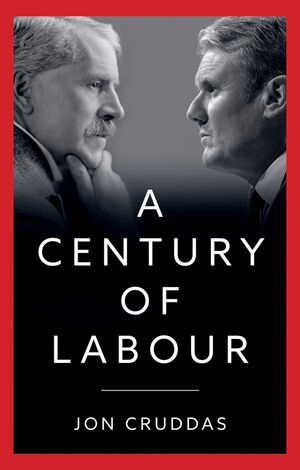
Stewart Lansley reviews A Century of Labour, by Jon Cruddas, published by Polity.
There are multiple accounts of the turbulent history of the Labour Party. In A Century of Labour, Jon Cruddas, standing down at the next election after 35 years in Parliament, offers an important and authoritative addition to this list.
The book, concise and topical, brings a fresh angle on a well-trodden story, by centring on Labour’s fundamental purpose. Cruddas evaluates the Party at different points in its long journey. He does so through the lens of key moral principles: distributional justice (of how the cake is shared), human rights that define liberty, and the human virtues that make for a good society. “Labour’s ever-changing ideological currents,” he argues, can be traced to the fluctuating dominance of these often competing goals.
Labour’s early model of “ethical socialism” – aimed at ending the immense injustices and crushing poverty of industrial capitalism – drew on humanitarian values that owed as much to Methodism as to Marxism. Labour first achieved power in two minority governments, briefly in 1924, and then from 1929-31. These first tastes of power faced severe external constraints, and were marked, Cruddas argues, by “moderation”. Labour’s Prime Minister, Ramsay MacDonald, prioritised security and confidence over radical reform, and saw his primary role as establishing Labour’s fitness to govern.
These priorities were reversed when Clem Attlee became Prime Minister in 1945. Attlee was infused with moral purpose, and as Cruddas describes, “united the three traditions of justice and in doing so would transform a nation.” Attlee aligned the need for social progress with a commitment to strengthening social rights. As he told the US Congress in November 1945, “we are in line with those who fought for Magna Carta, habeas corpus, and with the Pilgrim Fathers.” For some critics, his strategy was too “centrist”. Yet, given the conditions of post-war Britain, Labour’s boldness and ambition, produced “one of the great reforming administrations of the twentieth century.”
The critical issue of purpose should be at the heart of Labour politics, but has rarely been fully resolved. During Labour’s ‘wilderness years`, from 1951 to 1964, the Party’s strategy – to consolidate or advance – became the subject of bitter rivalry between its revisionist and fundamentalist wings. While the Harold Wilson governments from 1964 and 1974 faced a range of economic crises, they did deliver important and lasting liberal reforms that extended basic rights in key areas from race and gender to sexuality. Cruddas suggests, controversially, that the issue of distribution has been over-dominant in Labour history. Yet post-war pro-equality politics culminated – in the late 1970s – in peak equality and a low point for poverty. This egalitarian high water mark was an important historic achievement, if one that was short-lived.
From 1979 to 1997, Labour faced another extended period of opposition, and drained of confidence, further ideological turmoil. John Smith, leader from 1992, drew on the early thinkers to return the party to its ethical roots, with calls for “positive liberty”, the “collective provision of basic needs” and electoral and constitutional reform. On his premature death, aged 55, the leadership baton passed to Tony Blair.
In search of a big idea, Blair flirted with “stakeholding” and “communitarianism”, which might have strengthened the moral and democratic foundations of society. In the event, believing that Labour had to embrace free markets, globalisation and privatisation, and accept the “end of history”, “victory-for-capitalism” thesis, Blair opted for a new “third way” politics. This located the Party – according to its manifesto – between “the old left and the Conservative right.”
Blair, Labour’s longest serving Prime Minister, insisted he would govern according to the Party’s early ethical concerns. National renewal would be achieved through constitutional change, stronger human rights and anti-discrimination measures. Cruddas calls this coming together of the three strands of justice the “New Labour triptych”. Labour’s 13 years in power brought the Good Friday Agreement, boosts to social spending, falling NHS waiting lists, devolution, new anti-poverty measures, including the national minimum wage, and the 2010 Equality Act. But, Cruddas argues, the early “radicalism” gave way to “turbulence”, “diminishment” and a failure to deliver a lasting era of progressive renewal.
Allowing capital a largely free hand contributed to the 2008 financial crisis. Failure to reform an economic system with a built-in bias to inequality meant that many of the gains were easily unwound from 2010. It left “unaltered, unmodernised, long-term productive weaknesses and failures of economic design in terms of ownership and power.”
For Cruddas, the Party has only prospered – under Attlee, John Smith, and during Blair’s first term – when “the three different traditions of justice are combined.” Under Keir Starmer, there is little clarity of Labour’s governing purpose. We don’t know how much difference a Labour victory would make to Britain’s broken economy, shattered public services and for many, diminished life chances. Or, how much room there might be for the Party’s historic moral mission.
Stewart Lansley is the author of The Richer, The Poorer: How Britain Enriched the Few and Failed the Poor. A 200-Year History (Bristol University Press).
The publishers are offering the book at half price in January. Click on the link and use the code BUP23.
 Labour Hub