
Sue Lukes highlights some of the people who should be remembered and honoured today.
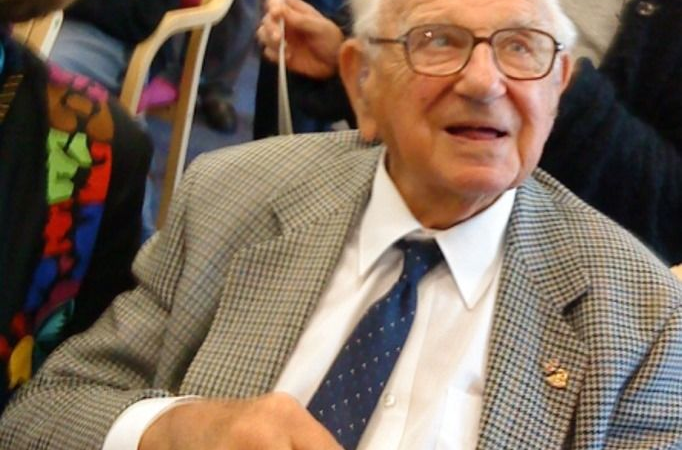
I have yet to see One Life, the film celebrating the life of Nicky Winton, but I was lucky enough to meet him a few times, and also – at a celebration of his 100th birthday – to introduce him to my father whom he rescued from Prague in 1939. Holocaust Memorial Day tends not to look too much at complexities, which is fine, but my father’s story is what it is.
His family were pretty assimilated, and for some reason prescient enough to realise the danger they were in, so signed him up for the Kindertransport. Places for it depended on people in the UK offering to foster the children, sponsor them and put up a guarantee bond that they would leave the country as soon as the danger was past.
Winton’s committee looked desperately for people to do that, and did not find enough. Many Jewish communal organisations responded that they had already taken children from Germany and Austria and now had ‘compassion fatigue’ as we now call it. So, many people who offered help were from the Woodcraft Folk – Winton was a socialist -the Quakers and the Seventh Day Adventists. And, for my father and others, the Barbican Mission stepped forward: an organisation dedicated to converting Jews to Catholicism. So Jana and Pavel, my grandparents, signed for my father to be converted, so he could get on the train. And then this conversion ‘by the sword’ became public and caused an outcry.
By the time my father arrived in the UK, the Barbican Mission had withdrawn the offer and he went to a different foster carer. Nicky Winton told the story to some of us at a meeting and said that a delegation from the Board of Deputies came to him to demand that he stop accepting the Barbican Mission’s offers. He explained that he had no-one offering to replace them, and without the sponsorship and guarantees the children could not get on the trains or get the visas – although Nicky actually forged some of those!. He asked for offers to replace them; the Board said they could not. He said he thought it was more important to save the children’s lives, and the Board left in silence.
Very few of the children ever saw their parents again. The focus on children was a product of the xenophobia and anti-semitism openly expressed in the media and by politicians then as now: getting visas for adults was made extremely difficult, but for children it was easier.
And, of course, the same racism and xenophobia that left my grandparents to be murdered means that in the UK now, refugee children who arrive alone are routinely refused the right to family reunion, and left, as my father was, to make their own way in a foreign land without parents. Many are even ‘assessed’ as adults and left in dangerous situations as a result, as reported this week by Refugee Council, the Helen Bamber Foundation and Human for Rights Network.
Of course, a film needs a central character and Nicky Winton is a worthy subject: he was modest, funny and committed to social justice. But he said he could not have done it alone. So on Holocaust Memorial Day I would like us all to remember and honour the others who made the rescue of my father and the other Czech children possible.
Doreen Warriner was a development economist, described as a “staunch feminist and internationalist with an interest in communism” who was investigated for some years by MI5. She went to Czechoslovakia in 1938 and became the local representative of the British Committee for Refugees from Czechoslovakia. She devised the Kindertransport as part of her efforts to get refugees out: a total of 15,000 including the 669 children. She fled as the Gestapo sought to arrest her in April1939.
Trevor Chadwick was a Latin teacher whom Winton asked to go to Prague and deal with the issues on the ground – negotiating with the Nazis, getting the children on to the trains – for four months in 1939. He apparently features in the film. “Trevor did the most difficult and dangerous work, he deserves all the praise,” said Nicky.
Marie Schmolka is another woman whose role has been largely ignored. Czech and Jewish herself, a social worker and social democrat, she was the Czech representative on the League of Nations Commission for Refugees. She alerted people initially to the plight of German refugees in Czechoslovakia and then to the need for all Jews to get out, which was what brought Doreen Warriner to Prague. Marie worked with her, travelled all over and campaigned to change public opinion. She was imprisoned and interrogated by the Nazis for two months, but got out and came to live in Hampstead. She died of a heart attack soon afterwards.
So on Holocaust Memorial Day, let’s give thanks for the lives, ideals and commitments of so many people without whom I and thousands of others, not just the Kinder but their children, grandchildren and great grandchildren, would not exist.
Sue Lukes was an Islington Labour Councillor from 2018 to 2022 and is a writer and consultant on migration issues.
Image: Nicky Winton on his 100th birthday. c/o the author.
 Labour Hub