
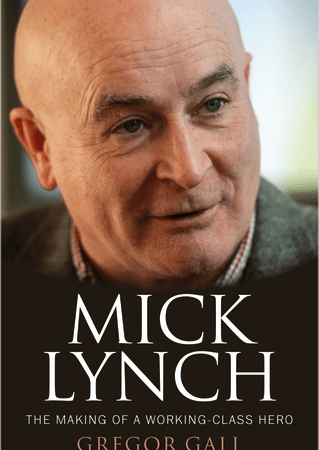
Mike Phipps reviews Mick Lynch: The making of a working-class hero, by Gregor Gall, published by Manchester University Press.
A newcomer to Britain travelling through leafy Kent would perhaps be surprised to see a piece of graffiti which I spotted last year on the wall of a country railway station saying “Mick Lynch for PM”. It was a sign of how much of the British public had warmed to the plain-speaking and persuasive transport workers’ leader – even at a time of disruptive strike action – especially when contrasted with the country’s woolly official Opposition.
University of Glasgow-based political scientist Gregor Gall, who previously wrote a biography of Lynch’s predecessor but one, Bob Crow, has now turned his attention to the current General Secretary of the National Union of Rail, Maritime and Transport Workers (RMT) to attempt to get to grips with the phenomenon that Lynch has become in the last two years.
“Within the space of a few weeks,” writes Gall, “he went from being virtually unknown among the wider public to having a national profile and being instantly recognisable. His demolition of established media operators – people who were supposed to have the professionally honed skills to take down, if necessary, their impertinent interviewees – was a joy for countless thousands to watch many, many times over.”
Assertive, forthright and frank, Lynch became a voice for the voiceless far beyond the members of his own small union. Increasingly, he spoke for “those whose interests were not represented, much less served, by the political process… A columnist in the Independent opined that ‘Mick Lynch has done more for workers in two days than Starmer has in two years’.”
It didn’t stop there. The Financial Times, called Lynch “A new folk hero for Britain’s working-class” and “a left-wing hero.” The Times said he was regarded as “a folk hero.” In Ireland, Lynch was called a “new folk hero” in the Sunday Independent, while in Scotland, the National declared him a “folk hero’” as did the Christian Science Monitor. The Scotsman and Herald said that Lynch was “a new hero for our times” and “a folk hero for our times” respectively. The New York Times called him “an unlikely national hero.” “Working-class hero” mugs and “man of the people” t-shirts, hoodies and mugs were produced featuring Lynch’s image.
Lynch was born in 1962 to an Irish Catholic family in West London. He was the youngest of five children and grew up in “real poverty”, a rented slum and later an unheated council flat. Money was tight: there were no family holidays. He left school at 16 with five O-levels and worked in a succession of manual jobs, invariably unionised in those days. Increasingly active, he was secretly blacklisted and denied work, for which he later won compensation. He did a degree in History at the LSE and then took a job with Eurostar, mainly “to get a bit of real money and keep my head down.” Instead he founded and build the Eurostar branch into one of the biggest in the RMT.
Lynch became increasingly active in the union and was frequently elected as a delegate to its AGM, served on its Council of Executives and in 2015 was elected Assistant General Secretary. It was a period of considerable factionalism within the organisaton. The General Secretary took leave from his job citing pressures on his mental health: Lynch covered for him but also went off sick due to stress, citing “the current stance of the NEC as overbearing, harassing and bullying towards myself.”
In 2021, he was elected as the union’s General Secretary. His leadership strengths were demonstrated by his decision to prioritise unifying a fractured union and setting the challenge to make it an organisation for all transport workers.
The author makes a considerable effort to pin down what makes Mick Lynch such an appealing leader – his family and class background, sense of values, self-deprecating humour, communication skills, his resolute commitment to getting a good deal for his members, and so forth. Lynch also offers that rare thing in contemporary politics: hope. “The reason the [Tories] want to bring in more [anti-union] laws is because we’re winning,” he said in November 2022.
Gall takes us through 2022’s industrial action in detail, which may be a bit specialised for some readers. But it includes the telling point, revealed by rail minister Huw Merriman at the House of Commons Transport Select Committee that the cost of the strike – over a billion pounds at the time – was “more than would have been the case if it was just settled.” This was a clear indication that the government’s approach to the dispute was entirely political, aiming to demonise the RMT union for electoral advantage. Mick Lynch understood this, saying “They think the RMT is the biggest enemy they’ve got and… they want to knock us back like they’ve knocked the miners back.”
The summer of 2022 saw strike action in other sectors, much of it publicly popular. The Conservatives’ response was to legislate for minimum service level provision, allowing employers in future to determine “how many staff and which staff were needed to run a minimum level of service. Failure of those selected to work could lead to dismissal, and failure of the union to cooperate could lead to contempt of court proceedings and hefty fines. Lynch likened the Bill’s effect to ‘conscription’ and ‘a suppression of our human rights’.” The Bill became law in July 2023.
Mick Lynch and the RMT were central to the launching of the Enough is Enough! Initiative to build working class solidarity against such attacks. Gall is not uncritical of its top-down approach to movement building: it seems doubtful that the campaign has put down deep lasting roots for the future.
Characterising Lynch’s overall politics is also not straightforward. He certainly has a class analysis, but for Gall is more democratic socialist than Marxist. This corresponds to Lynch’s own espousal of “traditional Labour values”, adding that “I am a reformist.” He saw the Soviet Union as a “murderous death cult”, had, according to Gall, a strong workerist streak to his politics, and was disdainful of far left activists as dogmatic and unlistening. All of this still places him well to the left of the current Labour leadership. Interestingly, he says his political hero is republican socialist James Connolly, adding, however, “His trade union activity is what mainly interested me.”
The reality is that it’s the absence of any real alternative coming from Labour’s current leadership that has led people to project their values and aspirations onto him. His elevation to the status of ‘working class hero’ underlines the yawning vacuum in official opposition politics. But it’s also the product of a strong, confident union that is not afraid to fight tooth and nail for its members.
Mick Lynch’s ascent also says a lot about the political times we live in. I cannot remember any union leader – in the middle of a strike which necessarily inconvenienced the travelling public – being so popular. For all his political commitment and rhetorical gifts, 1980s miners’ leader Arthur Scargill never came near. Lynch’s popularity underlines the desire of ordinary people not only to give the Tories a bloody nose but to break the elite consensus that has replaced the real political choice that Labour formerly offered under Jeremy Corbyn.
At the end of last year, the BBC reported that, “Members of the RMT union agreed to an offer from 14 train companies, which included a backdated pay rise of 5% for 2022-23 as well as job security guarantees.”
The offer was accepted by 90% of those voting on a 79% turnout. All the attacks on members’ jobs and conditions had been withdrawn – a real victory for the union and the tactics it deployed. The 18-month rail dispute may have ended, but it’s unlikely that we’ve heard the last of Mick Lynch. Apart from anything else, he has emerged in recent weeks as a powerful advocate for a ceasefire in Gaza.

Mike Phipps’ book Don’t Stop Thinking About Tomorrow: The Labour Party after Jeremy Corbyn (OR Books, 2022) can be ordered here.
 Labour Hub
[…] since 1989. Moreover, this action was widely popular – as captured by RMT General Secretary Mick Lynch’s elevation to “working class […]