
As predicted previously on Labour Hub, Keir Starmer in a major U-turn has ditched Labour’s policy of spending £28bn a year on its green investment plan.
“The spending pledge, announced in 2021, had been a key part of the party’s plans to reach climate targets and secure green jobs,” reports the BBC. “Sources insist the plan, which includes creating a publicly-owned green power company, is not being dropped altogether. But Labour will no longer commit to investing £28bn a year to deliver it.”
The policy climbdown comes on the same day the EU’s climate change service announced that global warming has exceeded 1.5C across an entire year for the first time.
That pledge was already diluted last June, with the £28bn target adjusted so that a Labour government would meet it about halfway through its first term rather than in its first year. Sources specified that this figure included around £8bn a year in existing Tory government green spending, making the extra spending commitment more like £20bn.
Labour’s leadership claims its change of policy is based on the need to look economically credible. Others disagree.
“This latest Starmer U-turn represents yet another capitulation to right-wing interests,” a Momentum spokesperson said. “Sadly, there is a huge gap emerging between the scale of the economic and environmental crises facing us, and the solutions being offered by a Labour leadership afraid of its own shadow.”
Unite leader Sharon Graham said: “The Labour movement has to stand up to the Conservatives’ false accusations of fiscal irresponsibility. There is a catastrophic crisis of investment in Britain’s economic infrastructure.”
Labour MPs were among the many critics of Starmer’s cave-in. “The dumping of the Green Prosperity Plan casts major doubt on whether Labour can provide the leadership to meet the challenges of a fast warming world,” warned Mick Whitley MP. “This latest U-turn will leave many voters asking what, if anything, our Party stands for.” He concluded that it was “Dangerously short-sighted politics.”
Barry Gardiner MP was blunter, tweeting: “Economically Illiterate. Environmentally Irresponsible. Politically Naïve.”
“Now is not the time to scale back our green industrial strategy,” said Bell Ribeiro-Addy MP.
Former Shadow Environment Minister Olivia Blake MP called the decision “disappointing”, adding, “As the world heats by over 1.5C, we should protect key planks of our climate agenda – e.g. a National Wealth Fund; Local Power Plan; GB Energy; Warm Homes Plan; No new oil & gas – and push, as a movement, for more green investment. “
Nadia Whittome MP agreed, saying of the £28 billion pledge, “We can’t afford to abandon it.”
Former senior policy adviser to Jeremy Corbyn Andrew Fisher said: “Labour dumping its Green Prosperity Plan shows it has no economic credibility and no environmental credibility. It’s bad for the economy, the environment and all our energy bills.”
It’s not just left wing figures who criticised Starmer’s back-tracking. John McTernan, a former adviser to Tony Blairs, said it was “probably the most stupid decision the Labour Party’s made.” He added: “What’s the change Labour now offers?”
Luke Tryl, director of pollsters More in Common, concurred: “The green investment pledge was Labour’s second most popular manifesto pledge with those intending to vote for the party. Defending the price tag wasn’t without risk, but I’ve no doubt ditching it ultimately does more harm than good to Starmer’s standing with key voters.
“It reinforces what is a major weakness that Labour doesn’t stand for anything and Labour isn’t up to meeting the challenges the UK faces. That might not matter given dissatisfaction with the Tories is so high, but it reinforces an attack line the electorate find plausible.”
Economists agreed. Ben Zaranko, an economist at the usually middle-of-the-road Institute for Fiscal Studies thinktank said: “Labour’s green investment plans were the only bit of clear daylight between the two major parties on tax and spend.”
He added that it “Looks increasingly like we’ll have a Ford Model T election: voters can have any fiscal policy they want, as long as it’s existing government policy.”
The centre-left New Economics Foundation was more scathing, saying “It’s deeply disappointing that Labour is set to ditch its £28bn green investment.
The UK has already fallen behind other countries on green growth and inaction now will prove far more costly down the line.”
And the centre-left Institute for Public Policy Research, usually close to the thinking of Labour’s financial team, said: “Tackling climate change isn’t just good for the environment, investing in the green transition is also good for the economy.” It had previously called the £28 billion a year commitment “sensible” and said the UK suffers from “investment-phobia”.
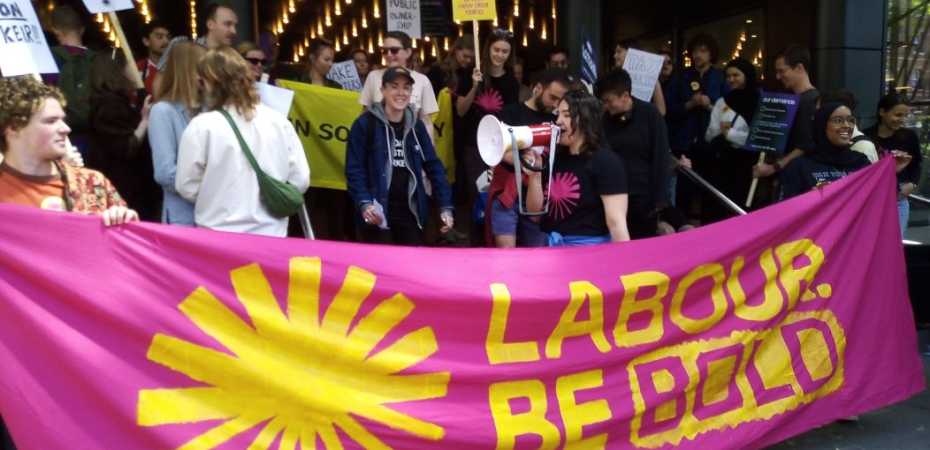
Image: Labour for a Green new Deal protest, June 2023, c/o Mike Phipps
 Labour Hub