
Below we publish extracts from the Parliamentary debate on Humanitarian Aid and Children in Gaza, held in Westminster Hall on Thursday February 8th.
Apsana Begum MP (Poplar and Limehouse): Before the war began, Gaza’s streets were alive with the sound of children. Roughly half the population are under 18, but unlike children in the UK, Gaza’s children have had to endure so much in their short lives. A 15-year-old will have lived through five wars, including the current conflict. Many have been displaced several times. Even so, they have never experienced destruction and death like this.
Since October, it has been clear that children have been affected by the conflict on an unprecedented and unparalleled scale. We know that the Hamas attacks involved the killing of Israeli children, and that an estimated 40 Israeli children were taken captive in Gaza. Nevertheless, more than 11,500 children have since been killed in Gaza by Israeli airstrikes and ground operations. The phrase “war on children” is echoing across the international community. Lost in the numbers are the faces, the names, the lives and the moments of joy that those children brought—children like six-year-old Hind Rajab, whose fate is reported to be still unknown after the car in which she was fleeing to safety with her uncle, his wife and their four children came under Israeli fire. More than 24,000 children have lost one or both parents…
The healthcare system in Gaza is in crisis due to major shortages of doctors and nurses, the lack of medical supplies and the destruction of hospitals. Small children caught up in explosions are particularly vulnerable to major life-changing injuries, and more than 1,000 children have had one or both legs amputated. According to the World Health Organisation, many of these operations on children were done without anaesthetic. Such horrors are virtually unimaginable for us in the UK, but it does not stop there. Many children are accessing well below the recommended water requirements for survival, and those under five are at high risk of severe malnutrition and preventable death due to famine. According to Islamic Relief, Gaza is now the world’s worst hunger crisis…
Why is humanitarian aid not getting to children who need it? What are the blocks on humanitarian aid? According to reports, the flow of aid is being drip-fed. Although around 500 trucks per day are needed to meet basic needs, most days fewer than 200 actually make it inside, and on one day this month it was reported that only 30 crossed into Gaza. Human Rights Watch argues that the blocking of humanitarian assistance amounts to collective punishment of the civilian population and poses further grave risks to children…
Then there is the question of funding itself. The United Nations Children’s Fund has requested $168.3 million to support its response in the Occupied Palestinian Territories for 2024. On 17 January, it said there was a funding gap of $55.5 million. Shortly after the International Court of Justice’s plausible genocide ruling, the UK stopped funding for the United Nations Relief and Works Agency, the largest UN agency operating in Gaza, due to allegations from Israel that 12 of the agency’s more than 13,000 staff were involved in the 7 October attacks. UNRWA has since spoken of being “extremely desperate”.
International aid agencies including Oxfam and ActionAid have said they are deeply concerned and outraged at what they have called a “reckless decision to cut a lifeline for an entire population”.
Amnesty International has said that while allegations against individuals must be independently investigated, cutting lifesaving assistance to millions could amount to collective punishment in and of itself.
Jeremy Corbyn MP (Islington North): There are now more than 1 million people around the Rafah crossing. It is a small town. It is grotesquely overcrowded and has a shortage of absolutely everything. One can cite many images, but I saw one the other day of two children—they looked five or six—walking down the road together, hand in hand. They were a boy and a girl. The girl was holding a bottle with a small amount of water in it, and they were aimlessly wandering about. When they saw anyone, they said, “Do you know where we can get food?” The world should not treat children that way, particularly when a few kilometres away there is plenty of food, medicine and clean water deliberately being denied to those people. This country signed the UN convention on the rights of the child in 1989—there is a stone commemorating that in Hyde Park—and we should abide by it…
The question of food supply to Gaza is obviously critical. The population is very young and possibly half of the 27,000 recorded deaths in Gaza will be of young people or children. The number who are still under the rubble is enormous. There is very limited access for outside help to get in. The numbers of medical staff who have been killed are huge, as are the numbers of journalists who could report on the situation—80 journalists have already lost their lives in Gaza. This is a horror show on live TV all over the world.
The idea that, somehow or other, this country can adopt a policy of not funding the one agency that can deliver help, food, aid and medicine to the children of Gaza I find to be completely unconscionable…
The number of people dying from wholly preventable conditions in the southern part of the Gaza strip is already greater than the number who have been killed by the daily bombardment there. And what are they dying from? Diarrhoea, hunger, malnutrition and lack of any kind of medicine.
I talked to a doctor who I met in Leeds two weeks ago when I was at an event in support of the people of Gaza. He told me that he had done something that he had hoped he would never, ever have to do in his life: perform an amputation on somebody without anaesthetic —on a child. Imagine being a professional doctor who has taken the Hippocratic oath and having to put a child through the most unbelievable pain in order to, hopefully, save their life. He told me of cases where he has performed a successful operation, in the sense that the operation was carried out, but the patient has then died of a heart attack because of the pain inflicted on them. None of that is necessary. Medical aid and anaesthetics could get there if only they were allowed in.
Currently, in the southern end of the Gaza strip there are reported to be 135,000 cases of diarrhoea; they have been recorded by those doctors who remain there. That is 13.5% of the people around Rafah and possibly even more than that. Diarrhoea is a killer, particularly of children, because it means that they cannot feed food down or keep their body hydrated; it is an absolute killer.
In addition, no child has been to school anywhere in the Gaza strip since November—so that is three months of education already lost. Even if the bombardment and fighting stopped tomorrow, there is no school to be reopened; there would have to be schools in tents for months, if not years, to come. The children affected will be physically devastated, and mentally scarred and devastated. What is the next generation going to be like when they have been through this horrific experience?
Surely, therefore, it is incumbent on all of us to do everything we can to bring about a ceasefire in Gaza and save the lives of children. The messages are there—from the UN, from all the children’s agencies, from the World Food Programme, from Amnesty International, from Human Rights Watch and from a whole range of other people who have either been to Gaza or managed to pick up information about what is going on there regarding the crying need for help, particularly for children. That help can best be achieved by a ceasefire…
I went to a primary school in Jabalia refugee camp; I have been there twice, on successive visits. It was a beautifully run if underfunded school. From the roof of the school, it was possible to see the fence—the border with Israel. We met the children; this was a primary school, so they were 10 or 11-year-olds. They were excitable, artistic, enjoyable to be with, full of ideas, full of hope and full of aspirations. I always left that school feeling, “Well, these children will be a huge asset to the country of the future, as they are the citizens of the future.” The school has now been destroyed—completely destroyed. Those kids have lost their school. Having lost their homes, the one strong factor in their lives had been their sense of a place to go to school, and that applies to every other school across the Gaza strip, as well as to every hospital across the Gaza strip.
Let us give all the aid we can to UNRWA now and give all the support we can now to the people of Gaza—particularly the children, so that they may grow up to at least live without the threat of being bombed day in and day out. But above all, get off the fence and get on the side of supporting a ceasefire now to save life in Gaza and bring about a long-term peace for all the people of the region, before this thing degenerates into a ghastly war that engulfs the whole region.
Rachel Hopkins MP (Luton South): Israel continues to use devastating tactics that have seen far too many innocent civilians and children killed. There have been unacceptable blocks on essential aid, with nowhere being safe for civilians. It is a humanitarian catastrophe, and now there are warnings of a deadly famine. Women, children and newborn babies bear the brunt of the violence in Gaza. Since the horrific attacks on 7 October, Israel’s devastating response has killed over 11,500 children in Gaza—one in every 100 children in the Gaza strip—and UNICEF has reported that 17,000 children have been left unaccompanied or separated from their families.
Many of my Luton South constituents, as well as non-governmental organisations such as Islamic Relief and Medical Aid for Palestinians, have highlighted the fact that, without an immediate and permanent ceasefire, the numbers dying of hunger, malnutrition, disease and unmet medical needs could far exceed those that have already been caused by the bombardment. Like many others, I have heard briefings from UK doctors who have regularly visited Palestine to carry out medical work, procedures and training. They are despairing that we will see children dying from preventable diseases and lack of simple medicines such as insulin for diabetes. That is terribly shocking.
Alongside the horrific physical impacts, Oxfam has reported that about 1 million children are in need of mental and psychosocial support. The deep trauma of Palestinian children will stay with them for the rest of their lives. Nearly all the children in the Gaza strip require mental health support. Many are presenting very challenging symptoms, including extremely high levels of persistent anxiety, with the responses to that such as not eating and being in despair.
While that is going on in Gaza, the worst hunger crisis and starvation are setting in; it is on the verge of being a famine. It has been reported that all children under five are at high risk of severe malnutrition, as that risk of famine conditions continues to increase. Other hon. Members mentioned hearing reports and receiving briefings from Islamic Relief staff in Gaza describing how desperate children are roaming the rubble-filled streets in search of any scraps of food that they might find.
Like others, I have heard first hand from doctors who have, sadly, had to do medical procedures in Gaza without anaesthetic, including the amputation of children’s arms and legs, because there is a critical shortage of drugs and medical supplies. We also hear about babies being born on the streets, and the umbilical cords being cut with whatever sharp object is to hand.
The constant, indiscriminate bombing, the debris, the electricity blackouts and the lack of fuel make it extremely dangerous to distribute any aid and make many parts of the Gaza strip inaccessible. As has been so well put by others, to meet the need for humanitarian aid, an estimated 800 trucks of aid would have to enter Gaza daily; since 7 October, however, the highest daily average has been two trucks. As my hon. Friend the Member for Poplar and Limehouse said, we really need to question whether this is a blockade and what that would actually amount to.
Andy Slaughter MP (Hammersmith): What impresses me most about Gaza, as others have mentioned, is the resilience of its people, despite the utter squalor of life, caused by occupation and the control of land, sea and air borders for a long period, such that most are reliant on aid, cannot leave the country, except in very few cases, and have been living almost as stateless citizens, in limbo, for nearly a generation now. Gaza has a highly educated population, and it has become clear during the current conflict, as we have seen hospitals and other civilian infrastructure destroyed, that it was there. Indeed, many doctors and other specialists have gone out from this country to assist medics and others in Gaza in running the health service as best they can, despite the deprivation of supplies. At the same time as being horrified by the conditions that people had to live in, one could not help but admire the fact that life continued as normally as it could under the circumstances. Not only did a siege go on, but there were four or five separate land or air assaults by Israel on Gaza between 2008 and the current conflict. Life had been worn down, and people had been worn down, not just physically but mentally, over that period.
The other aspect of Gaza that is perhaps unique is that there is nowhere to flee to. There is no route out of Gaza. Gazans do not want to leave Gaza. They do not want to be forced into Sinai or elsewhere, or into any of the mad schemes that extreme members of the Israeli Government have come out with. Undoubtedly, there are those who would like to be able to cross the border, perhaps because they are wounded or injured, they are foreign nationals or have family abroad, or they simply cannot stand what is happening, but they are simply unable to. That adds another dimension of horror to the situation. People are being bombed and shelled daily, as we have seen. We do not get the full picture, but we see that whole districts and neighbourhoods, and the majority of residences, have been damaged or destroyed in what would be an extraordinary level of bombardment in any war but is particularly so in such a narrow and small piece of land.
People have mentioned some of the headline statistics, if I can put it that way. The fact that 85% of the population have been displaced is extraordinary. Some 27,000 people have been killed, over 11,000 of them children, and we have heard about the half a million people who are in the most severe level of food crisis. A very substantial proportion of people around the world who are in that highest level of crisis are now living in Gaza, which previously had a first-world economy, in many ways, and first-world education and skills. That is the seriousness of the case, and that is why we have seen attempts to defend the victims through action in the International Court of Justice in the United Nations itself.
The above extracts are from Hansard. The full debate can be read here.
On Wednesday February 7th a new EDM was tabled on International Court of Justice Ruling on Gaza and the UK’s duties under the Genocide Convention. Ask your MP to sign it.
This article contains Parliamentary information licensed under the Open Parliament Licence v3.0.
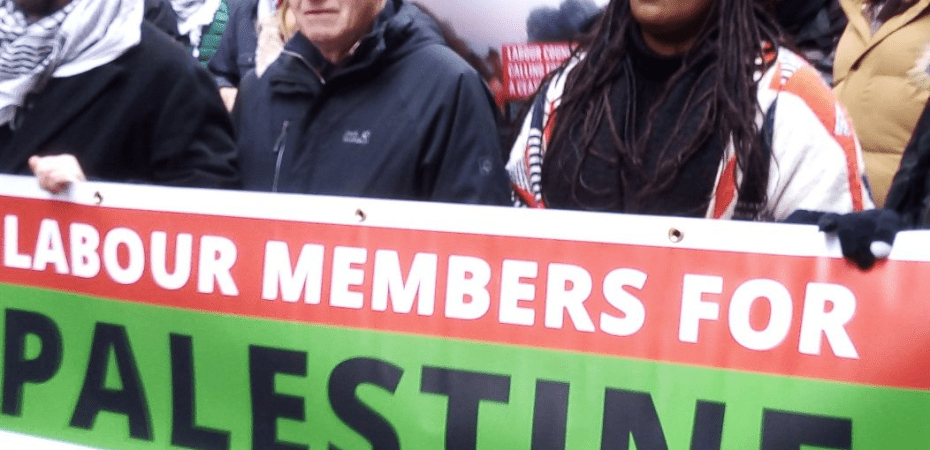
Image: January 13th ceasefire demonstration in London, c/o Labour Hub.
 Labour Hub