
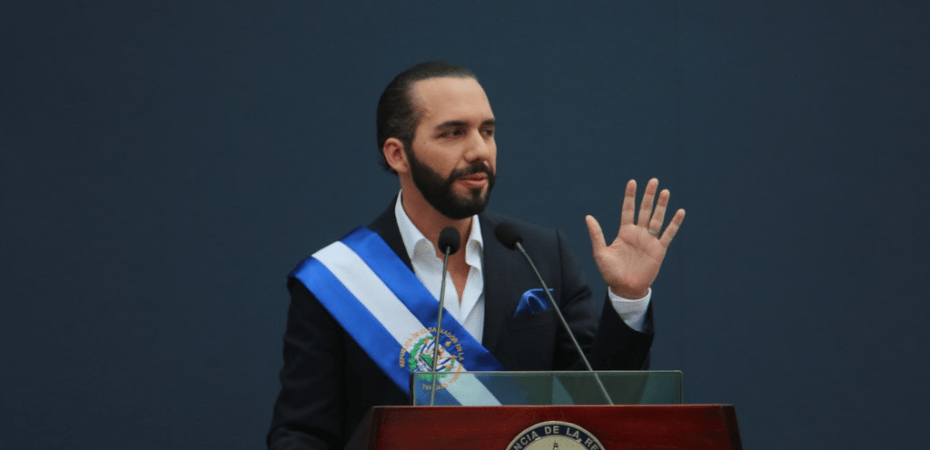
El Salvador went to the polls on Sunday February 4th. President Nayib Bukele hailed his re-election with 83% of the vote as the highest ever in any democratic contest worldwide. But the election took place against a backdrop of a nearly two year state of emergency which has left 1.6 % of the population incarcerated – also the highest in the world. This State of Exception has generated major human rights concerns, including thousands of complaints of police abuse, torture and persecution. Press freedom is also under threat, with journalists saying El Salvador is becoming a police state. This report is edited from the blogs of Tim Muth, who lives in the country.
El Salvador held elections on Sunday for president and for deputies to the country’s Legislative Assembly. Easily cruising to re-election was Nayib Bukele, the country’s millennial president, first elected to a five year term in 2019. He was re-elected despite six provisions in the constitution which prohibit a president of El Salvador from serving two successive terms. High court judges, put in place by Bukele’s Nuevas Ideas party when it got control of the country’s Congress in 2021, gave him a path to ignore those constitutional prohibitions.
On Friday, February 9th, El Salvador’s Supreme Electoral Tribunal announced the final results of the presidential election. We already knew Bukele had won in a landslide, the only real question was the exact margin of victory. With turnout around 52%, Nayib Bukele won with 82.7% of the votes.
The announcement of the final results in Bukele’s unconstitutional re-election came on the fourth anniversary of Bukele’s first major step towards asserting authoritarian power in the county. On February 9th, 2020, Nayib Bukele sent armed troops ahead of himself into the Legislative Assembly. He was demanding that the Assembly, then controlled by parties other than Nuevas Ideas, approve a loan package to buy military equipment. As Bukele sat himself down at the place of the president of the Assembly, with his troops ringing the legislative chamber, Bukele sent a clear message that he wanted an Assembly subservient to his will. The move foreshadowed what was to come when Bukele’s Nuevas Ideas party swept into power in June 2021, and promptly placed allies in the supreme court and attorney general’s offices, and ten months later placed the country under the emergency State of Exception.
Populist autocrat
Bukele’s election night victory speech before a crowd of supporters in Plaza Barrios, repeated his claim of the largest victory in democratic history, and followed with minutes of railing against his critics in the international press and human rights organizations.
This election occurred under an ongoing set of emergency decrees called the State of Exception. The State of Exception, since March 27th, 2022, has suspended a variety of due process rights for persons arrested, allowing jailing without judicial orders, jailing without informing persons of the charges, suspending rights to talk with a lawyer, and indefinite detentions without trial. To date more than 76,000 people have been arrested and thrown in prison without trials according to unverifiable social media reports from security forces. Despite Bukele declaring his country to be the safest in Latin America, he has declined to return these constitutional protections to the citizens of the country, declaring that every last gang member must be hunted down and removed.
Bukele’s victory came as a surprise to no one. His approval rating in public opinion polls has been as high as 90% with Salvadorans giving him credit with dismantling the street gangs in the country and reducing homicide levels to historic lows for a country which only nine years ago was the murder capital of the world.
Bukele’s support is driven by perceptions of substantial improvement in the security situation in the country, along with a polished publicity machine which portrays the president as author of a glimmering new El Salvador. The cult of personality which surrounds Bukele seems impervious to documented revelations of corruption and wrongdoing in his government published by independent journalists in the country.
Bukele’s single-handed control of all the branches of government in the country and the imposition of an ongoing State of Exception confirm in the minds of many his description as a “populist autocrat.” Those evaluations were solidified by an interview his Vice President Felix Ulloa gave to the New York Times:
“To these people who say democracy is being dismantled, my answer is yes — we are not dismantling it, we are eliminating it, we are replacing it with something new,” said Félix Ulloa, who is running for re-election as vice president alongside Mr. Bukele… Mr. Ulloa said the vast majority of the country actually wants Mr. Bukele to be president “for life.”
On social media, Bukele, assured of his own re-election, engaged in a campaign of fear, claiming that opposition parties want to release gang members from the country’s prisons, and that he needs to have super-majority domination in the Legislative Assembly to continue that State of Exception and keep the justice system locking up criminals.
The State of Exception suspends the constitutional due process protections against arbitrary capture and detention, and allows people to be thrown into prison for months on the slimmest of allegations. An anonymous phone tip can be sufficient to have someone captured. The “exceptional measures,” which are touted by the Bukele regime for their impact in reducing gang-related crime in the country, have been used in some cases, say advocates, to silence and threaten activists and community leaders who protest development projects of friends of the Bukele regime.
US approval
There has been a complete reversal of the public discourse from the US State Department towards El Salvador. The change appears to coincide with the arrival of the current ambassador William Duncan in January 2023. Duncan was, to put it mildly, effusive in his praise for how the Bukele government had improved the public security situation in the country during the State of Exception.
Duncan has decided to be silent in public about any concerns over human rights, the rule of law in El Salvador, or the autocratic direction of the Bukele government. The US seems to be reading the public opinion polls in El Salvador, and recognizes that its public criticisms of Bukele have had zero effect, and may have even made Bukele stronger by letting him portray himself as the David standing up to a US Goliath. Whether there is any diplomacy behind closed doors on behalf of democracy and human rights is unknown, but there is no sign it is having any effect.
The number of Salvadorans arriving at the southern US border has declined significantly. That may be the only metric the US cares about in this relationship.
Legislative elections
Almost none of the Legislative Assembly results had been processed. As of Wednesday night, a recount had commenced for all of the ballots for the Legislative Assembly as well as a portion of the presidential ballots where vote tallies had not been previously completed.
There are growing concerns about the ability of the TSE to guarantee the credibility of final results when they do appear. An audio recording of a private meeting between the TSE and political party leaders obtained by El Faro included a suggestion by the chair of the TSE that there might have been internal sabotage of the computer systems to tally and transmit votes. Some are now calling for the election to be redone on March 3rd, when national elections for municipal governments are already scheduled.
The elimination of opposition party deputies from the Legislative Assembly will have been accomplished both by the popularity of Bukele, and by association his political party, but also by “election engineering” in the year leading up to these elections. The Nuevas Ideas-controlled Congress changed Salvadoran laws in several respects to give Bukele’s party an even stronger hand.
- It reduced the number of seats in the Legislative Assembly from 84 to 60, meaning a small party would need a greater share of votes to capture a single seat.
- It changed the mathematical formula for allocating seats to parties to a method which favours large parties at the expense of smaller ones. For more on this change, see my earlier post.
- It directed that all votes over the Internet, and all votes cast from abroad by Salvadorans using a passport as identification, should be allocated to the Department of San Salvador, presuming that diaspora votes would overwhelmingly favour Nuevas Ideas and swamping the Department where opposition parties have much of a base.
With sole super-majority control of the Legislative Assembly, Bukele can now continue to operate in a government which has no checks and balances on his exercise of power. He can extend indefinitely the State of Exception with its power to arrest anyone without question. He can modify any or all provisions of the Salvadoran constitution, including any limitations on further re-elections.
Tim Muth is a US-trained lawyer who works on matters involving civil liberties and human rights. He blogs at El Salvador Perspectives, and you can follow him on Twitter as @TimMuth.
Image: Nayib Bukele. https://www.flickr.com/photos/presidenciard/47980632231. Creator: Gobierno Danilo Medina. CC BY-NC-ND 2.0 DEED Attribution-NonCommercial-NoDerivs 2.0 Generic
 Labour Hub