
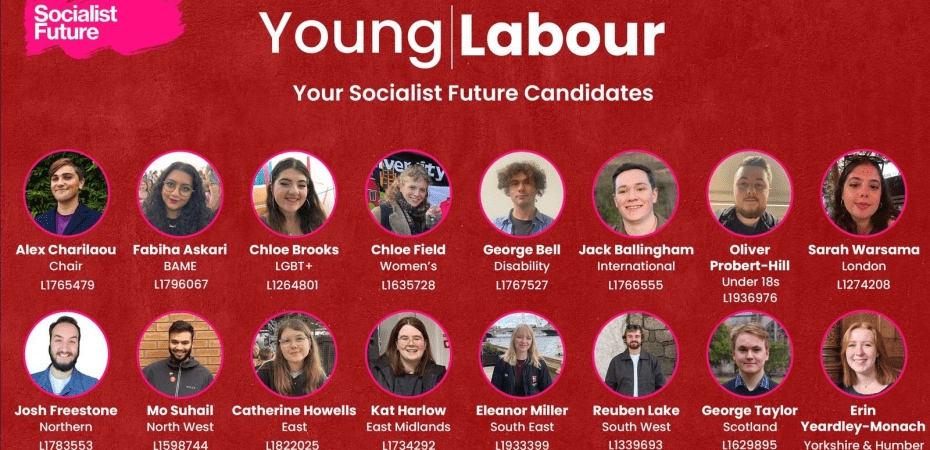
By Jack Ballingham
This year, elections to the national committees of both Young Labour and Labour Students will take place, on an earlier than usual timetable after the Party’s NEC decided to bring the process forward. These elections are young members’ opportunity to choose their national voice within the Labour Party for the next two years.
Young people now have to face a society in which they will be the first generation in living memory to be worse off than their parents. Higher education remains inaccessible and expensive, and the government has neglected to invest properly in further education. Private renting, at sky-high prices and in terrible condition, is the reality for many young people, in an era where council housing seems more a vague memory of the past than a possibility in the present.
These, and the myriad other crises facing young people today, demand swift and radical action from an incoming Labour government. Available data suggests that the Party now commands the support of an overwhelming majority of young people (indeed, of anyone younger than their 60s). Progressive action on housing, education, wages, the climate crisis and more is an absolute necessity. To squander this support by failing to address the issues affecting these voters would be a mistake of historic proportions.
However, the Party leadership has, in recent years, made it quite clear that solving these issues is not on the agenda. Keir Starmer has backtracked on his leadership pledge to abolish tuition fees when in office, to take one example. In housing, transport, education and industry, progressive policy is in the firing line or has already been junked. The slow death of the £28 billion green investment pledge is the latest instalment in this saga.
On the other side of the coin, young members within the Labour Party must also be recognised and engaged with as young members. This demands equal dignity and a seat at the table, and for young members not to be treated by the leadership and NEC as an inconvenience.
Young Labour and Labour Students should serve as a voice for young members within our Party, not just as a reserve army for official Party campaign days. There is more to being a young member of the Labour Party than to be deployed to marginal seats; like any other Party member, young Labour members want to campaign, but also to develop policy, take on leadership and advocate for what is right. Their organised bodies should be forums for policy discussion, and sites of democratic decision-making, as well as campaigning.
And yet, this is not the reality we currently face. At Party Conference in 2023, an NEC rule change removed CLP youth officers from their executive committees. Labour Students appears to have rapidly reverted to the old anti-democratic habits of ‘NOLS’, which it was supposed to have escaped. Its first conference was shorn of its constitutional status, while Young Labour has been barred from holding a conference, organising events, posting on social media or even communicating with its members for some time.
It is clear that Socialist Future candidates, for both Young Labour and Labour Students, are the only ones offering a genuine commitment to tackling these issues. It is crucial that both of these committees will speak up for their members, advocate for the necessary policies to benefit our generation, and play their part in electing the next Labour government – and after that, will hold them to their promises.
All of the above considered, as a candidate for the position of International Officer on the Young Labour committee, I am also keenly aware of the rapidly mounting crises abroad, and the pressing need for an internationalist outlook. The problems affecting young people here in Britain are important and urgent, but seem to pale in comparison with the everyday realities of young people elsewhere.
The climate crisis, for instance, will affect today’s young people most severely, whether in Britain or anywhere else; it is possibly the deadliest manifestation of the classic ‘tragedy of the commons’ problem. It is unsurprising that it ranks highly among young British voters’ priorities.
It is also the reality, however, that young people in other parts of the world are battling with the impacts of the crisis right now, nowhere more so than in the Pacific island nations. People there face the prospect of their homes being submerged by rising sea levels in the comparatively near future. Tuvalu’s own negotiator at the COP28 conference, herself only 25 years old, was reckoning with a future where her home no longer exists. The representative of the Marshall Islands movingly stated that “we will not go silently to our watery graves”.
As well as the climate crisis, young people around the world are also badly affected by war and conflict. In our current era, it seems that children and young people are no more shielded from the horrors of war than anybody else. Amid all the coverage of the conflict in Palestine, it must be remembered that half of those under siege in Gaza are children. The UK has a moral obligation to do what it can to stop this suffering, in Gaza and elsewhere, which it is currently not meeting.
Young Labour, Labour Students, and the whole Labour Party and movement, have a duty to stand in solidarity with young people living the day-to-day reality of these ongoing crises abroad, and to hold our leaders to account when they fail to do so themselves. In these current elections, I and all Socialist Future candidates are committed to putting this internationalism at the heart of Young Labour’s activity.
Nominations for the Young Labour and Labour Students committees may be made up until 23rd February. Young Labour nominations must be made by Young Labour branches or, in their absence, by CLPs. Labour Students nominations may be made by any individual verified student member of the Party. The voting period for both elections is 14th March – 5th April.
Jack Ballingham is a Young Labour member in Selby CLP, and a Socialist Future candidate for the position of International Officer on the Young Labour committee.

 Labour Hub