
Peter Rowlands offers some reflections.
The upcoming general election does not have to be held until January, but most commentators think it will be in the autumn when cost of living indicators could be more favourable and tax cuts will have had time to register.
It is difficult to see the Tories winning, given Labour’s consistently large poll leads, and to form a government they would need a majority of seats, as it is unlikely that any other party would be willing to enter into any coalition or support arrangement with them. But politics is currently very volatile, and the huge majority that some polls predict for Labour is by no means certain. There are broadly three possible scenarios for Labour:
1) A large or fairly decent majority, say, over 50. This would probably maintain the leadership’s control over policy, despite any opposition from the left, unless they were able to persuade others to join them.
2) A smaller majority. This would mean the left holding the balance of power which the leadership would find difficult to deal with.
3) A hung parliament, with the SNP, or the Lib-Dems, or other small parties, or a combination of them, holding the balance of power, which would make it difficult for the Labour leadership and could lead to a change.
I think that at this stage it is worth trying to assess what the various currents in the Party represent, for MPs, other elected representatives, and the wider membership.
The 200 odd MPs consist of a spectrum from left to right, as do all other parliaments, councils and CLPs, although not necessarily in the same proportions. The parliamentary Labour Party has a clearly defined left of about 30, although they are divided, with a ‘soft left’ drawn from a section of the Tribune group, broadly of those who are leftish but lack confidence in any but the mildest reforms being achievable.
The right includes Blairite neoliberals alongside traditional right wingers. However, many in the PLP can probably best be categorised as ‘pragmatic centrists’, more concerned with what is likely to be electorally successful than ideology. This explains much of the support for Starmer. On the right there is clearly some level of disagreement, but even allowing for the justifiable reluctance, for electoral reasons, to make clear commitments, it is difficult to see what motivates the leadership, beyond the desire to manage government more efficiently than the Tories – hopefully not difficult – and to be well regarded by the business establishment.
The use of the term ‘Labour right’ is very different now from in the period up until the 1980s, when the right, despite their ideological capitulation to neoliberlism in the 1970s,were defenders of the social democracy established under Attlee in the late 1940s. Today that is dismissed as Corbynite leftism. However, it has been argued that the Social Democratic Party manifesto of 1983 was more left wing than those of Corbyn in 2017 and 2019, rightly I think. That is not a criticism, rather a recognition that the mild social democracy of those manifestos was as far as it was politically possible to go at the time. Yet the 2017 manifesto disproved the myth, strong in Labour since 1983, that it wasn’t possible to do well with a left manifesto.
In general there has clearly been a shift to the right, reflecting a continual abandonment of membership by the left and big poll leads. This shift was apparent at the last conference compared to the previous one, reflecting changes in the delegates selected by CLPs, and is likely to be true, to some extent of Labour groups on elected councils and regional parliaments.
But even if Labour achieves a large majority there would undoubtedly be strong pressure, both from the membership and from its electoral support, to adopt more radical policies than those that it has indicated it will pursue. This could lead to a change to more radical policies. But if this doesn’t happen, there is a danger that a Labour government will be a one-off and suffer the same fate as the French Socialist Party in 2017, when it lost the presidency and was largely eliminated as a large parliamentary party, because in office it didn’t seek to address the problems of French society.
That is why it is vital, as John McDonnell MP and others have said, that the left is ready to respond to the demands for radical change when and if Labour wins the election, or Starmer may be the last Labour prime minister for a long time. Polly Toynbee seems to think that there is some secret left programme that will be revealed when and if Labour wins, but if Starmer and Reeves are secret socialists they have done a brilliant job of hiding it.
The stakes are high. A left programme can only begin to tackle the serious problems that need to be addressed, but it must do so in ways that register with the electorate, who might otherwise opt for the radical right if Labour does nothing much in office .That must not happen.
Peter Rowlands is a member of Swansea West CLP.
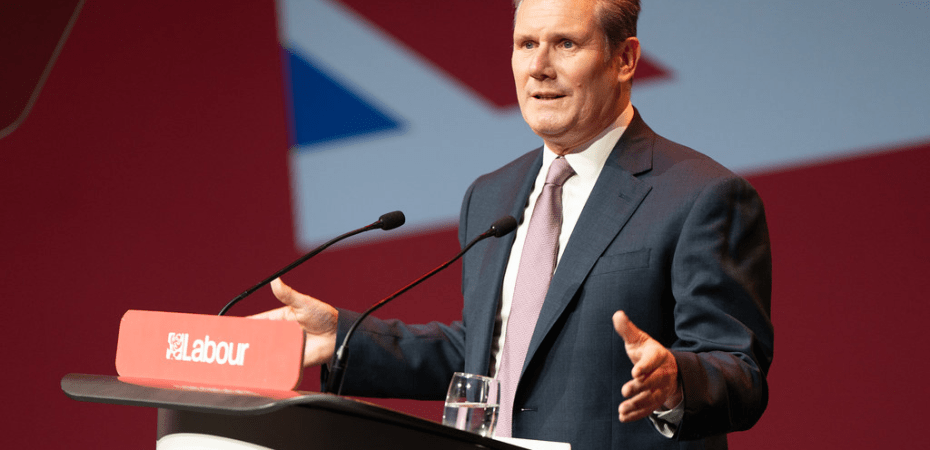
Image: Keir Starmer, https://www.flickr.com/photos/190916320@N06/53240561562 Creator: Keir Starmer | Credit: Labour Party Copyright: Labour Party. Licence: CC BY-NC-ND 2.0 DEED Attribution-NonCommercial-NoDerivs 2.0 Generic
 Labour Hub