
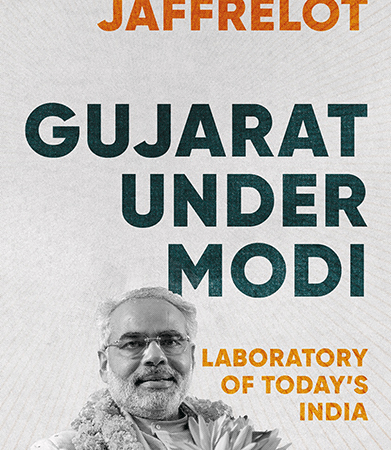
Mike Phipps reviews Gujarat Under Modi: Laboratory of Today’s India, by Christophe Jaffrelot, published by Hurst.
Deemed too ‘high-risk’ to publish when it was first written a decade ago, this book lays bare the story of Narendra Modi’s stewardship of his home state of Gujarat, where he served as Chief Minister from 2001 to 2014.
Under Modi, Gujarat became “a laboratory for Hindu nationalism”: never before had the Bharatiya Janata Party (BJP) won so many elections in a row in a state of the Indian Union. This exceptional development resulted from a unique combination of factors, particularly the accommodation that the dominant Congress Party made to Hindu nationalism and rising social and religious polarisation. There were communal riots in 1969, 1985 and 1992,culminating in the 2002 anti-Muslim pogrom that led to the largest number of Muslim deaths since Partition. Modi was Chief Minister during the latter events.
The carnage began following an attack by Muslims on a train carrying Hindu nationalists, resulting in 59 fatalities. Chief Minister Modi inflamed tensions by describing the attack, against official intelligence, as “pre-planned” and a “one-sided collective violent act of terrorism from one community.” This authoritative explanation quickly became the widely accepted version of events in the media and triggered a wave of Hindu nationalist violence against minorities, while local police stood by.
Some of the attacks were military-like in their organisation and precision. Trucks arrived in Muslim neighbourhoods full of men armed with gas cylinders for blowing up places of worship, factories, houses and other businesses across the state. The perpetrators had lists of addresses to target, indicating considerable advance planning. Women were often attacked first and the use of rape was systematic. Children were burned and butchered beyond recognition. Besides the main cities, hundreds of villages were targeted. Up to 2,000 people were killed and over 200 mosques destroyed.
Later testimonies from those responsible said they were encouraged in their atrocities by local police. Senior politicians were also said to be involved, including close associates of Modi. A senior police officer testified that Modi had said that “the situation warranted that the Muslims be taught a lesson” and that “emotions were running very high among the Hindus and it was imperative that they be allowed to vent out their anger.”
Modi’s conduct was criticised even from within his own party, to the extent that he submitted his resignation, but pro-Modi sentiment was more than sufficient for him to survive. “Modi had an opinion poll conducted that showed that if elections were organised then, BJP would win two-thirds of the seats in the Gujarat Assembly,” notes Jaffrelot. Modi immediately started campaigning for early elections, even though the violence had far from subsided. Those who stood in his way were vilified.
The BJP triumphed after a violent electoral campaign. But the impact of Modi’s discourse went beyond Gujarat. In August 2002, a national survey showed that for nearly an absolute majority of respondents, the Gujarat riots were due not to the state government or Hindu nationalists or even to local rabblerousers, but to “Muslim fundamentalists”. Religious polarisation had been manipulated to catapult Modi onto the national political stage.
Following the 2002 riots, the Modi government in Gujarat pursued a strategy of politicisation of the police – rewarding officers who had facilitated the pogroms and sidelining those who had tried to prevent them. The judiciary too was communalised. This was vital if any meaningful inquiry into the BJP’s activities in Gujarat were to be avoided. “More importantly,” adds Jaffrelot, “the de-institutionalisation of the rule of law found expression in the promotion of Hindu vigilante groups, which exerted a form of cultural policing in the streets as well as on university campuses.”
The result was an increased criminalisation of politics with human rights activists targeted and sometimes murdered. Political opponents were harassed. A new crony capitalism developed, increasing inequalities in the state. Communal polarisation masked social polarisation and Modi’s minimal state and neglect of the poor would become the template for national governance.
The ruthless centralisation of power that Modi enacted as prime minister was also modelled on his behaviour as Chief Minister of Gujarat a decade earlier, subverting the government bureaucracy and marginalising his own party rivals. The author assembles a great deal of material on this and while it explains the mechanics of Modi’s rise to national power, it is not as significant a charge sheet as the deliberate and lethal stoking of communal tensions.
But there is a lot to learn from Modi’s ascent – his casting himself as a victim, in line with other supposed anti-elite populists elsewhere, his self-projection as an honest ‘son of the soil’ against cosmopolitan forces, his use of polarisation both “to win elections and to maintain a majoritarian hegemony as well as the social status quo.”
Despite his anti-Establishment rhetoric, Modi put himself at the service of the elites who appreciated his social conservatism. The poor and minorities were the first casualties of the Modi government, but not the only ones, argues the author. Liberals, NGOs, intellectuals and all dissenting voices were also attacked because they defended a different vision of society.
The Congress Party in the state , fearful of alienating Hindu voters, downplayed robust criticism of Modi and compromised their values of secularism and social justice in the process. In consequence, their opposition was woeful.
Universities were targeted, as were primary and secondary education. In 2005, a new social sciences textbook was introduced which “presented Nazism in a positive manner and did not mention the Holocaust.” Freedom of the press also came under attack.
Muslims of Gujarat remained undisputed victims of discrimination with funds earmarked for them specifically by the central government withheld by the state government, including scholarships and financial aid to rebuild religious buildings that had been destroyed in 2002. The state also applied pressure to ensure ghettoization, with public services such as schools, hospitals and public transport withheld from Muslim areas and separation enforced by vigilante groups and a newly politicised police force.
Over time, Jaffrelot’s aim in writing this richly detailed book shifted – from a political biography of a regional leader to a warning to the whole country. “Never before had a regional leader been able to re-scale a political repertoire rooted in a particular state and transpose it to an all-India level.” Modi did this through a combination of communal polarisation, eroding the rule of law, a supply-side oriented economic policy that promoted crony capitalism and social polarisation, the personalisation of power and the construction of a political project that would deliver a sufficient electoral majority.
There are lessons here that reach beyond India’s borders. Authoritarian merchants of division, careless of the rule of law, supposedly railing against the elites but actually serving their interests, are on the rise globally. Understanding the components of this phenomenon is the first step towards building a movement against it. This book is a valuable contribution to that process.
Mike Phipps’ book Don’t Stop Thinking About Tomorrow: The Labour Party after Jeremy Corbyn (OR Books, 2022) can be ordered here.

 Labour Hub