
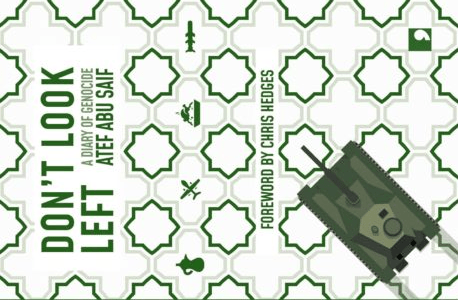
Mike Phipps reviews Don’t Look Left: A Diary of Genocide, by Atef Abu Saif, published by Comma.
Atef Abu Saif is a Palestinian writer whose novels, short stories and other writing have been translated into several languages. This recognition does not make him any less of a target, however: even the launch in Manchester of his daily diary of Israel’s latest onslaught was nearly cancelled. Only direct action by over 100 artists, as previously reported on Labour Hub, shamed the host organisation into allowing it to go ahead.
“Atef is no stranger to the violence of the Israeli occupiers,” reporter Chris Hedges tells us in the Foreword of this book. “He was two months old during the 1973 war and as he writes, ‘I’ve been living through wars ever since. Just as life is a pause between two deaths, Palestine, as a place and as an idea, is a timeout in the middle of many wars.’ During the 2008-2009 Israel assault on Gaza, he sheltered in the corridor of his home for 22 nights with his wife, Hanna, and two children while Israel bombed and shelled.”
That summary scarcely prepares us for what is to come. Abu Saif’s diary takes us from the beginning of the current stage of the conflict with the Hamas attack on Israel until the end of 2023 when he was finally able to leave Gaza. On October 7th, he is swimming in the sea when the first Israeli bombardment begins. By Day 3, he is recording the devastation:
“On arriving I’m horrified by what I see: everything is gone. The entire street, both sides, flattened. The supermarket, the bureau de change, the falafel shop, the fruit stalls, the perfume parlour, the sweet shop, the toy shop… all burned.”
Three nights in, he is given a two-minute warning to evacuate the hotel he is staying in. “The Israeli military had phoned through and informed them they were going to be bombed.” Several hundred people were crammed into hotel’s lobby. “A boy of about six was holding his younger brother’s hand, who couldn’t be more than two, trying to calm him down… When it came, the first explosion lifted everything in the hotel several feet into the air.”
In the night, three journalists are killed, despite wearing highly visible jackets emblazoned with the word “PRESS”. Other friends are killed, as entire neighbourhoods are buried in rubble.
Day 10 sees an Israeli strike on a four-storey building in which his cousin and sister-in-law live. The bodies of the latter’s daughter and grandchild are retrieved. The only survivor appears to be another daughter who graduated from art school a day before the war broke out. Now she has had both legs and her right hand amputated. Later, unable to access painkillers, she asks Abu Saif for a lethal injection.
The following night a piece of Israeli shrapnel kills a friend’s son while he is asleep. 500 people are killed in the Baptist Hospital, where the author’s life was saved after he was shot as a teenager during the First Intifada.
“News comes that the Israelis want to evacuate more than 60% of the Strip’s inhabitants, presumably so they can flatten the City of Gaza. Leaflets are dropped everywhere by helicopters saying, in Arabic, that anyone who remains north of the Wadi will be regarded as partnering with a terrorist organisation.” But Abu Saif is contemptuous of such orders, noting that dozens of those heading south were killed by missile strikes on the road.
“We prepare for the worst all the time,” he says. Women go to bed fully dressed, with their hair covered, so they can evacuate quickly. Children have taken to writing their names and family mobile numbers on their limbs, so they can be identified and their relatives informed in the event of their death.
Bombardments continue at night. The author spends his days monitoring the news at Press House, searching for bread – particularly dangerous , as “so many bakeries have been targeted by the Israelis” – and clean water for the day, helping to move the rubble to find the bodies of his sister-in-law and her husband.
Day 17: the most violent night so far, with 600 people killed in attacks on different parts of the Strip. Two days later, 700 are killed. Three weeks in, the death toll is 7,000, half of them children. “We all survive, only by mistake, because a rocket failed to reach us,” says Abu Saif. “Because death didn’t recognise us, or mistook us for someone else. We wake up each day, only by these accidents.”
Death has become randomised. On returning one night to his flat to get a gas cylinder for cooking, “I suggest that, on exiting the building, Yasser [his 15-year old son] carries a mattress and pillow with him so that the drone operator thinks we are just evacuating the apartment. I know that this won’t necessarily dissuade him from wiping us out – he has an hourly quota to meet, I’m sure – but you have to try and make it easier on yourself in any small way.”
Day 26: the author drives north to Jabalia following an intense Israeli bombardment there. The old alleyways and narrow lanes that Jabalia was famous for and that housed people who took refuge from north of the Gaza Strip after 1948 are gone. “It looked like the end of a war movie. Everything is destroyed. Some 50 buildings had been brought to the ground.” The neighbourhood in which he was born and grew up is largely flattened. He spends two hours helping with the relief effort, digging out body parts.
The following night, the son, grandmother and aunt of a colleague he has been sharing a room with are all killed in an airstrike.
Day 29: an Israeli missile strikes the main gate of Al-Shifa hospital, just eight metres from where Abu Saif is standing. The area, as the IDF know, is a crowded bottleneck: sixteen people are killed. The next day he is himself injured in a blast.
The same day an Israeli missile strikes a school which his children used to attend and where hundreds of families are now sheltering. “Not a single body retrieved from the massacre was complete.”
Day 31. “This morning Mohammed al-Jaja was killed along with his entire family. I cried when I heard the news, I couldn’t believe it. We were together just yesterday in the Press House. He took care of me and helped treat my injured leg.”
He concludes: “The city gets smaller and smaller. Every day there is less and less space for us to use, to move around in, sleep, breathe. Fewer supermarkets, fewer bakeries, fewer groceries, fewer pharmacies and fewer loved ones.”
Gaza begins to empty as food and water run out. Fresh fruit and vegetables are unavailable as most of the Strip’s farming areas are completely under the control of Israeli troops. “Tanks and bulldozers have ploughed over the fields, as they did in 2014, destroying all crops, orchards, irrigation systems, and of course the farmers’ homes.”
Day 33. “I went to pay my condolences to my friend Saleem and his mother for the loss of his brother, Majid. Majid passed away in an Israeli jail recently after the soldiers refused to give him his medication… In the prison, the soldiers took his medication off him and threw it away. He died.”
Day 36. Al-Shifa Hospital is now under siege. “Anyone seen moving from one hospital building to another is shot on sight.”
Day 43. “From 9:30pm to 6:30am, the air raids never stopped coming, from the west, the north and the east. Hell was poured on Jabalia. Hundreds of buildings were destroyed… In the Tal Azzatar school’s shelter, a missile kills dozens and injures hundreds more.” Meanwhile, at the Al-Shifa Hospital, the IDF gives everyone one hour to leave. Two days later, the Indonesian Hospital is bombed and hundreds are killed.
Day 46. “We cannot stay here any longer. We have decided. The shells over the last two nights have been so close, I didn’t just see the light and hear the thunder of their explosions, I saw them flying mid-air, as they passed right by my window.” The author’s son is keen to leave. His father, however, is adamant about staying.
So it is an imcomplete family group that goes to the checkpoint early in the morning. The kids in front of him are shaking, they are so afraid of the Israeli soldiers. This goes on for two kilometres. Random arrests are made. As the road opens out, there are scores of dead bodies. Finally they negotiate a ride on the back of a truck and go south.
In Khan Younis, the sight of a grocer’s stall with tomatoes and cucumbers causes a woman to burst into tears. “It’s been 40 days since I’ve seen vegetables,” she says. There are now a million people in a city that used to host 150,000. There are queues for everything. As winter comes on, those living in tents are ill-equipped to deal with the rain, wind and cold.
The plan now is to get to Cairo and from there to Ramallah. “The lists for all those allowed out, published the night before online, are coordinated by the Israelis, with the Egyptian Army following their orders.”
Day 49 brings a four-day truce. But people who attempt to return to their homes are shot at by the Israelis. Dozens are killed. When the war resumes days later, Khan Younis becomes Israel’s primary target, with shelling and missile strikes on all sides.
Day 58. The author’s family home in Jabalia is destroyed by Israeli missiles, along with six other houses. “When I left the place ten days ago, I never dreamt it would be the last time I saw it.”
Everyone left just hours before, including his father. “Now, a 74-year-old man is homeless for no other reason than someone made a strategic decision to make him suffer.” The same night, a further fifty buildings are bombed in Gaza City, with hundreds reported dead. Five days later, his father-in-law’s house is hit, pulverised by Israeli tanks. Fortunately, it is empty at the time.
Khan Younis is increasingly cut off, as roads leading to it are bombed and Israeli tanks get nearer. Basic foodstuffs are increasingly unavailable and for people not staying in a shelter, aid is unavailable. This applies to thousands of families who are staying in houses owned by relatives or in tents outside of officially recognised camps, where bitterly cold nights, heavy rain and flooding make life even more miserable. Meanwhile, Israeli drones hovering over the tents prevent people from sleeping.
Day 69. “Yesterday I saw the images from Jabalia Cemetery. Israeli tanks had driven over the graves, exposing and systematically disinterring bodies in huge numbers… For me, it is just about humiliation.”
Day 77. “My sister Naema phones. She has just visited my dad. He cannot walk, she tells me. His body is weak from lack of proper nutrition. They haven’t had bread for more than a week.” That night, an Israeli airstrike massacres 75 people at Maghazi Refugee Camp.
On the 84th day of the war, the author learns that he is allowed to leave with his son. He has spent 46 days in the north, seeing his colleagues killed around him, and thirty days in a tent with only a blanket, yet he still feels shame at abandoning everybody else.
His immediate ordeal is over. For the rest, it continues: 300,000 Palestinians are now being forced out of Rafah, having earlier been ordered by Israel to head south for ‘safety’.
Around the world, millions of people have taken action against these monstrosities. They will not quickly forgive the political elites that have looked away from or collaborated with Israel’s war crimes.
This is a distressing but essential read. But great writing is a powerful weapon. Every line of this book is a howl of outrage against Israel’s brutal collective punishment of a dispossessed nation. Small wonder that the enemies of Palestine tried to block the book’s recent launch.

Mike Phipps’ book Don’t Stop Thinking About Tomorrow: The Labour Party after Jeremy Corbyn (OR Books, 2022) can be ordered here.
 Labour Hub