
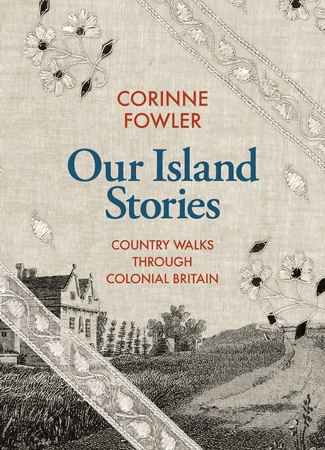
Mike Phipps reviews Our Island Stories: Country Walks through Colonial Britain, by Corinne Fowler, published by Allen Lane.
“The British countryside occupies a special place in our national imagination,” writes Corinne Fowler at the start of this new book, “a place of idyllic seclusion… something steadfast and reassuring, something that has existed since time immemorial.”
But it hasn’t. “The nation’s uplands, shorelines, valleys, lakes, villages and fields were profoundly shaped by the colonial world: British trade, conquest, economic activity and direct rule from the turn of the seventeenth century to the decline of empire in the early twentieth.” Through the course of ten walks, across rural Britian, the author illustrates this neglected fact.
The connections are surprising. Familiar as I am with the Thames Valley, I had no idea that so many people who had made their fortunes with the East India Company settled around the village of Pangbourne, that it became known in the 18th century as “England’s Hindoostan.”
Each journey is undertaken with a co-walker. On Jura, the author is accompanied by Graham Campbell, the SNP’s first Caribbean-heritage councillor, who is keen to trace his own family history, although it’s said that there are more Jamaicans than Scots with the surname Campbell. Many derive from Colonel John Campbell, who established a plantation there in 1700, enslaved 460 people and had many descendants.
In the northwest, Fowler walks to Whitehaven, once Britain’s second largest tobacco importer and third largest slave-trading port. “The town’s merchants trafficked over 5,739 people, and caused at least 906 deaths on transatlantic voyages.” The wealth made is still visible in the town, which boasts 268 buildings on Historic England’s most important historic constructions list.
Britain’s global connections had other impacts. During the American Covil War, Union forces blockaded Southern cotton-exporting ports, which over time had a grave impact on the UK cotton industry. The Lancashire town of Darwen suffered a five-year Cotton Famine, with real distress, hunger and rampant disease. Limited relief was dispensed by local Poor Law guardians in the most miserly fashion. Despite this, there was widespread sympathy across Lancashire for the anti-slavery cause, although in Liverpool, three out of four of the city’s newspapers sided with the Southern states.
Fowler also walks around Dolgellau, the wool-making capital of Wales in the early 18th century. Its main customers were American slaveowners, who bought the coarse cloth to clothe workers on American and West Indian plantations. At this time, the Welsh plains were clothing 279,000 enslaved people.
In Dorset, whose main ports all participated in the slavery business, the author finds six prominent slave-owning families all living within a 13-mile radius. Local people were shipped from here, as elsewhere in England, to become indentured labourers on colonial plantations. Among those protesting against wage cuts and profound poverty were villagers in Tolpuddle, whose resistance led to the transportation to Tasmania of six activists 190 years ago, an event now annually commemorated.
In Cornwall too, local exploitation went hand in hand with colonial expansion. The author walks through the parish of Gwennap, which by 1824 was producing a third of the world’s copper.
The copper was accessed in appalling conditions: workers, sometimes as young as 15, descended a series of ladders, which could sometimes take an hour and a half, to reach the ore. This was mined by candlelight, using axes and explosives. In 1841, this one parish experienced 75 fatalities, from various mining ‘accidents’. The copper mined played a major role in Britain’s slaving business, traded for human beings along Africa’s west coast.
This book is likely to stir up fresh controversy. In the past, Fowler has been vilified for writing about such issues, accused of hating British history and being unpatriotic. The abuse was so intense that at its height she was unable to leave her house unaccompanied.
Much of the vitriol stems from the author’s highlighting of inconvenient truths, about historic figures, such as Wordsworth, who became increasingly conservative as he aged, whom centuries of reverence have rendered irreproachable in the eyes of many.
Again and again, Fowler finds that colonial slaveowners and domestic landowners who enclosed the commons and exploited those dispossessed were the same people. So when her opponents rail against her challenge to the accepted narrative about Britain’s development, it’s really a ruling class version of events that they are defending rather than any objective national historical record.
It’s also a version that is calculated to make people of colour feel unwelcome in the UK countryside, as Fowler’s various co-walkers testify. In that light, Fowler’s book is not just about setting the historical record straight – it’s about shaping the kind of society we want Britain to be.
Mike Phipps’ book Don’t Stop Thinking About Tomorrow: The Labour Party after Jeremy Corbyn (OR Books, 2022) can be ordered here.
 Labour Hub